If you’ve ever run YouTube ads and wondered whether they were actually doing anything – even when nobody clicked – you’re not alone. This is the quiet frustration of every performance marketer who knows that brand awareness doesn’t always show up in last-click reports.
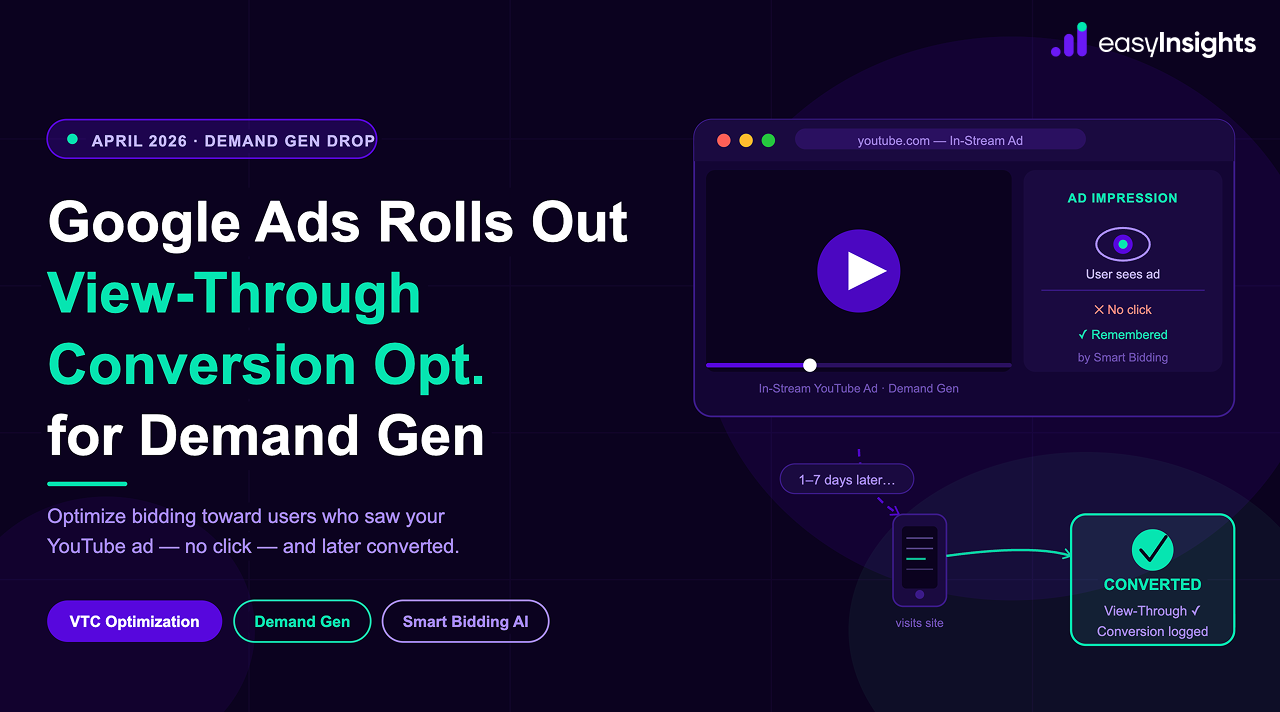
Google just acknowledged that frustration officially. In its April 2026 Demand Gen Drop, Google announced two meaningful updates to Demand Gen campaigns: View-Through Conversion (VTC) Optimization is now available in Google Ads, and the Commerce Media Suite is expanding to cover Demand Gen inventory. Both are worth understanding clearly – no hype, just what they actually do and what it means for your campaigns.
Jump ahead to:
April 2026 Demand Gen Drop – What’s New
| View-Through Conversion Optimization | Commerce Media Suite → Google Ads |
Demand Gen campaigns can now optimize bidding toward users who saw your YouTube ad but didn’t click – and later converted. Enables Google’s AI to value impressions that influence future purchases. | Retailers’ first-party catalog and conversion data now powers Demand Gen targeting across YouTube, Discover, and Gmail – not just DV360 and SA360 as before. |
What Is Demand Gen?
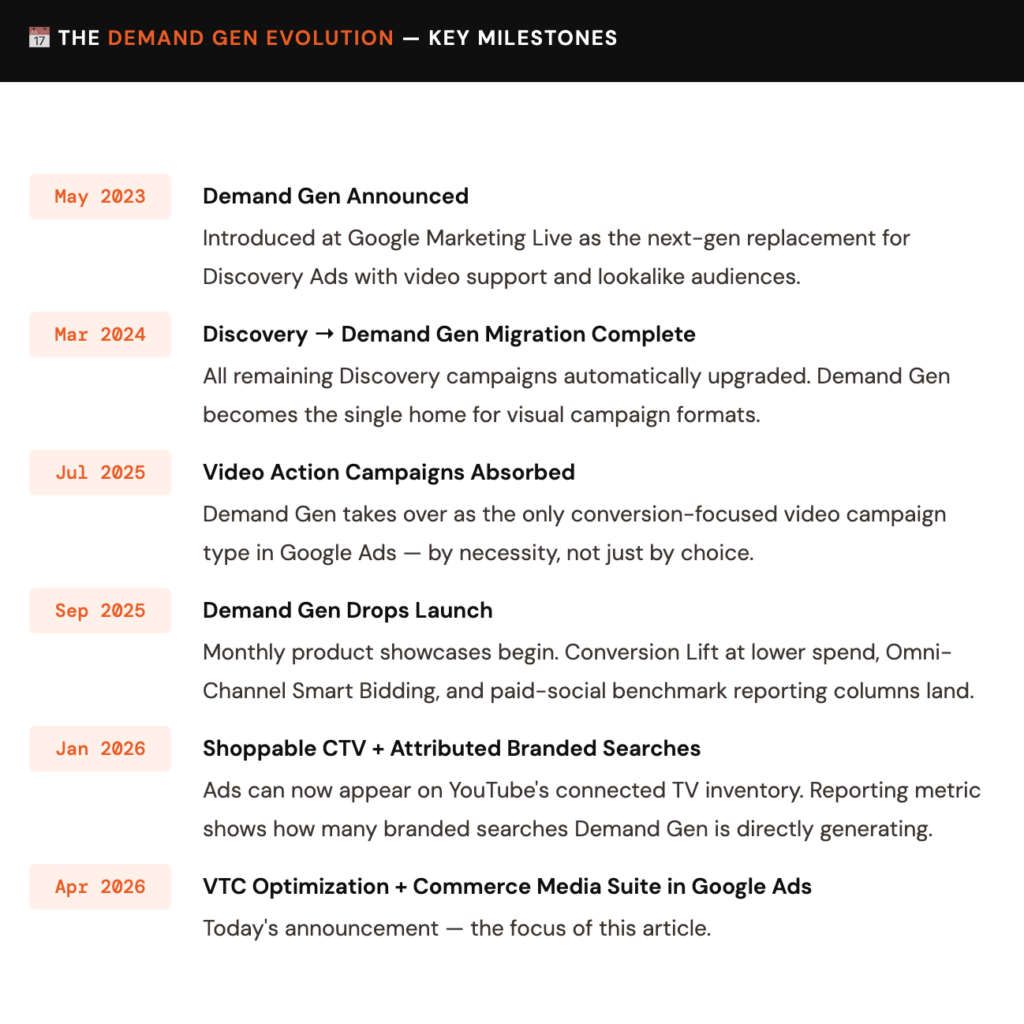
Demand Gen is Google’s AI-powered campaign type designed to reach people before they’re actively searching for your product. Think of it as the Google equivalent of a Meta or TikTok awareness campaign – except it runs across YouTube (in-stream, Shorts, in-feed, home feed), Gmail, Google Discover, and now even Google Maps.
It replaced Discovery Ads in 2024, absorbed Video Action Campaigns in mid-2025, and has since been evolving at a pretty rapid clip through Google’s monthly “Demand Gen Drops.” If you haven’t revisited it lately, it’s a fundamentally different product today than it was 18 months ago.
Understanding View-Through Conversions – The Real Explanation
Before we get into what’s new, let’s be honest about what a view-through conversion actually is – because it’s one of the most misunderstood metrics in digital advertising.
A view-through conversion (VTC) is recorded when a user sees your ad without clicking on it, and then converts on your website within a defined lookback window (usually 1-7 days). They didn’t tap. They didn’t engage. They just saw it – and some time later, they bought (or signed up, or called).
This is why platforms like Meta have reported VTCs for years. And it’s also why VTCs are controversial – they can inflate credit attribution significantly and lead to overlap with conversions that other channels (like Search) would claim as their own. More on that shortly.
How VTC Optimization Works in Demand Gen
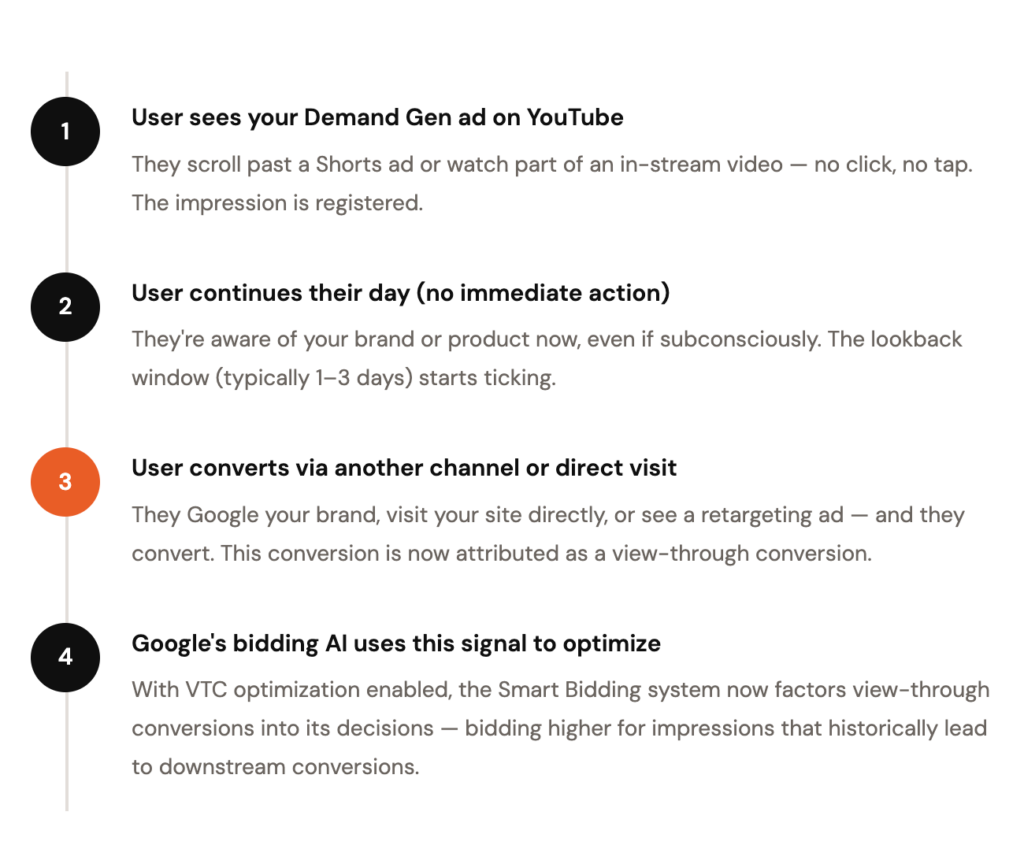
Why This Update Matters
The practical significance here is twofold. First, it brings Demand Gen bidding parity with other platforms. If you’re running video ads on Meta and already optimizing for view-through conversions there, your Demand Gen campaigns were operating with fundamentally different signal inputs. That comparison was always apples-to-oranges. Now it’s more equal.
Second, it gives Google’s Smart Bidding a richer dataset to work with. When the bidding algorithm only has click-based conversions to optimize toward, it naturally under-values impressions that lead to indirect conversions. VTC optimization corrects for this – at least in theory.
What This Means for Your Demand Gen Strategy
If you’re running Demand Gen campaigns today, here’s how to think about these updates practically.
1. Enable VTC Optimization – but watch your attribution
2. Use Conversion Lift to validate the real impact
3. For retailers: activate Commerce Media Suite
4. Treat Demand Gen as a top-of-funnel channel – not Search
5. Use the platform-comparable columns
6. Watch for Google Marketing Live (May 20, 2026)
Conclusion
VTC optimization is now live for Demand Gen in Google Ads. It lets your campaigns optimize toward users who saw your YouTube ad and later converted – without clicking. Enable it thoughtfully, keep your lookback window short, and validate with Conversion Lift before scaling.
| Make Your Google Ads Data Work Across Your Entire Stack EasyInsights integrates your Google Ads – Demand Gen, Search, Shopping – with your CRM, nurturing tools, and the rest of your marketing stack. Book a demo |