If your campaigns feel harder to optimise in 2026, it’s not your strategy – it’s your data.
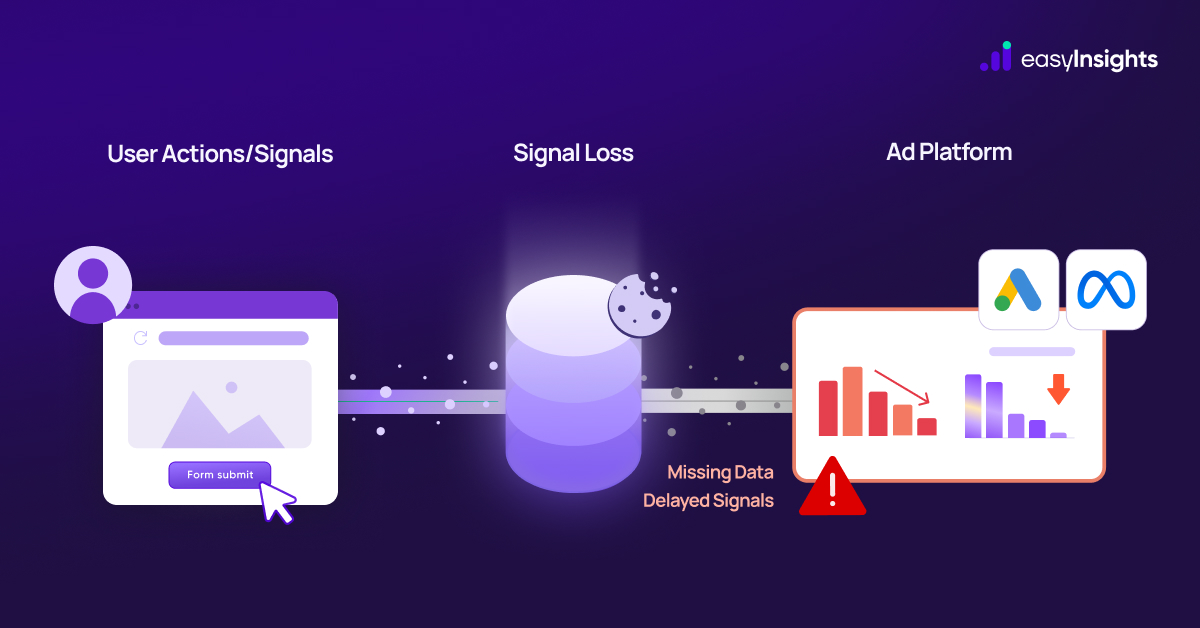
With Google’s Privacy Sandbox reducing third-party cookie access and GDPR 2.0 tightening consent and data usage, ad platforms are receiving fewer and weaker conversion signals by design. What shows up as missing conversions, rising CPAs, or unstable learning phases is actually a structural shift toward privacy-first advertising.
These changes aren’t temporary. Traditional tracking no longer works the way it used to, making optimisation harder without a stronger signal strategy.
In this blog, we’ll explore how Privacy Sandbox and GDPR 2.0 are cutting off your data – and how to stay compliant without losing optimisation power by rethinking how signals are collected and activated.
Jump ahead to:
Why Privacy Sandbox and GDPR 2.0 Are Cutting Off Your Data
For years, marketers assumed every click and conversion was trackable. That assumption is breaking as Privacy Sandbox and GDPR 2.0 intentionally limit cross-site tracking, reducing the volume and quality of data available for optimisation. As a result, marketers are seeing:
- Missing conversions as users deny consent or block tracking
- Inflated CPAs due to weaker signals feeding bidding algorithms
- Unstable learning phases as automation struggles with incomplete data
This isn’t a temporary tracking issue. Privacy Sandbox and GDPR 2.0 represent a structural shift in how data flows – replacing user-level visibility with aggregated, delayed, and limited signals.
The outcome is clear: signal loss, attribution gaps, and declining optimisation efficiency. Traditional pixel-based and last-click models no longer tell the full story – and performance will continue to suffer unless tracking and optimisation strategies evolve.
What Is Privacy Sandbox – and Why It Changes Everything
The Privacy Sandbox is Google’s privacy-first framework that replaces third-party cookies with browser-based APIs, enabling ad targeting and measurement without sharing user-level identifiers across websites. Key replacement APIs include:
- Topics API – Infers broad interest categories based on recent browsing history to help serve relevant ads without tracking users across sites.
- Protected Audience API – Enables remarketing and audience targeting through on-device interest groups and browser-run ad auctions, preventing third parties from monitoring cross-site behaviour.
- Attribution Reporting API – Provides privacy-enhanced conversion measurement by reporting campaign outcomes without traditional user identifiers.
Why These Changes Matter
Privacy Sandbox intentionally limits key functions that powered traditional tracking:
- User-level visibility — No user IDs are shared across sites, meaning platforms have less granular insight into individual behaviour.
- Cross-site tracking — Third-party cookies that once stitched together journeys across domains are no longer accessible for broad tracking.
- Deterministic attribution — Attribution shifts from exact, user-level paths to aggregated, privacy-conscious reports with noise and delays.
Privacy Sandbox replaces cookie-based advertising with browser-controlled, privacy-first mechanisms, fundamentally changing how data is used for targeting and measurement.
Also Read: What is Facebook CAPI (Conversions API)
GDPR 2.0 – What’s Actually Different This Time?
GDPR 2.0 isn’t just a nominal update – it strengthens how data privacy is enforced and expands what counts as personal data, consent, and compliance obligations for brands.
- Stricter enforcement, not just new rules: Regulators are ramping up penalties and speeding up enforcement actions, pushing brands to take compliance more seriously than ever.
- Expanded definition of personal data: GDPR 2.0 broadens what counts as personal data to include biometric, behavioural, and location data – meaning more types of information now fall under protection.
- Lawful processing requirements: Organisations must obtain clear, explicit consent for each type of processing and ensure documentation and transparency.
- Heavier scrutiny on:
- Consent quality — consent must be specific, informed, and easily withdrawn.
- Data sharing with third parties — tighter rules on how and why personal data is shared or processed.
- Consent quality — consent must be specific, informed, and easily withdrawn.
- Fines now impact mid-sized businesses too: With tougher penalties (potentially higher fines and repeat-offender costs), enforcement has expanded beyond just Big Tech.
Why “Consent Mode + Cookies” Is No Longer Enough
Using Consent Mode with cookies no longer guarantees the strong, complete data marketers depended on. That’s because Consent Mode doesn’t improve signal quality – it simply adjusts how data is collected based on user consent, and often ends up modelling much of what’s missing instead of capturing real user actions.
Consent Mode ≠ Signal Quality
When users decline cookies, Consent Mode sends only limited, anonymized signals, not full tracking data. Google then uses modelled estimates to fill gaps, which lack the precision of real behavioural data.
Modeled Conversions ≠ Real Business Outcomes
Conversion modelling predicts what might have happened based on patterns – but estimated conversions aren’t the same as actual brand outcomes you can trust for optimisation or budgeting.
What’s Still Missing
Even with Consent Mode turned on, critical business-level insights are still incomplete:
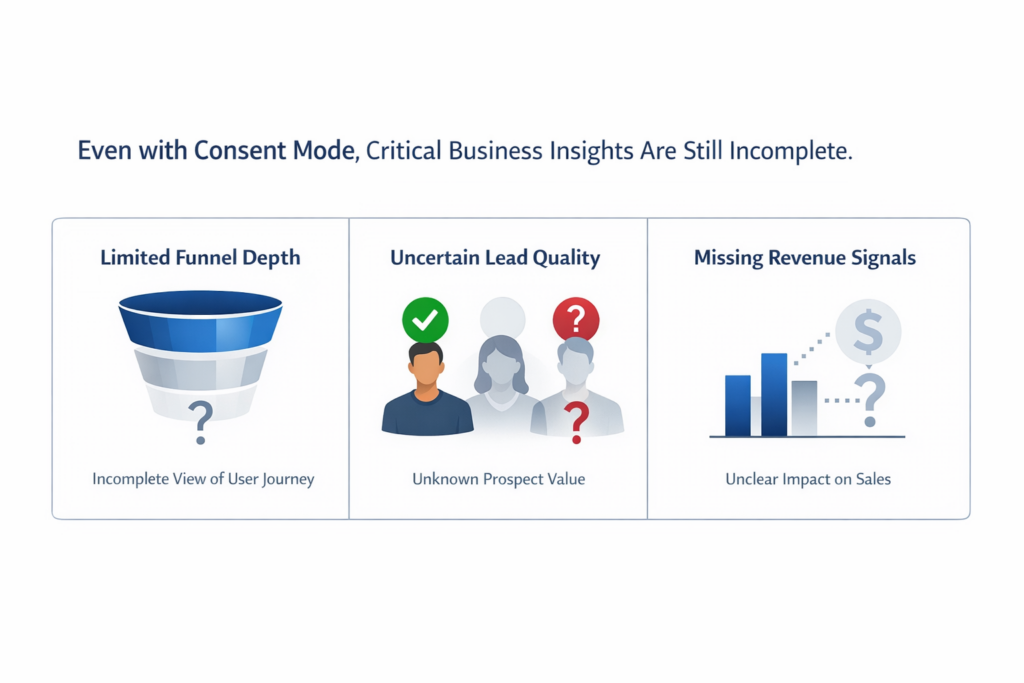
- Funnel depth – You can’t reliably see how users move from awareness to purchase when cookies are blocked, and data is modelled.
- Lead quality – Without user-level identifiers, you can’t distinguish high-value leads from low-value ones.
- Revenue signals – Revenue and purchase values tied to individual conversions often don’t make it back into your analytics or ad platforms without first-party tracking or dedicated server-side setups.
Privacy-First, Signal-Rich Marketing
Privacy-first marketing isn’t about losing data – it’s about using better signals.
As user-level tracking fades, brands must shift from tracking people to understanding events, from raw conversions to enriched signals, and from volume-driven metrics to quality-based optimisation.
The winners will be those who activate first-party data with real business context, not those chasing more tracking coverage.
How EasyInsights Helps You Stay Compliant and Optimized
EasyInsights functions as a privacy-first data infrastructure layer, enabling performance marketing without cookies or user-level tracking. It safely activates first-party data, enriches conversions server-side, and adds business context before signals reach ad platforms.
By mapping CRM stages, lead quality, and revenue signals into optimisation-ready data, EasyInsights replaces raw events with meaningful signals.
The outcome is GDPR-compliant tracking with stronger signal quality, allowing platforms to optimise for real business outcomes even as data access continues to shrink.
Final Thoughts
Privacy changes aren’t a passing phase – they’re permanent. As regulations tighten and platforms restrict tracking, signal loss is inevitable. But poor optimisation doesn’t have to be.
Brands that adapt their signal strategy – focusing on first-party data, enriched conversions, and quality-based optimisation – can continue to scale efficiently in a privacy-first world. Performance doesn’t disappear with privacy; it simply demands a smarter approach.
Book a demo with EasyInsights and explore how stronger signals for better performance!