Ever noticed how your Meta Ads performance can feel like a roller coaster? One week, your ROAS is soaring – and the next, it suddenly drops with no clear reason. Many advertisers jump to conclusions: maybe the audience fatigued, the creative lost steam, or the algorithm went off track.
But in reality, these ups and downs are rarely random. What you’re witnessing is the Explore–Exploit cycle – a natural part of Meta’s ad delivery algorithm that continuously learns, tests, and optimizes to drive better results.
In this blog, we’ll break down what the Explore–Exploit cycle really means, how it impacts your ad performance, and how understanding it can help you scale campaigns confidently without panicking at every dip in ROAS.
Jump ahead to:
What Is the Explore–Exploit Cycle in Meta Advertising?
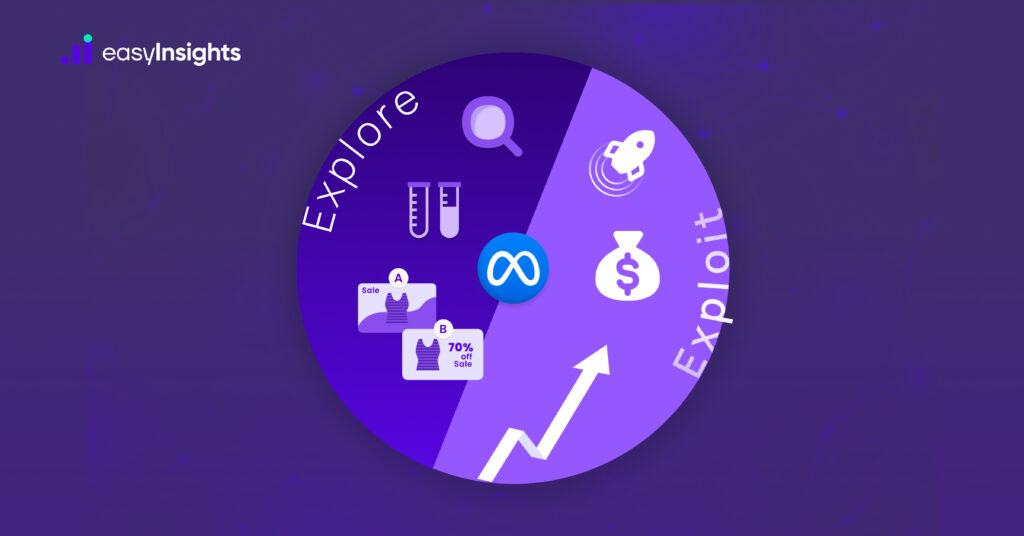
Meta’s ad system works a lot like how humans learn. First, it tries different options to understand what works (that’s explore). Once it learns what’s performing best, it focuses more on those winning patterns (that’s exploit).
This constant loop helps Meta spend your budget in the smartest way possible – without you manually testing every little thing.
In simple words:
Explore = Meta is learning.
Exploit = Meta is scaling what works.
Also Read: Understanding Meta’s Andromeda
Understanding the Ups and Downs of Ad Performance
If you’ve ever checked your Meta Ads dashboard daily, you’ve probably felt that sinking feeling – one day your numbers look fantastic, and a few days later, it’s like everything crashed overnight. It’s easy to assume something went wrong – maybe the creative stopped working, maybe the audience got exhausted, or maybe Meta changed its algorithm again.
But here’s the truth: most of the time, nothing’s actually broken. What you’re experiencing is just Meta’s algorithm shifting gears – moving from the exploit phase (where it’s capitalizing on what works) back into explore mode (where it’s testing new pockets of opportunity).
This testing phase often looks like a dip in performance, but it’s really the system gathering fresh data to fuel the next wave of growth. Think of it as planting seeds – the results don’t show up immediately. Depending on your sales cycle or average order value, it might take a week or two for those explorations to mature into conversions.
So, the next time your ROAS takes a sudden dip, don’t hit the panic button. It’s not a downfall – it’s Meta’s algorithm doing the groundwork to find your next performance spike.
How the Explore Phase Works
Meta Learning Phase
When an ad set first goes live (or after a big change), Meta enters its “learning phase.” In this window, the algorithm is experimenting: it shows your ad to different audience segments, tries multiple placements (Feed, Stories, Reels, etc.), and rotates through your creative variations. The idea is to collect data-signals like who clicks, who converts, what time of day works best, and which placements yield more value.
By doing this, Meta builds a statistical understanding: which users are most likely to perform the conversion event you care about.
Why performance fluctuates
During this learning phase, performance can be very volatile. There are a few reasons for this:
- Meta is still testing, so it hasn’t yet “locked in” on the best-performing audiences + creatives, meaning costs (CPA) can swing.
- Until it gathers enough data, its delivery predictions are not stable – so impressions might go to sub-optimal segments.
- If the ad set doesn’t generate enough optimization events (conversions), Meta may struggle to exit learning, which prolongs instability.
Role of conversion volume
Conversion volume is critical. Meta generally needs around 50 optimization events (like purchases, leads, add-to-cart) within a week for an ad set to exit the learning phase.
If your campaign doesn’t generate enough of these events – due to a small budget, infrequent events, or a too-narrow audience – Meta might label the ad set as “Learning Limited”. That means it’s not getting enough data to optimize properly.
Low conversion volume slows down how quickly Meta can learn and stabilizes delivery; higher volume speeds up the process.
What Triggers “Explore Mode”
Here are the main events that cause Meta to enter (or re-enter) the explore or learning mode:
- New campaigns / ad sets
- When you launch a fresh campaign or create a new ad set, Meta doesn’t yet know which audience or creative will work best, so it begins exploring.
- Significant edits
- If you change targeting (ages, location, interests), swap creatives, or switch the optimization event (e.g., from “link click” to “purchase”), Meta often resets to learning.
- Larger budget changes or bid strategy updates can also re-trigger the learning phase.
- Even pausing an ad set for more than 7 days and then restarting it might reset learning.
- Limited data environments
- If your audience is too small or too tightly defined, Meta may struggle to gather enough data (conversions) to learn efficiently.
- Low budget per ad set can constrain Meta’s ability to deliver enough impressions and conversions for learning.
- Low event signals
- If your chosen optimization event happens very infrequently (for example, “Purchase” in a niche or high-ticket business), then conversion volume may be too low to hit the 50-event threshold.
- That scarcity of data can make Meta stay longer in explore mode or go into “Learning Limited” status.
Why This Matters for Marketers
Patience Is Key: Let the learning phase run its course – once it stabilizes, you’re more likely to see efficient, predictable performance.
Budgeting & Expectations: In the explore phase, costs are often higher and performance more erratic. Marketers need to plan with that in mind.
Avoid Over-Editing: Constant changes reset learning; that wastes time and money.
Maximize Conversion Volume: Use a high-frequency event (if possible), allocate enough budget, and consider consolidating ad sets to help Meta learn faster.
Also Read: Meta’s New Performance Goal: “Maximize ROAS”
How the Exploit Phase Works
How Meta Finds High-Probability Converters
Once Meta has collected enough data during the Explore/Learning Phase (for example, enough conversion events, engagement signals, and audience performance patterns), it begins to favour users who are more likely to take your desired action. These “high-probability converters” are identified through:
- Signal aggregation: The algorithm tracks which user attributes (demographics, behaviors, interests) and which placements lead to more conversions.
- Historical performance: It leans on data from previous conversions, learnt through the pixel or Conversion API, to prioritize similar users.
- Optimized delivery: Rather than distributing impressions broadly, Meta narrows delivery to audience-segments and creatives that are statistically more likely to convert.
This targeted delivery helps stabilize your campaign performance: Meta reduces spend on underperforming segments and reallocates to those that yield better results.
Cost Stabilization and ROAS Improvement
- As delivery becomes more refined, cost per action (CPA) tends to decrease. Because Meta is showing your ad to more high-intent users, each conversion costs less on average compared to the volatile explore phase.
- ROAS often improves or becomes more predictable. With fewer wasted impressions and better targeting, you’re investing in users who are more likely to generate meaningful actions.
- Over time, performance swings that were common in the learning phase start to smooth out – delivery becomes more stable and reliable.
Scaling Inside the Exploit Phase
Once Meta’s delivery stabilizes, you can start to scale more confidently – but it has to be done carefully, or you risk undoing the gains you’ve made.
Budget Expansion
- Increase budget gradually. Jumping budgets too drastically (for example, +100% overnight) can reset the ad set back into learning. This destabilizes performance.
- A good rule of thumb: raise your daily budget by 10–15% every few days so the algorithm can absorb the change without disruption.
- Another approach: duplicate your winning ad set and scale up with the duplicate. The original ad set remains intact and stable, while the new one takes the risk.
Audience Expansion
- Once exploit is underway, you can safely expand your audience because the algorithm knows which segments are working.
- Use broader lookalike audiences (or larger audience pools) so Meta can explore “new-but-similar” users, while still prioritizing the attributes of your best converters.
- Introduce structurally new levers: new creatives, new placements or slightly different targeting, but without making massive or frequent changes. These give Meta more space to scale.
Optimization Based on SKAdNetwork (SKAN) / Conversion API (CAPI) Data Quality
- To scale reliably, strong signal quality is key. If you’re using CAPI, ensure that your conversion tracking is accurate and clean – bad or missing server-side event data can confuse Meta’s algorithm and hurt scaling.
- For mobile app campaigns (especially iOS), leverage SKAdNetwork (SKAN) data. Use the SKAN data to validate which user segments are truly delivering value and feed that signal back into your scaling decisions.
- Monitor data quality regularly. When your tracking is clean, Meta can optimize more precisely – allowing you to scale without sacrificing ROAS.
Also Read: How ATT, the loss of IDFA, and SKAdNetwork reshaped digital marketing forever.
Why This Matters for Marketers
- Confidence in Scale: When you scale during exploit, you’re not flying blind – Meta already has enough signal to make smart decisions.
- Sustainable Growth: Gradual budget increases and cautious audience expansion help avoid “blow-up” scenarios (where ROAS crashes after scaling).
- Better ROI: With strong tracking (via CAPI / SKAN) and stable delivery, you maximize the efficiency of your ad spend.
Explore–Exploit in Advantage+ Campaigns
Meta’s Advantage+ campaigns are built to automate the entire Explore–Exploit Cycle. Unlike traditional ad sets where you manually choose audiences, placements, and structures, Advantage+ uses its own machine learning model to explore faster, lock onto winning patterns, and scale with minimal interference. Here’s how the cycle works inside these automated campaigns:
Automated Exploration
Advantage+ campaigns begin with a broader, more aggressive exploration phase than traditional campaigns. Meta tests dozens of variables at once:
- Multiple audience pockets
- Age groups and interests
- Variations in placements (Feed, Reels, Stories, etc.)
- Creative combinations
- User behaviors and predictive signals
- First-time vs returning customers (with A+ Shopping segmentation)
Because Advantage+ uses machine-driven exploration, it searches a wider universe of audience possibilities, including segments you would never manually target.
This allows Meta to form a deeper understanding of:
- Who your high-intent buyers are
- Which creatives resonate
- What pre-purchase behaviors correlate with conversions
The result: exploration is faster, cheaper, and more accurate than manual setups.
How Meta Shortcuts Exploration to Reach Exploit Faster
Advantage+ uses several optimization shortcuts to reach the exploit phase quicker:
1. Predictive Modeling
Meta uses past platform-wide conversion patterns to pre-rank users before you even start.
This means exploration begins with higher-quality data compared to traditional campaigns.
2. Massive Creative Testing at Scale
Advantage+ automatically mixes and matches multiple creatives and formats during the first few days.
Winning combinations are identified early, so the exploit phase begins sooner.
3. Real-Time Budget Redistribution
As soon as Meta detects strong audience-creative matches, it rapidly shifts budget toward them – without waiting for the slower learning thresholds of standard campaigns.
4. No Manual Targeting Restrictions
Fewer constraints = faster learning.
Advantage+ doesn’t get slowed down by narrow targeting, conflicting ad sets, or overly segmented structures.
Signals That Matter Most in Advantage+ Optimization
Even though Advantage+ is automated, it still needs high-quality data signals to optimize correctly. Here are the signals that have the strongest impact:
1. Conversion Event Accuracy
If the Purchase/Lead/Add-to-Cart event is inaccurate or misfiring, the algorithm can’t identify your best buyers.
2. High-Quality CAPI Signals
Server-side events (via CAPI) give Advantage+:
- More reliable event data
- More stable match rates
- Better attribution
- Cleaner conversion feedback loops
This accelerates both learning and scaling.
3. First-Party Data
Advantage+ especially benefits from:
- CRM lists
- Past purchasers
- Email or phone audiences
- High-fidelity customer data
The cleaner the identifiers → the stronger the performance inside A+.
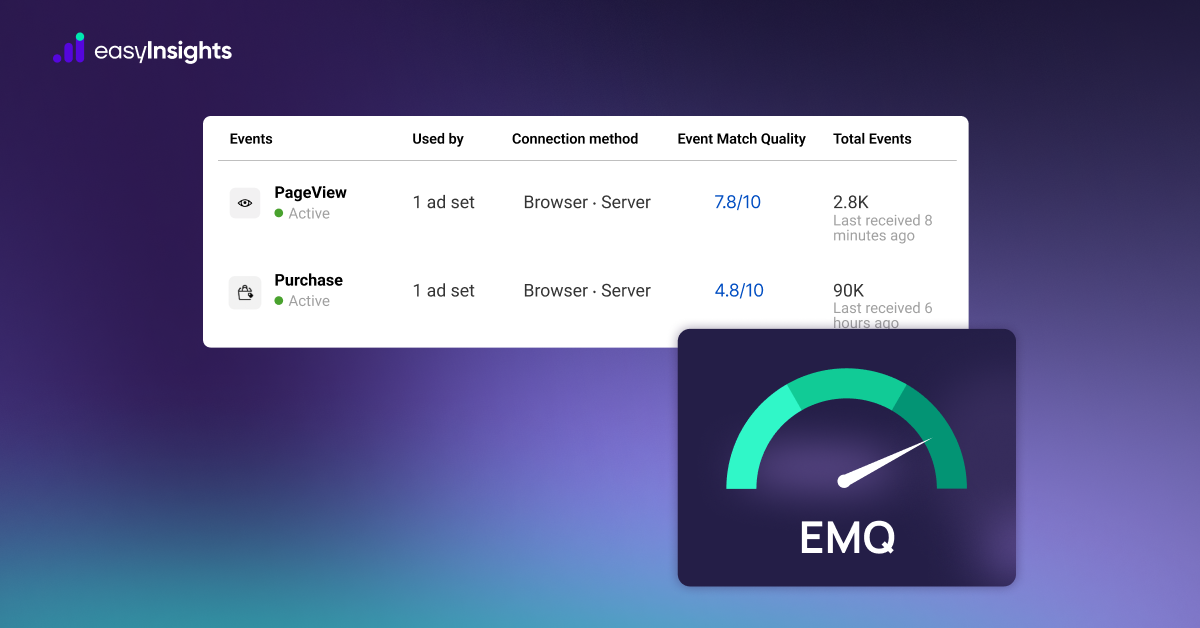
4. Strong Match Rates
Meta needs to match your customer identifiers to real user accounts.
Poor match rates = missed signals, slower learning, and weaker exploit performance.
5. Cross-Device & Multi-Platform Signals
Advantage+ uses a unified signal system, reading user behavior across:
- Messenger
- Audience Network
More signals → faster optimization.
Why Advantage
Because Advantage+ campaigns:
- Explore wider
- Collect signals faster
- Match identifiers more accurately
- Scale based on real-time learning
- Auto-allocate spend to the best combinations
They often reach the exploit phase dramatically quicker than traditional campaigns – especially when backed by clean server-side data from tools like EasyInsights.
How EasyInsights Helps You Navigate the Explore–Exploit Cycle
Understanding the Explore–Exploit cycle is one thing – managing it with confidence is another. That’s where EasyInsights steps in.
EasyInsights unifies your marketing, ad, and revenue data across platforms like Meta and Google into a single, platform. Instead of guessing whether your performance dip is part of an “explore” phase or a real efficiency issue, you can see the full picture in real time.
Here’s how EasyInsights simplifies decision-making during the cycle:
- Cross-Platform Clarity: View your Meta Ads data alongside other channels to identify whether dips are platform-specific or part of a wider trend.
- Automated Performance Insights: Detect when campaigns shift between exploration and exploitation phases without manually crunching data.
- Smarter Budget Allocation: Optimize spend based on long-term ROAS trends, not short-term fluctuations.
- Cohort-Level Tracking: Understand how new audiences mature into conversions over time – especially useful for longer sales cycles.
By helping you see beyond surface-level volatility, EasyInsights lets you focus on strategy, not speculation. You’ll know when to scale, when to hold, and when to optimize – all backed by unified, transparent data.
Conclusion
At the end of the day, the Explore–Exploit cycle isn’t something to fight – it’s something to understand and work with. Meta’s algorithm is built to learn, test, and optimize continuously, even if that means temporary drops in performance. What feels like volatility is often progress in disguise.
The advertisers who thrive on Meta are the ones who zoom out, stay patient, and use data to guide their decisions, not emotions. They trust that exploration fuels future returns – and that consistency pays off.
And that’s where EasyInsights comes in. By unifying your marketing and revenue data across platforms, EasyInsights gives you the clarity to see beyond daily fluctuations. You can easily track trends over time, identify true performance patterns, and make smarter budget decisions – without second-guessing the algorithm.
So, instead of reacting to every dip, trust the cycle, track the data, and let EasyInsights show you the bigger picture behind your marketing performance.
To learn more, book a demo with EasyInsights!