Jump ahead to:
Introduction
WhatsApp built its empire on one thing: your phone number. It was the frictionless onboarding mechanic that got 3 billion people onto a single platform. But it also made phone numbers the backbone of every marketing workflow that touches WhatsApp – from CRM matching to retargeting to chatbot routing.
That backbone is about to crack.
Starting June 2026, WhatsApp will let users communicate entirely via username – no phone number required. For consumers, it’s a privacy win. For performance marketers, it’s a disruption that most teams aren’t prepared for.
This article breaks down exactly what’s changing, what breaks in your stack, and what to do about it.
What WhatsApp Is Actually Changing
The update has two distinct layers. One affects users. The other affects businesses. Both affect marketers.
Layer 1: Usernames for Consumers
WhatsApp users will soon be able to create a unique username – something like @priya.mehta – and share that instead of their phone number. Anyone with that username can message or call them. Their actual number stays hidden.
The feature is opt-in, so it won’t flip overnight. But adoption will be fast, especially in privacy-conscious markets and among younger demographics. If you’re running performance campaigns where WhatsApp opt-ins are collected via phone number forms, the pool of users willing to share their number is about to shrink.
Layer 2: BSUID for Businesses
This is the part that most coverage is missing, and it’s the part that matters most to you.
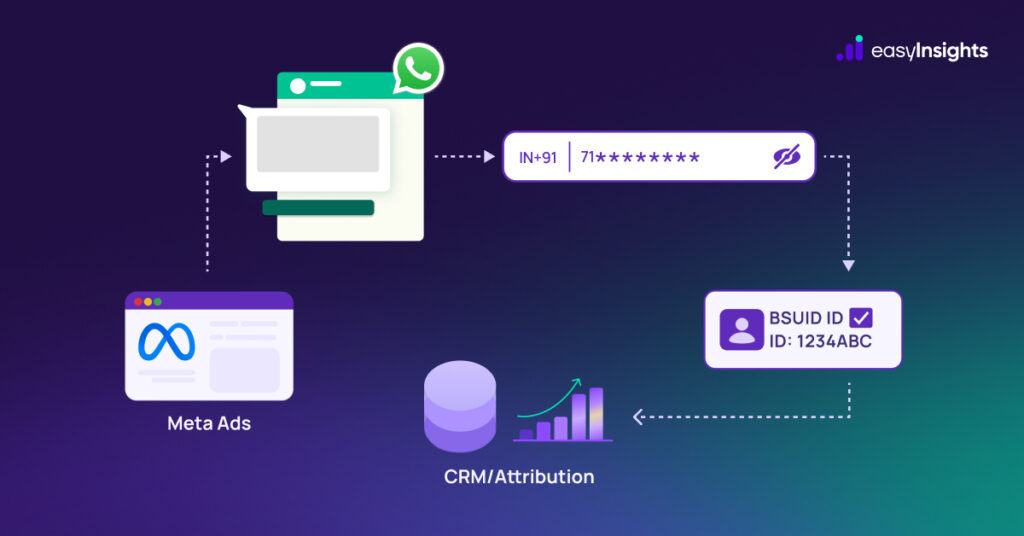
When a user hides their phone number, businesses can no longer use that number as an identifier. WhatsApp’s solution is the BSUID – Business-Scoped User ID. It’s a unique identifier assigned to each user per business. Think of it as a persistent, anonymous handle:
| How BSUID Works You get one BSUID for User X in your WhatsApp thread. A competitor talking to the same user gets a completely different BSUID. Neither of you can cross-reference the user’s identity across platforms. But within your own thread, the identifier persists – so your CRM and automations can still track the conversation. |
It’s deliberately privacy-preserving. Users can’t be tracked across businesses. But it also means phone-number-based matching – the thing holding your entire WhatsApp marketing stack together – stops working for users who opt in to the username system.
What Breaks in Your Marketing Stack
Let’s be specific. Here’s a breakdown of which tools and workflows are affected and how severely:
| System / Workflow | Before June 2026 | After June 2026 (for opted-in users) |
| CRM matching | Match contact by phone number | Must map BSUID → contact record |
| WhatsApp chatbots | Identify user via incoming phone number | Must accept and store BSUID as primary key |
| Retargeting audiences | Upload phone number lists as custom audiences | Phone lists won’t match username-only users |
| Click-to-WhatsApp Ads | Lead’s number captured on first message | Number hidden; BSUID is your only identifier |
| Attribution | Phone number used to stitch ad → CRM → conversion | Attribution chain breaks without BSUID integration |
| Broadcast lists / outbound | Send campaigns to phone number lists | Only reachable users are those who messaged you first (BSUID acquired) |
| ⚠ The Attribution Gap The trickiest breakage is attribution. If a user clicks a WhatsApp ad, starts a conversation, and later converts – but you never captured their phone number because they’re username-only – your current attribution model will show that conversion as untracked. For performance marketers optimizing ROAS, this is a real reporting problem. |
What This Means for Click-to-WhatsApp Campaigns
Click-to-WhatsApp (CTWA) ads are one of the fastest-growing ad formats in markets like India, Brazil, and Southeast Asia. They’re effective precisely because the handoff from ad to conversation is frictionless – and because you capture a live lead the moment someone messages you.
“The phone number was never just a contact detail. It was your attribution anchor. Lose it, and you lose the thread connecting ad spend to revenue.”
With the username update, a segment of users who click your CTWA ad will appear in your WhatsApp Business inbox with no phone number attached – only a BSUID. If your downstream systems (CRM, CDP, attribution tool) aren’t updated to ingest and store BSUIDs, these leads simply fall through the cracks.
The good news: the BSUID is still a persistent identifier. It doesn’t change between sessions. If you build your system to treat it as a first-class ID from day one, you can maintain conversation continuity, lead scoring, and even lifetime value tracking – just without the phone number attached.
The Opportunity Most Marketers Are Missing
Here’s the contrarian take: this update is actually a forcing function for better WhatsApp marketing hygiene – and an opportunity for brands that move first.
Branded Usernames Are First-Mover Territory
WhatsApp is allowing businesses to claim branded usernames. The brands that move fast will secure @Nike, @Zomato, @YourBrandName before competitors do. A memorable username makes you easier to find, easier to share, and more trustworthy – especially in markets where WhatsApp scams are common.
Opt-In Quality Will Improve
If users can now reach you without sharing their phone number, your opt-in rates for WhatsApp conversations will likely increase. The barrier drops. More top-of-funnel conversations, more BSUID relationships to nurture. The trade-off is a weaker identifier – but a larger, warmer audience is a fair exchange if your nurture flows are solid.
Privacy-First Brands Win Trust
Explicitly communicating that you respect user privacy on WhatsApp – that you only use BSUIDs and won’t try to cross-reference phone numbers – is a brand differentiator in markets where data trust is a purchase driver.
The Bottom Line
WhatsApp’s username feature isn’t just a privacy update – it’s a structural change to how identity works on the world’s largest messaging platform. For performance marketers, the phone number has been a load-bearing wall. Meta is removing it, and giving you a replacement (BSUID) that’s deliberately less powerful from a tracking standpoint.
The marketers who treat this as a compliance checkbox will lose attribution visibility and lead quality data. The marketers who rebuild their stacks around BSUID early – and use the username system to increase top-of-funnel volume – will come out ahead.
| Know exactly where your WhatsApp leads are coming from EasyInsights.ai connects your ad spend, CRM, and WhatsApp data into one clean attribution view – built to handle the BSUID transition before it hits. See How It Works → |