Ads are live, budgets are being spent – but results don’t move the way they should. Most performance marketers blame creatives, audiences, or platforms, but the real issue often sits deeper: unclean or unreliable signals.
In this blog, we’ll break down what signals mean in performance marketing, why bad signals quietly derail campaign performance, and how cleaning and aligning these signals can help platforms optimize on real user intent instead of guesswork.
Jump ahead to:
What Are “Signals” in Performance Marketing
Signals are the actions users take that ad platforms learn from, like purchases, form fills, app installs, or key events. These actions tell platforms who is interested and who to find more of, so ads can be shown to the right people.
When signals are clear and accurate, platforms optimize better. When they’re messy or incomplete, performance drops. In fact, Gartner estimates poor data quality costs organizations an average of $12.9 million per year, largely because systems and decisions rely on bad signals.
What Happens When Signals Are Not Clean
When the data that tells ad platforms what users do isn’t clean, everything downstream gets messed up, and it becomes harder for the platform’s machine learning to find the right audience for your ads. Here’s how common problems show up:
Missing events: Platforms don’t see real conversions, so algorithms fail to learn who the actual buyers are, increasing CAC.
Duplicate conversions: Over-counted events inflate performance metrics, leading to wrong bidding and false optimization signals.
Delayed data: Late event delivery slows or resets learning, causing under-optimization and unstable performance.
Wrong events prioritized: Optimizing for low-value actions (like page views) pushes spend toward poor-quality outcomes instead of revenue.
How Dirty Signals Break Platform Learning
Performance marketing relies on platform algorithms that learn from your data signals to decide targeting and costs, but when those signals are dirty or inaccurate, optimization breaks, and performance suffers.
Algorithms learn from what they’re fed: When signals are dirty or incomplete, platforms optimize on noise instead of real user intent.
Wrong signals mean wrong audiences: Inaccurate data misguides targeting, wasting spend on users unlikely to convert.
Budget leaks to low-quality users: Poor data quality can waste up to 21% of media spend, pushing budgets toward false positives instead of real customers.
Explore More: Why You’re Losing Signals Every Day – and How to Recover Them Legally with First-Party Data
The Common Symptoms Marketers See
When data signals are spoiled, campaigns stop scaling, lead volume rises, but quality drops, and teams end up blaming creatives, audiences, or platforms when the real issue is unreliable data causing unstable performance and endless guesswork.
What Clean Signals Actually Look Like
Clean signals are accurate user actions sent to ad platforms in real or near real time, so algorithms can learn quickly and correctly. When conversions are linked to real revenue and stay consistent across tools and platforms, optimization improves, and reporting becomes reliable.
According to industry research, accurate and timely data is critical for marketing performance, while poor data quality directly leads to wasted spend and wrong optimization decisions.
How to Fix Signal Quality Without Overengineering
Step-by-step, non-technical:
Define high-intent events
Identify actions that clearly show buying intent (like purchases, demo bookings, or qualified form fills) and focus tracking on those.
Remove unnecessary conversions
Stop tracking low-value actions that add noise and confuse ad platforms.
Validate event firing
Ensure events trigger correctly, only once, and at the right time.
Connect marketing data with revenue data
Link leads and conversions to actual sales outcomes to see what truly drives revenue.
Automate where possible
Use automation to keep data clean, consistent, and updated without manual effort.
How EasyInsights Helps
How EasyInsights helps clean and align signals:
- Captures real user intent
EasyInsights tracks first-party interactions like form fills accurately, even with privacy limits, giving clearer insight into who really intends to convert. - Sends high-quality leads back to ad platforms
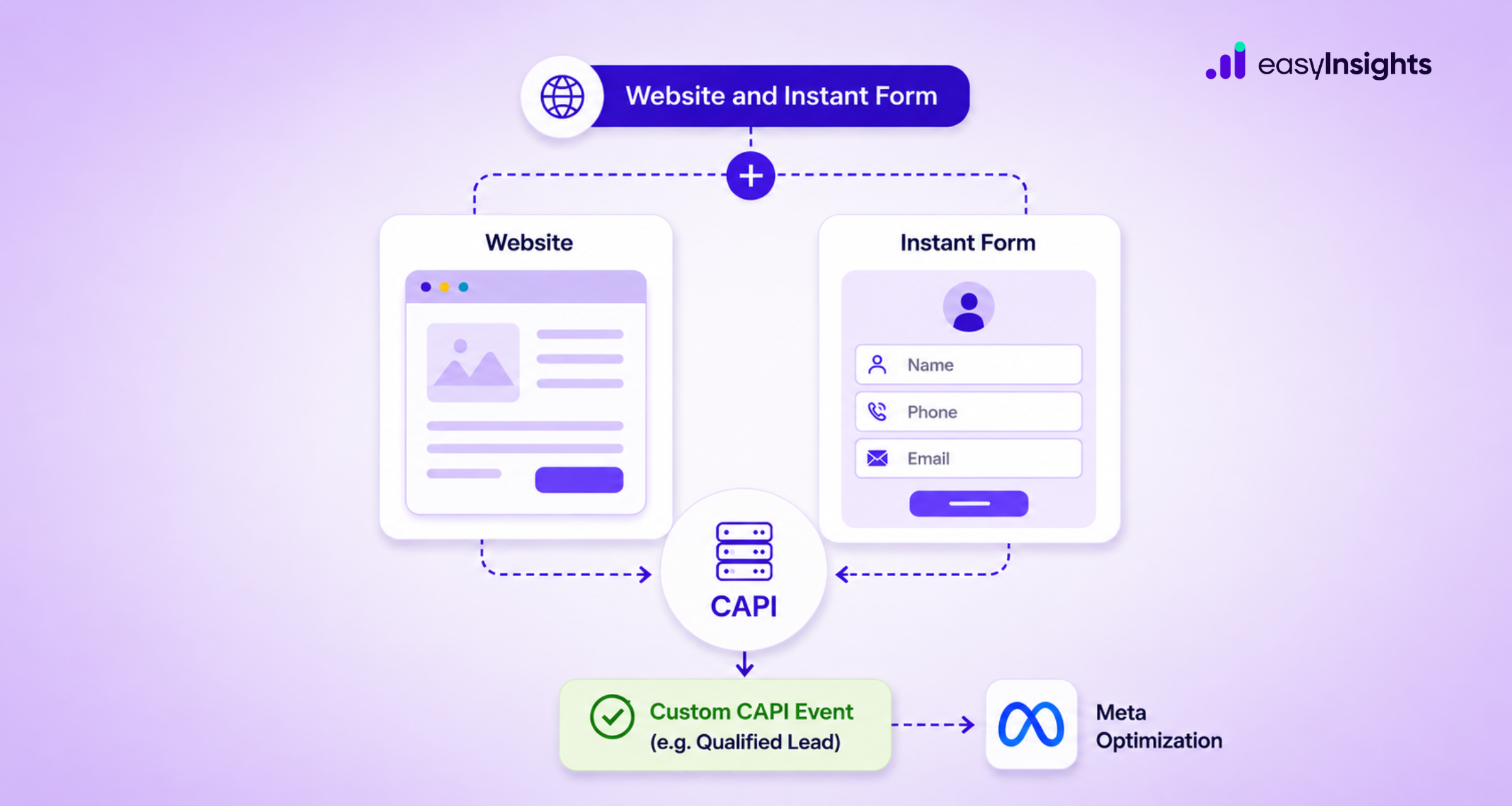
It uses server-side integrations (e.g., Meta CAPI, Google Ads API) to send clean, deduplicated conversion events and CRM outcomes back to platforms for optimization. - Helps ad platform AI optimize on real outcomes
By feeding platforms accurate conversion and revenue data tied to actual user behavior, EasyInsights enables the advertising AI to learn and improve targeting and bidding for genuine business results.
Final Thought
Clean signals are the foundation of better marketing performance. When platforms learn from real user intent instead of noisy or broken data, optimization improves naturally. By aligning marketing actions with actual business outcomes, you move from chasing clicks to driving real growth.