In the world of growth marketing, it’s tempting to focus only on acquiring new customers. But acquisition alone isn’t enough. True growth comes from nurturing relationships over time, optimizing touchpoints, and turning first-time buyers into loyal brand advocates.
This is where lifecycle marketing comes in. Lifecycle marketing is more than just a buzzword – it’s a strategic approach that aligns marketing efforts with the entire customer journey, allowing brands to deliver personalized experiences, increase retention, and drive measurable growth.
For growth marketers, adopting a lifecycle marketing mindset isn’t optional – it’s essential.
In this blog, we will delve into what lifecycle marketing is, its key stages, and why it is crucial for growth marketers to drive sustainable, data-driven growth.
Jump ahead to:
Understanding Lifecycle Marketing
Lifecycle marketing is a customer-centric strategy that targets customers differently based on their stage in the journey with your brand. Unlike traditional marketing that often focuses heavily on acquisition, lifecycle marketing treats every interaction as an opportunity to move the customer further along their journey. In a survey of lifecycle marketers, 83% report email as their proven ROI channel for this kind of approach. Now, let’s understand the key stages of the customer lifecycle.
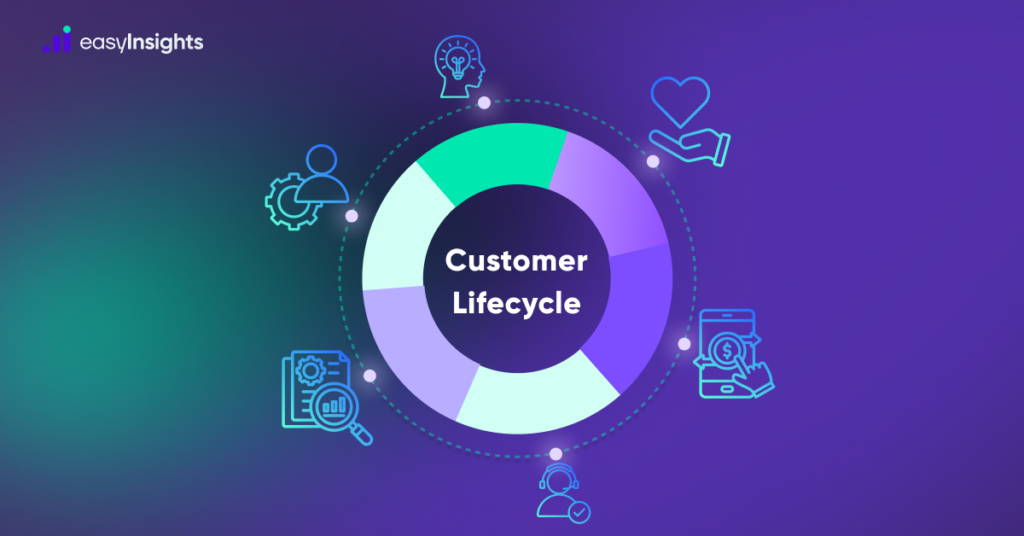
The Key Stages of the Customer Lifecycle:
1. Attract (Brand Awareness Stage)
The Attract stage focuses on getting people to notice your brand for the first time. The goal is simple – increase brand visibility, reach the right audience, and bring new prospects into your marketing funnel. This is where your brand builds its first impression and sparks interest.
Strategies to Attract Customers
- Run Visibility & Awareness Campaigns
Use ads and content that simply show people who you are and what you offer. These campaigns work even when audiences aren’t actively searching for your product. - Choose the Right Channels for Your Audience
- For B2C brands, digital ads, social media, and TV help you reach a massive audience quickly.
- For B2B brands, niche platforms like LinkedIn, industry portals, and webinars work better to get qualified leads.
- Create Strong Brand Recall
Use consistent branding – colors, logos, messaging, tone – across every platform to build a recognizable identity that stays in people’s minds. - Use CRM & Automated Outreach
Lead nurturing emails, drip campaigns, and automated prospecting help build early interest and keep your brand top-of-mind. - Stay Visible Across All Touchpoints
Whether it’s social media, blogs, events, or paid ads, maintain a unified presence with clear messaging to build trust and familiarity.
2. Engage (Interest & Consideration Stage)
Once people start showing interest – clicking your ads, visiting your website, or asking questions — you enter the Engage stage. The aim is to help them interact with your brand through helpful, easy, and meaningful experiences.
Strategies to Engage Prospects
- Make It Easy to Experience Your Offering
Free trials, demos, samples, or walkthrough videos help prospects understand your product firsthand. - Provide Helpful Content That Builds Trust
Publish blogs, tutorials, case studies, FAQs, user guides, and testimonial videos that explain your product clearly and build credibility. - Respond Quickly to All Queries
Use inbound and outbound methods – chat support, emails, helplines, DMs — to answer questions fast and boost engagement. - Showcase Expertise Through Valuable Resources
Host free webinars, podcasts, masterclasses, or knowledge sessions to position your brand as an industry expert. - Encourage Digital Interaction Across Platforms
Make your website, social pages, and landing pages engaging and user-friendly. Collect contact details through forms, newsletters, or gated content.
3. Convert (Decision Stage)
This stage is where prospects are ready to buy, and you guide them to take final action. Conversion depends on both logic (price, features, benefits) and emotion (trust, confidence, social proof).
Strategies to Convert Leads into Customers
- Use Clear & Strong Call-To-Actions (CTAs)
Tell prospects exactly what to do next – “Buy Now,” “Schedule a Demo,” “Start Free Trial.” - Highlight Your Unique Selling Proposition (USP)
Clearly show what makes your product better – features, pricing, quality, support, or innovation. - Show Social Proof to Build Trust
Add testimonials, ratings, reviews, case studies, and client logos to reassure customers. - Create FOMO With Limited-Time Incentives
Use urgency-driven tactics like flash deals, seasonal discounts, limited stock alerts, or exclusive offers. - Offer Smooth and Secure Checkout Experience
Simple forms, easy payment options, transparent pricing, and instant confirmations help complete the sale without friction.
4. Retain (Customer Retention Stage)
Keeping existing customers happy is far more profitable than acquiring new ones. The goal in this stage is to create repeat purchases, build long-term relationships, and offer value beyond the initial sale.
Strategies to Retain Customers
5. Referral & Loyalty (Advocacy Stage)
Happy customers become your best marketers. This stage focuses on turning satisfied users into brand ambassadors who refer others and continue to stay loyal.
Strategies for Referral & Loyalty
- Introduce Reward-Based Referral Programs
Give customers incentives – discounts, coupons, freebies – for referring friends and family. - Build a Strong Loyalty Program
Offer points for every purchase, unlock tiers, or provide exclusive benefits to repeat customers. - Encourage Public Reviews & Testimonials
Make it easy for customers to share their experience on social media, Google reviews, or your website. - Gamify the Experience
Add badges, milestones, rewards, or progress levels to make the product journey enjoyable and competitive. - Celebrate Customer Milestones
Send personalized messages or perks on anniversaries, achievements, or purchase milestones to build emotional connection.
Lifecycle marketing is data-driven: every stage relies on insights from user behavior, engagement metrics, and purchase history to deliver timely and relevant messaging.
Importance of Lifecycle Marketing for Growth Marketers
Growth marketing is about scaling smartly, not just spending more on ads. Lifecycle marketing supports this by maximizing the value of every customer and every interaction. Here’s why it’s crucial:
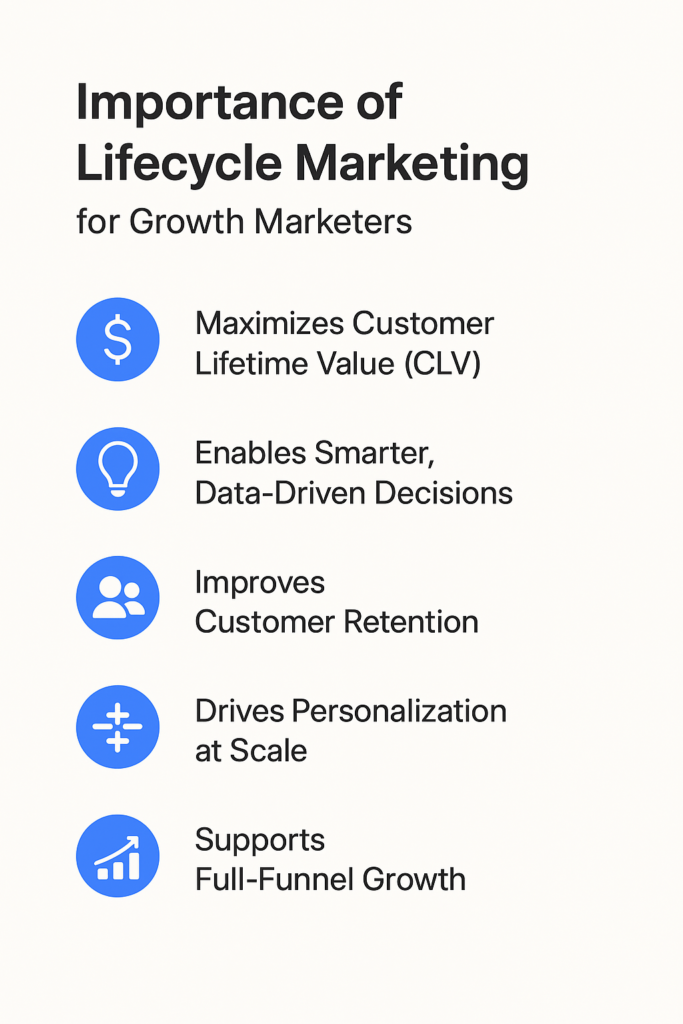
1. Maximizes Customer Lifetime Value (CLV)
Acquiring a new customer costs 5–7x more than retaining an existing one. Lifecycle marketing ensures that marketers don’t just chase new users but focus on maximizing the value of current customers.
- Example: By using automated email sequences with product recommendations post-purchase, a brand can increase repeat purchases and CLV.
2. Enables Smarter, Data-Driven Decisions
Growth marketers thrive on data. Lifecycle marketing provides insights at each stage of the funnel:
- Where do customers drop off?
- Which campaigns drive conversions?
- Which segments respond best to certain offers?
With this data, marketers can optimize campaigns in real time, reduce wasted spend, and increase ROI.
3. Improves Customer Retention
Retention is a key metric for growth. Lifecycle marketing strategies ensure continuous engagement through:
- Personalized emails
- Loyalty programs
- Retargeting campaigns
- Feedback loops
This reduces churn and keeps customers returning, which is far more cost-effective than constantly acquiring new users.
4. Drives Personalization at Scale
Customers now expect relevant, personalized experiences. Lifecycle marketing enables growth marketers to segment audiences and deliver stage-specific content:
- Awareness stage: Educational blog posts or free resources
- Conversion stage: Discount codes, free trials, or product demos
- Retention stage: Personalized recommendations and loyalty rewards
This level of personalization boosts engagement, trust, and conversions.
5. Supports Full-Funnel Growth
Lifecycle marketing ensures growth isn’t lopsided. It balances acquisition, engagement, conversion, and retention, creating a sustainable growth engine.
- Example: A SaaS company can use lifecycle marketing to:
- Attract users through webinars
- Nurture leads with drip emails
- Convert trials to paid subscriptions
- Upsell or cross-sell existing customers
- Encourage referrals and testimonials
- Attract users through webinars
By connecting every stage, the brand builds a repeatable, scalable growth loop.
How Growth Marketers Can Implement Lifecycle Marketing
- Map Your Customer Journey
Identify the key touchpoints and interactions at each stage. Use analytics to understand where users drop off. - Segment Customers by Stage
Not all users are equal. Segment based on behavior, engagement, and purchase history. - Develop Stage-Specific Content & Campaigns
- Awareness → Blogs, social media posts, lead magnets
- Engagement → Email newsletters, webinars, case studies
- Conversion → Retargeting, offers, demos
- Retention → Onboarding flows, product recommendations
- Advocacy → Referral programs, reviews, loyalty incentives
- Awareness → Blogs, social media posts, lead magnets
- Leverage Automation & Personalization
Use marketing automation tools to deliver timely messages based on triggers (e.g., abandoned carts, milestone anniversaries). - Measure & Optimize
Track KPIs for each stage: CTR, conversion rates, retention, referral activity, and customer lifetime value. Continuously test and refine campaigns.
The brand uses data from each stage to adjust offers, messaging, and targeting, creating a self-sustaining growth cycle.
How to Use EasyInsights for Full-Funnel Lifecycle Reporting
Growth marketers today need a complete view of the customer journey to optimize campaigns at every stage, and EasyInsights makes this possible with its full-funnel lifecycle reporting capabilities. By connecting all your marketing channels – from social media and Google Ads to email marketing tools and CRM systems – EasyInsights allows you to track every touchpoint, giving a clear picture of how each interaction contributes to the customer lifecycle. You can segment customers across stages such as awareness, engagement, conversion, retention, and advocacy, helping you identify where users drop off and where optimization is needed. With EasyInsights, you can monitor key metrics like impressions, clicks, conversions, repeat purchase rates, and referrals, all from a single dashboard.
The platform also supports multi-touch attribution, enabling you to see which campaigns and channels drive the most value and adjust budgets and strategies accordingly.
Finally, by analyzing these insights, growth marketers can retarget users, create personalized campaigns, refine messaging, and optimize content strategies to increase engagement, retention, and advocacy. In essence, using EasyInsights for full-funnel lifecycle reporting transforms lifecycle marketing from a strategy into a data-driven growth engine, helping marketers make informed decisions that improve ROI and maximize customer lifetime value.
Conclusion
For growth marketers, lifecycle marketing isn’t optional – it’s a strategic necessity. It ensures that every customer interaction is purposeful, every campaign is data-driven, and every stage of the journey is optimized for growth.
Brands that adopt lifecycle marketing don’t just grow fast; they grow smart, sustainable, and scalable, turning every customer into a long-term advocate.
Growth marketers can leverage tools like EasyInsights to unify customer data, track behavior across the lifecycle, and create automated, personalized campaigns that drive measurable results.
Learn more, book a demo with EasyInsights!