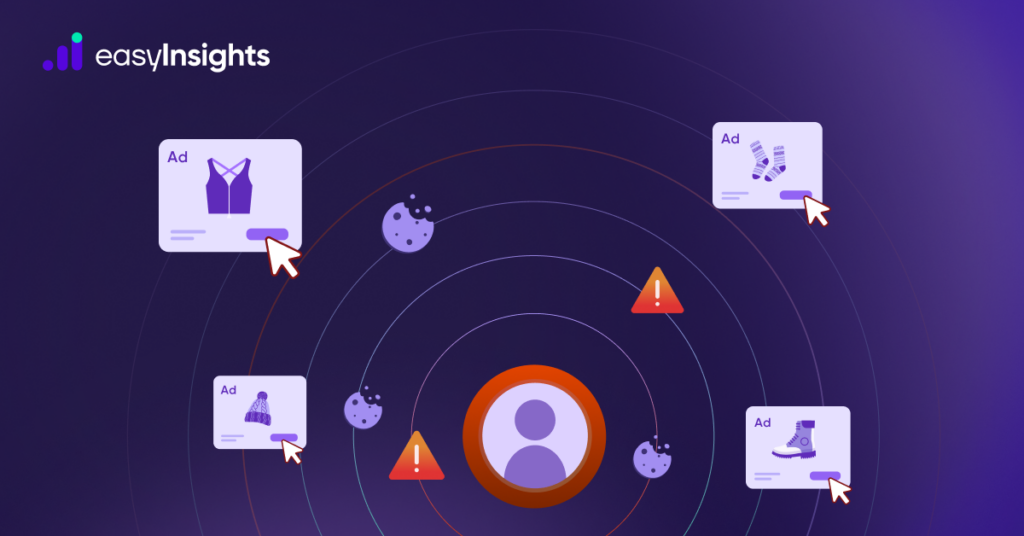
Many brands today are spending more on retargeting ads yet seeing diminishing returns and falling ROAS, leaving marketers feeling like their campaigns are just randomly firing ads instead of driving conversions. Instead of appearing helpful, retargeting often feels repetitive, mistimed, or intrusive because the same audiences see identical ads too frequently – causing ad fatigue and a poor user experience.
Part of the problem is that traditional retargeting strategies haven’t evolved with changes in data privacy, tracking limitations, and platform behaviour. As a result, audiences grow saturated, campaign costs rise, and engagement drops.
In this post, we’ll explore why retargeting feels random today and how you can make it data-driven again – by improving audience segmentation, creative relevance, and the quality of your tracking signals.
Jump ahead to:
What Retargeting Was Supposed to Do
Retargeting-also known as behavioral retargeting-was built as a high-intent, lower-funnel tactic designed to re-engage users who had already shown interest in a brand or product. By focusing on warm audiences instead of cold prospects, it aimed to deliver higher conversion rates and stronger ROAS than generic display ads.
Early retargeting relied on browser cookies and tracking pixels. When users visited a site, a cookie allowed ad platforms to recognize them later and show relevant ads across the web. With simpler funnels, fewer devices, and consistent tracking, campaigns felt predictable and easy to optimise-making retargeting both profitable and reliable for marketers.
In this context:
- Clear cookies acted as reliable identifiers of past interest.
- Simple user journeys meant fewer gaps in visibility across platforms.
- Fewer devices and channels made retargeting audiences easy to reach consistently.
Together, this made early retargeting feel like a low-effort, high-impact strategy for recapturing potential customers and closing the loop on conversions.
Why Retargeting Feels Random Today
Even though retargeting was once predictable and performant, it now often feels unreliable, mistimed, and inefficient. Several structural shifts in consumer behaviour, privacy policy, and tracking technology have made modern retargeting campaigns behave more like guesses than precision tools.
Broken User Journeys
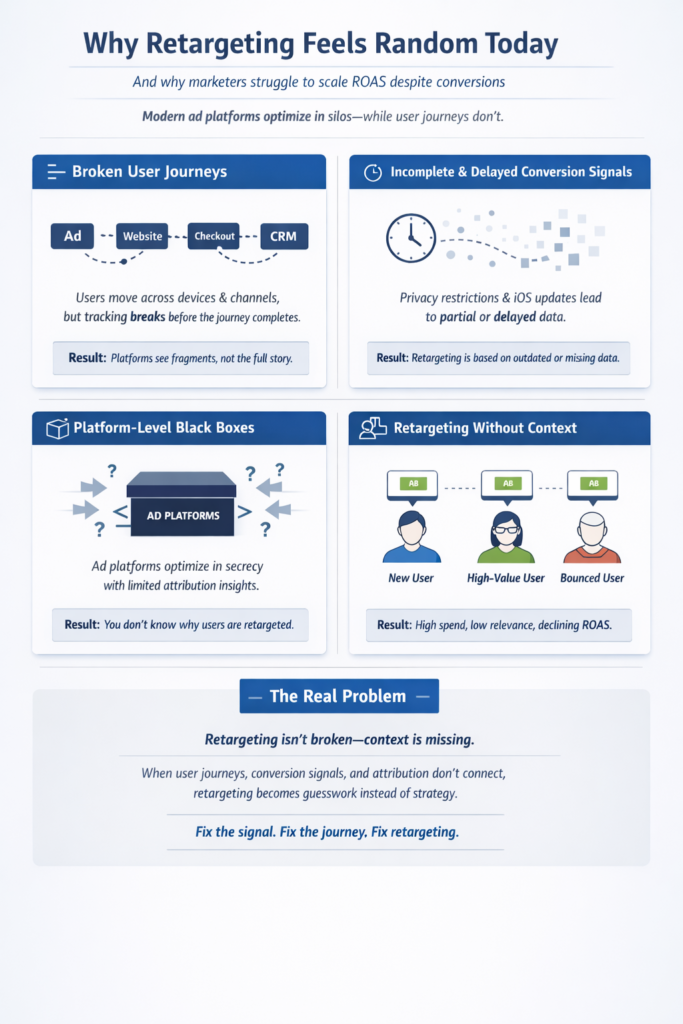
One of the biggest challenges is that today’s customers rarely follow a simple path from click → site visit → conversion. Instead, people switch between devices, browsers, and apps, and most retargeting systems can’t link those interactions to a single user.
This means:
- A user who browses on mobile, researches on a laptop, and checks out via email might be treated as three separate people, fragmenting intent signals.
- When a user moves across devices or domains without a unified identity, platforms lose the ability to associate past behaviour with future actions.
In effect, what should be a continuous user journey becomes multiple disconnected fragments, making retargeting lists noisy and unpredictable.
Incomplete & Delayed Conversion Signals
Modern tracking is plagued by signal loss and timing gaps that break the feedback loops platforms depend on for optimisation:
- Client-side tracking failures – Browsers increasingly restrict cookies (e.g., Safari’s Intelligent Tracking Prevention), and ad blockers strip scripts, which prevent pixels from firing reliably.
- Missing post-purchase events – When purchase events don’t reach an ad platform in real time (or at all), it can’t suppress those users from retargeting audiences, leading to ads shown after conversion.
- Delayed or dropped signals distort optimisation because platforms learn slowly or with incomplete data, making audience building and bidding less effective.
Together, these gaps leave campaigns with partial or stale data, so retargeting becomes less precise and more random.
Platform-Level Black Boxes
Modern ad ecosystems like Meta and Google Ads are powerful but opaque. They use AI and modelling to fill in missing data, which helps, but also creates uncertainty:
- Platforms optimise campaigns based on partial data and algorithmic prediction, meaning you can’t always see why a particular user was targeted.
- Over-reliance on modelled conversions makes the signals feeding optimisation less transparent, reducing marketer control.
The result is a “black box” effect: you know ads are being shown, but not the true journey or intent behind the person seeing them, which feels random from a strategic standpoint.
Retargeting Without Context
When retargeting isn’t grounded in meaningful user behaviour, it starts to feel irrelevant or annoying:
- Users may be retargeted even after converting, simply because the platform didn’t receive or process the purchase signal correctly.
- Audiences with low intent – like someone who bounced after a few seconds – are sometimes treated the same as high-intent users, leading to wasted spend.
- There’s often no differentiation between browsers, buyers, and repeat users, so campaigns lack the context needed for personalised messaging.
Without smart segmentation and clean signals, retargeting becomes a blunt instrument – showing ads arbitrarily rather than strategically.
Read more: Everything You Need to Know About Customer Journey Mapping
The Real Cost of Random Retargeting
When retargeting feels random instead of relevant, it doesn’t just underperform – it actually costs you in multiple ways.
1. Budget Wastage on Already-Converted Users
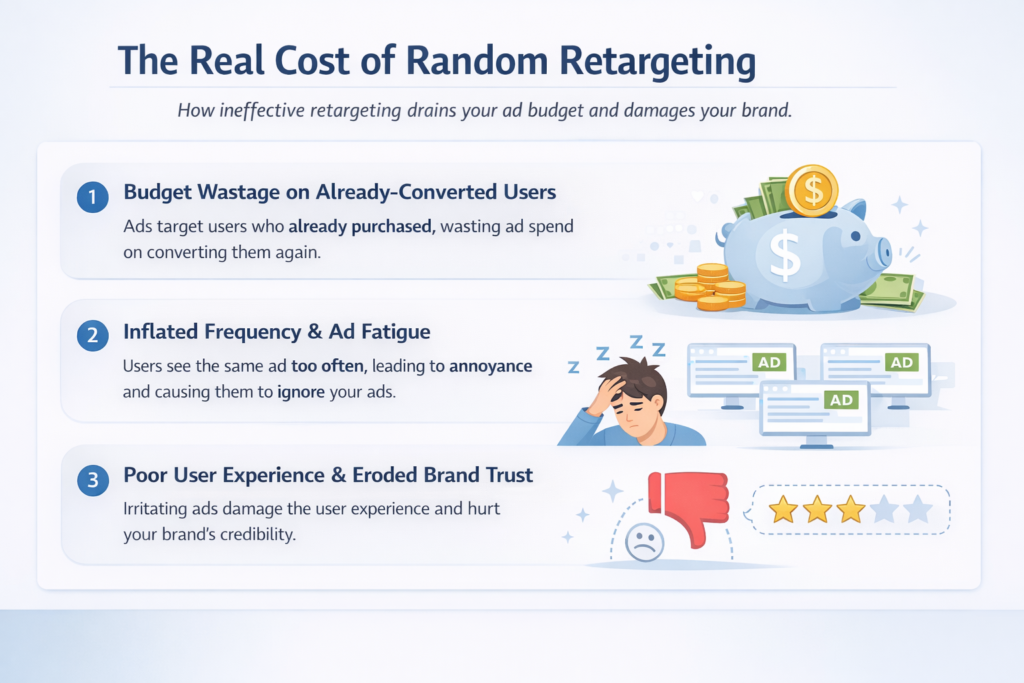
Random retargeting often means showing ads to people who have already purchased or completed the action you’re targeting. When a platform doesn’t receive clean conversion signals – because of tracking gaps or delayed data – it keeps those users in your retargeting pool. That wastes ad spend on audiences unlikely to convert again, instead of focusing on high-intent prospects.
2. Inflated Frequency & Ad Fatigue
Showing the same ad repeatedly without frequency caps leads to ad fatigue, where users become desensitised or annoyed. This not only lowers engagement but quietly burns a significant portion of your media budget before you even detect performance decay. In some analyses, fatigued creatives have been shown to consume 30–50% of monthly budgets without delivering conversions.
3. Poor User Experience & Eroded Brand Trust
Users who see the same stale ads over and over – especially after they’ve already taken action – can experience frustration rather than interest. This creates negative brand associations and damages brand trust, making users less likely to engage positively in future interactions.
What “Data-Driven Retargeting” Actually Means Today
When people talk about “data-driven retargeting,” they’re not just referring to more dashboards, more reports, or even more money spent on ads. At its heart, it means feeding clean, accurate, real-time signals into your retargeting systems so that ads are shown to the right people, at the right time, with the right message – instead of feeling random and repetitive.
Real-User, Deduplicated Conversion Data
Data-driven retargeting starts with clean conversion signals – not noisy duplicates or inflated events. When platforms see duplicated conversions (e.g., a purchase reported twice), it misguides optimisation, inflates performance metrics, and ultimately reduces efficiency. Deduplicated data ensures that each user action (like a purchase or lead) is counted only once, leading to more accurate audience segments and better learning by ad platforms.
Identity Stitched Across Web, App, and CRM
Understanding who a user really is – across devices and channels – is key to relevance. Modern retargeting relies on identity resolution, which ties together behaviours from a website visit, app interaction, email click, or CRM record into a single user profile. This unified view lets systems avoid treating one person as many different anonymous fragments, and supports more personalised and precise retargeting.
Real-Time Event Sharing with Ad Platforms
Instead of letting signals sit in silos or arrive late, data-driven retargeting pushes real-time events into platforms like Meta and Google. When a user takes an action (e.g., adds to cart, watches a demo, completes a purchase), that event gets shared instantly – triggering accurate audience updates and preventing irrelevant ad delivery. This real-time signal flow improves optimisation and reduces wasted impressions.
Retargeting Based on Journey Stage, Not Just Page Views
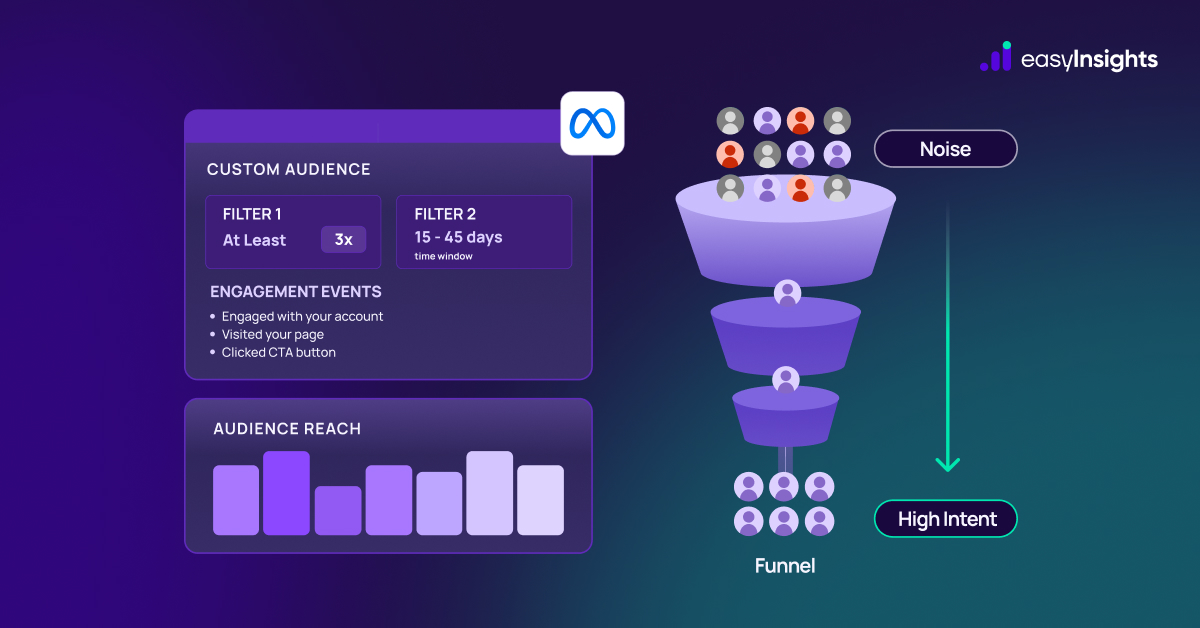
Modern audiences are not “one size fits all.” A data-driven approach looks at where someone is in their journey – from early interest to conversion or repeat purchase – and retargets with contextually relevant ads rather than generic page-view lists. This can include segmenting by how recently they engaged, what actions they took, and whether they’re already customers or high-value prospects.
The Data Fixes That Make Retargeting Predictable Again
Fixing retargeting performance doesn’t start with new creatives or higher budgets. It starts with repairing the data foundation that feeds your ad platforms. Below are four actionable data pillars that make retargeting predictable, efficient, and scalable again.
Server-Side & First-Party Tracking
Traditional client-side tracking relies on browser cookies and pixels, which are becoming increasingly unreliable due to privacy changes, such as Safari’s Intelligent Tracking Prevention (ITP), ad blockers, and cookie consent restrictions. As a result, many user actions never reach ad platforms, leading to broken audiences and missed suppression signals.
Server-side and first-party tracking solve this by sending events directly from your server or backend systems, reducing data loss and improving reliability. This ensures platforms receive consistent, privacy-compliant conversion signals.
Benefit for retargeting accuracy:
- Fewer missing or delayed events
- Better suppression of converted users
- More stable optimisation and audience building
Unified Customer Identity
- Merging anonymous and known users
Modern users interact across multiple touchpoints before converting. Unified customer identity connects anonymous website visitors with known users once they log in, submit a form, or make a purchase – creating a single, continuous user profile.
- Connecting Meta, Google, Shopify, CRM, and app data
By stitching identity across ad platforms, ecommerce systems, CRMs, and apps, marketers avoid treating the same person as multiple users. This enables accurate retargeting, prevents overexposure, and supports personalised messaging across the funnel.
- Preventing double-counting
When the same conversion is reported multiple times – for example, from both browser and server – ad platforms receive inflated signals. This skews optimisation, inflates ROAS, and confuses retargeting logic.
Deduplication ensures that each real user action is counted only once, regardless of how many tracking systems report it.
- Sending clean signals back to platforms
Clean, deduplicated events help platforms optimise toward real outcomes instead of noisy data. This improves bidding accuracy, stabilises learning phases, and ensures retargeting audiences stay relevant.
Additional read: Why Your Tracking Fell Apart After iOS – and How to Rebuild Clean, Reliable Data Flows
How Better Data Changes Retargeting Outcomes
When retargeting is powered by clean, connected data, performance shifts from guesswork to control. Instead of blasting ads broadly, platforms receive accurate signals that help them optimise faster and more precisely.
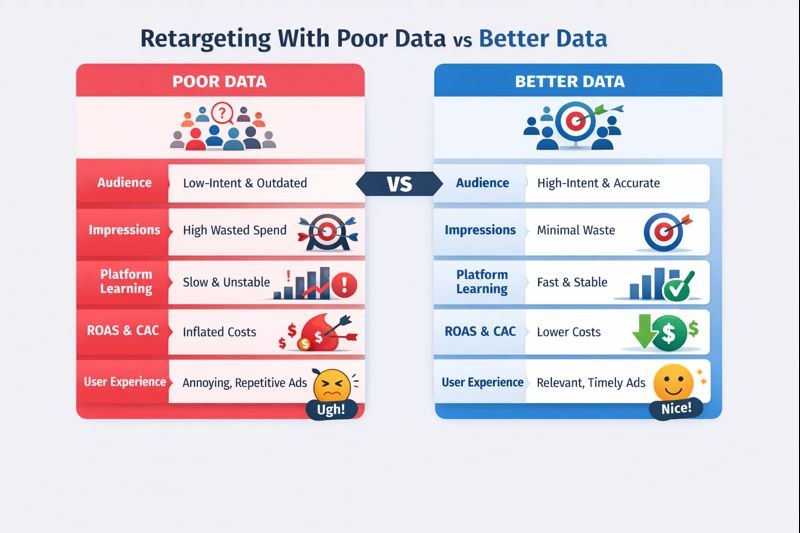
- Lower wasted impressions
Clean conversion and suppression signals ensure ads stop showing to users who’ve already converted, reducing spend on irrelevant audiences. - Faster campaign stabilisation
With real-time, deduplicated events, ad platforms learn quicker. Campaigns exit the learning phase faster and show more consistent performance. - Improved ROAS and Lower CAC
When platforms optimise on real outcomes instead of noisy or duplicated data, budgets flow toward high-intent users-improving ROAS and bringing down CAC. - Retargeting feels intentional, not random
Ads align with the user’s actual journey stage. Messaging becomes timely, relevant, and contextual-improving both performance and user experience.
How EasyInsights Helps Fix Retargeting & Attribution
EasyInsights helps brands move from fragmented, platform-level reporting to clean, unified, and reliable data-which is the foundation of predictable retargeting and accurate attribution.
Instead of relying on siloed dashboards from Meta, Google, or GA4, EasyInsights creates a single source of truth by unifying data across ad platforms, web/app analytics, ecommerce systems, and CRMs. This ensures conversions are deduplicated, user journeys are stitched across devices, and platforms receive real, trusted signals for optimisation.
With EasyInsights, marketers can:
- Send accurate server-side conversion data back to ad platforms
- Prevent retargeting of already-converted users
- Build journey-based retargeting audiences, not just page-view lists
- See which channels truly influence conversions, just who claims the last click
Retargeting that feels intentional instead of random, faster campaign stabilisation, and more confident decisions driven by clean data, not assumptions.
Conclusion
Retargeting isn’t broken-but the data behind it is. As customer journeys become more complex and platforms operate in silos, relying on fragmented tracking and last-click attribution only makes performance feel random and unreliable.
When conversion signals are clean, identities are unified, and journeys are stitched across channels and devices, retargeting becomes predictable again. Budgets are spent more efficiently, platforms learn faster, and ads feel relevant instead of repetitive.
Brands that invest in better data infrastructure don’t just improve retargeting-they gain clarity, control, and confidence in every marketing decision. And in a world where attribution keeps getting harder, that clarity is the real competitive advantage.
Implement data driven retargeting with EasyInsights – Book a demo