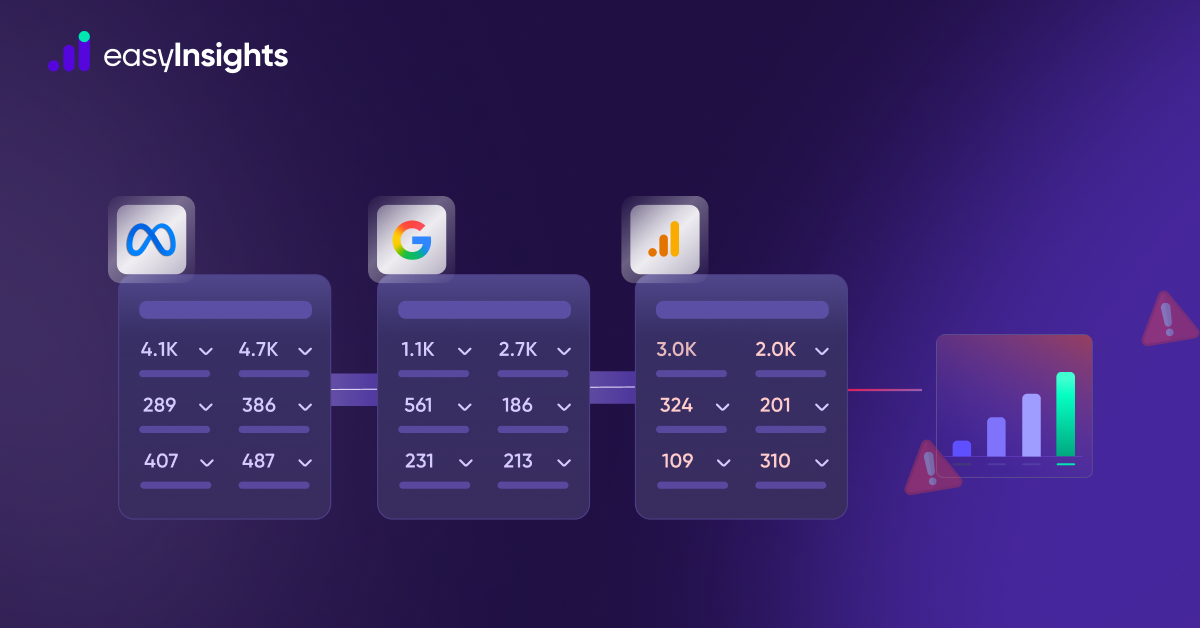
Every platform claims credit for the same sale. Meta shows one number, Google shows another, GA4 tells a different story, and your CRM says something else entirely.
So how do you actually know which platform is driving sales?
The honest answer: you don’t, at least not with the way attribution works today.
Customer journeys have become too fragmented, privacy rules have tightened tracking, and each platform operates inside its own closed system. The result? Broken attribution, inflated CAC, inaccurate ROAS, and marketing budgets that feel like guesswork instead of strategy.
In this blog, we’ll break down why you can’t tell which platform earns sales, what’s actually causing these conflicting reports, and-most importantly to fix multi-touch attribution once and for all so you finally get a single source of truth.
Jump ahead to:
The Modern Attribution Problem
Walled Gardens & Conflicting Reports
With attribution becoming increasingly challenging, many of the biggest platforms – from social media to search to large marketplaces – operate as “walled gardens.” These ecosystems control their own data: how they measure impressions, clicks, conversions, and attribution. That control means each platform reports conversions according to its own logic, attribution window, and definitions.
As a result, a single purchase might be counted differently by different platforms, leading to conflicting reports.

Cross-Device, Cross-Channel Customer Journeys
The 2025 customer journey is anything but linear. Someone might discover your brand on social media, browse later on a laptop, click an email days later, and finally buy through a search ad on mobile. Add offline touchpoints like calls or store visits, and the path gets even more fragmented.
Single-touch models like last-click or first-click can’t capture this complexity. They credit only one touchpoint-usually the final click-while ignoring the social, display, email, and retargeting interactions that actually shaped the decision. This identity fragmentation is now one of the biggest reasons cross-channel attribution remains so inaccurate.
Data Loss: Cookies, Privacy Laws, and Tracking Restrictions
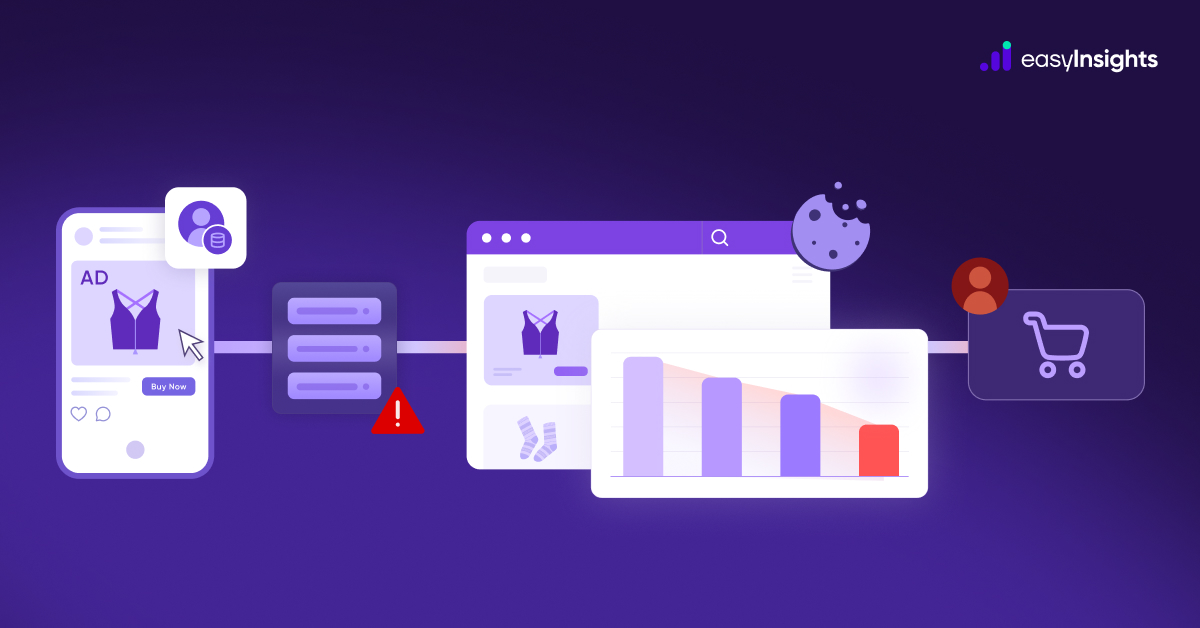
For years, third-party cookies powered attribution and cross-site user tracking. Today, privacy regulations and browser changes have fundamentally disrupted this model. Safari and Firefox already block third-party cookies, and Chrome is phasing them out in favor of privacy-first alternatives.
As cookies disappear, so does reliable cross-site and cross-device tracking. Persistent identifiers break, click IDs vanish, events go unlinked, and conversions drop-leaving attribution incomplete or blind across large parts of the funnel.
Also read: Top Common Marketing Attribution Mistakes
Why You Can’t Tell Which Platform Actually Drove the Sale
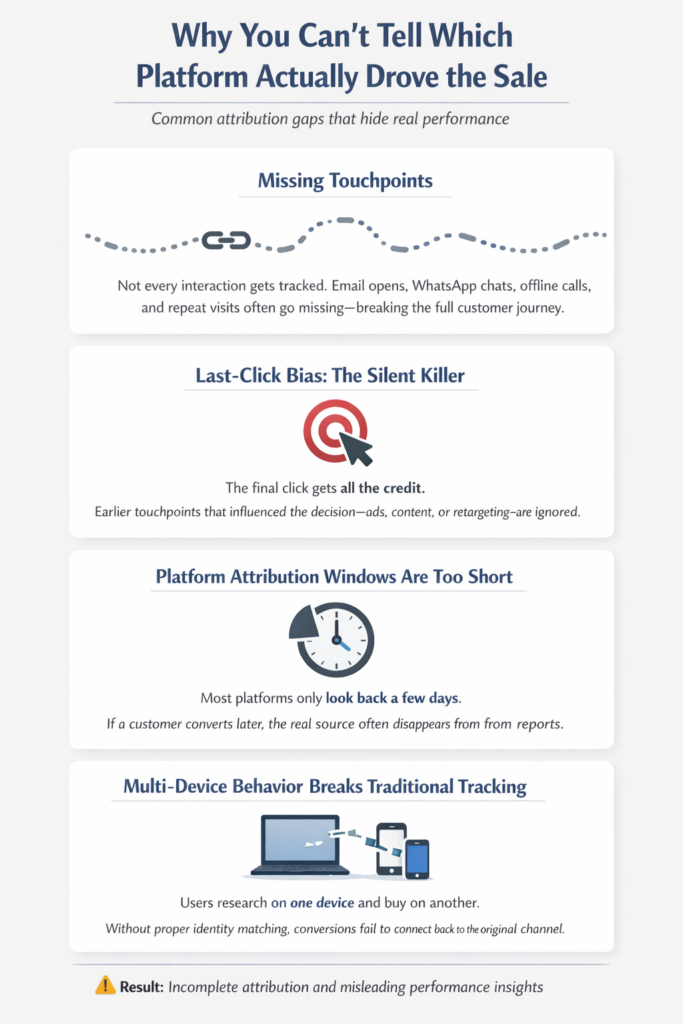
Missing Touchpoints
Many of the most influential touchpoints in a customer journey simply don’t get tracked. Upper-funnel channels like Meta, YouTube, or Display may spark initial interest but rarely receive credit when the final purchase happens elsewhere.
Similarly, high-intent channels like email, SMS, and remarketing flows heavily influence conversions; most attribution models fail to capture them because they happen outside platform-controlled environments.
Last-Click Bias: The Silent Killer
Last-click attribution remains the default in many analytics platforms-even though it misrepresents true performance. It overvalues lower-funnel channels like Google Search, which naturally capture the last interaction, and undervalues social, video, and mid-funnel channels that build demand earlier.
This is why a Google campaign can show strong ROAS, but your overall revenue doesn’t move-because you end up redirecting budget away from the channels that actually create demand.
Platform Attribution Windows Are Too Short
Every platform uses its own attribution window, which creates conflicting and incomplete reporting:
- Meta: 7-day click
- Google Ads: 30-day click
- GA4: Up to 90 days, but still misses many cross-device sessions
When the customer journey lasts longer than the tracking window, the platform simply stops counting the influence-leading to partial or misleading results.
Multi-Device Behavior Breaks Traditional Tracking
Most users switch devices repeatedly before purchasing. A common scenario:
- User discovers your brand on Instagram (mobile).
- Researches the product later on the laptop.
- Finally returns on mobile to complete the purchase.
If the journey breaks across browsers, apps, or devices where cookies/IDs don’t persist, earlier touches are lost. The conversion is then credited only to the final device or channel-even if other platforms actually drove the intent.
This fragmentation is one of the biggest reasons attribution appears inconsistent across Meta, Google, and GA4.
The Impact on Marketing Performance
Wrong Budget Decisions
When attribution is broken or biased, budget allocations become distorted. Marketing teams tend to cut spend on upper-funnel or awareness channels – even if those are the ones generating demand – simply because they don’t get “credit” in last-click or incomplete attribution models.
At the same time, budgets get disproportionately shifted toward channels that appear to deliver conversions, even if those conversions only happened because of earlier unseen touchpoints.
Inflated CAC & Broken ROAS
Because credit is mis-assigned, metrics like CAC and ROAS become misleading. You may see “good ROAS” or “low CAC” on paper – but in reality, these metrics don’t reflect the full customer journey.
Over time, this leads you to scale campaigns that look efficient but aren’t truly cost-effective. You end up paying more to acquire customers than you realize, and overall profitability gets hurt.
Slow Learning Cycles
When attribution data is wrong or incomplete, optimization becomes unreliable. Algorithms and marketers optimizing campaigns based on flawed data end up reinforcing suboptimal strategies – for instance, pushing more spend into channels that seem to convert well (on last-click) but aren’t actually driving incremental sales.
learning cycles slow down, growth plateaus, and marketers can’t confidently experiment or scale because every decision is built on shaky foundations.
How to Fix Multi-Touch Attribution (MTA) Once and For All
Build a Unified Conversion Source of Truth
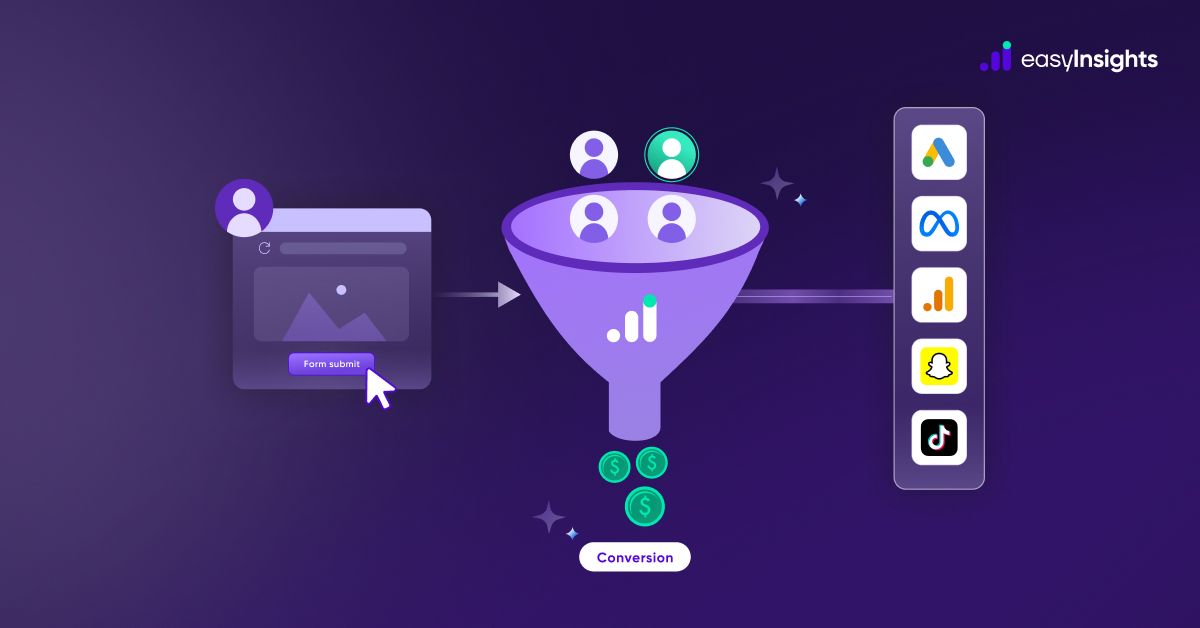
Centralize data from ads, analytics, CRM, and offline sources into a single data layer. Deduplicate conversions and use first-party identifiers (hashed email, login IDs, user IDs) to stitch user activity across devices and channels. Without this foundation, MTA will always be fragmented.
Reconstruct the Full Customer Journey
Connect every touchpoint – from first ad impression to final purchase – across digital and offline interactions. This reveals the true path to conversion and shows which channels assist, not just close, conversions.
Combine Deterministic + Probabilistic Matching
As cookies and device IDs fade, rely on deterministic data where available and probabilistic models where identifiers are missing. This hybrid approach fills attribution gaps while staying privacy-compliant.
Use Data-Driven Attribution (DDA)
Move beyond rule-based models. Algorithmic attribution uses data and machine learning to assign credit based on real conversion impact, uncovering the true value of upper- and mid-funnel channels and enabling smarter budget allocation.
The EasyInsights Approach
If you want to highlight a real platform solving MTA challenges, EasyInsights provides one of the most complete attribution and data-unification stacks available for performance marketers.
180-Day Attribution Windows
Most ad platforms cap attribution at 7–30 days, hiding long-cycle and high-consideration conversions. This leads to fragmented MTA where every platform claims full credit.
EasyInsights creates a single, deduped source of truth – merging, resolving, and deduplicating the entire journey. With up to 180-day attribution, teams gain visibility into delayed purchases, retargeting loops, and true multi-touch impact.
Unified Data Across Meta, Google, Shopify, CRM & More
EasyInsights automatically consolidates data from Meta, Google Ads, Shopify, web analytics, CRM systems, and offline sources into a single, unified data layer. It brings together ad interactions, on-site behavior, purchases, customer records, and offline conversions-resolving identities and deduplicating events across platforms.
Identity Graph + Cross-Device Stitching
By combining hashed PII, session-level identifiers, and click IDs, the platform builds customer-level identity resolution, even when deterministic IDs are missing.
This enables marketers to see:
How a user moved from Meta → Website → Email → Google → Purchase
How anonymous clicks become known customers
What sequence of interactions actually drove the sale
Real-Time Deduped Conversions
EasyInsights removes:
– Double-counting across channels
– Server-side vs pixel duplicates
– CRM vs platform mismatch
– Event mismatches from UTMs, API setups, or SKAN limitations
This ensures Meta, Google, and internal dashboards all optimize on the same clean events-preventing wasted spend and broken ROAS.
Conclusion
Today’s customer journeys are messy. People don’t click once and buy. They research, drop off, come back on another device, interact across multiple channels, and convert much later. Traditional attribution models simply can’t keep up-and that’s why performance data often feels incomplete or misleading.
The EasyInsights approach fixes this by bringing everything together in one clear view. With longer attribution windows, unified data across platforms, strong identity matching, and real-time deduped conversions, marketers finally see what actually drives sales, not just what gets clicks.
Get accurate attribution with EasyInsights – Book a demo