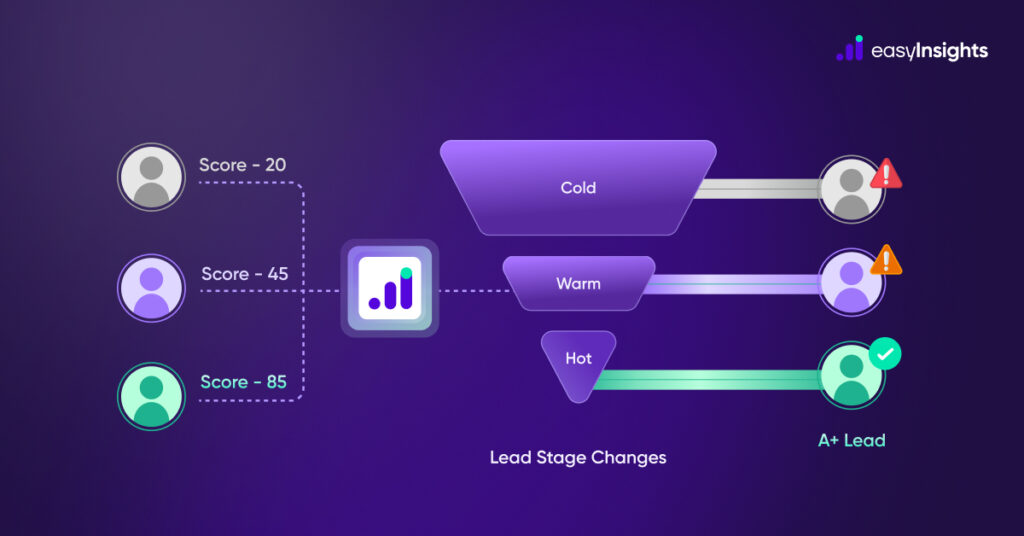
Most businesses don’t have a lead generation problem.
They have a lead quality illusion.
CRMs are full. Dashboards look healthy. Sales teams are “following up.”
And yet – deals stall, pipelines leak, and CAC keeps rising.
The reason?
Most leads are being judged using outdated, rule-based scoring systems that were never built for modern, multi-channel buyer journeys. Static points, manual rules, and surface-level engagement signals can’t tell you which leads will actually convert.
This is where lead grading – powered by AI – changes everything.
Jump ahead to:
Lead Grading Explained
At a high level, lead grading is a qualification method used to evaluate how well a lead fits your ideal customer profile (ICP).
While lead scoring typically assigns numerical values (points) based on lead behaviour (e.g., page views, form submissions, email opens), lead grading focuses on fit criteria, such as:
- Company size and industry
- Job role or function
- Budget authority
- Geographic location
Leads are often assigned grades like A, B, C, or D – similar to academic grades – where A leads fit the ICP closely and D leads are poor matches.
Rule-Based Lead Scoring: The Old Way
Traditional lead scoring systems use static rules created by marketers or sales ops teams.
For example:
- +10 points for a whitepaper download
- +20 points for a pricing page visit
- +5 points for opening an email
These models operate on fixed criteria with no learning capability. They can’t adapt to changing buyer behaviours, and often result in:
- Misclassification of leads
- Sales teams chasing low-quality prospects
- Wasted time on non-converting contacts
In fact, research shows that traditional methods can be highly inaccurate, with accuracy rates between 30%–60%, compared to around 85%–90% for AI-based systems.
Lead Grading vs Lead Scoring – Key Differences
| Feature | Lead Scoring | Lead Grading |
| Focus | Behaviour & engagement | Fit & profile alignment |
| Approach | Points system | Grade buckets (A–D/F) |
| Flexibility | Static rules | Can evolve with data |
| Complexity | Simple to set up | Requires richer data |
| Outcome | “How engaged?” | “How suitable?” |
Lead scoring answers what leads are doing, while lead grading answers who leads are in terms of your ideal customer.
In combination, they allow prioritization matrices (e.g., A1 = high fit + high score) for more precise sales actioning.
Also Read: Lead Grading Can Help Your Sales (and Marketing) Teams Seamlessly Drive Engagement and RoI
Common Problems with Rule-Based Lead Scoring
Static, rule-based systems often struggle because they:
Overemphasise simple engagements
A lead might download multiple resources but lack authority or budget — yet still score high.
Are slow to adapt
Rules don’t change unless manually updated, meaning they lag behind evolving buyer behaviours.
Ignore context
When actions are scored without context (e.g., timing or intent), the model can miss the real purchase signals.
For instance, only about 25% of captured inbound leads are actually sales-ready — highlighting how traditional scoring often misleads sales teams.
How AI Transforms Lead Grading and Scoring
AI uses machine learning and predictive analytics to evaluate leads far beyond static rules. Here’s how it’s better:
Adaptive Learning
AI models continuously learn from historical conversions and behaviour patterns, improving accuracy over time.
Multi-Dimensional Analysis
Instead of a handful of points, AI considers thousands of signals — including behaviour across channels, firmographics, and real-time interactions.
Real-Time Scoring & Grading
AI can update scores and grades instantly as new data arrives — significantly faster than human-defined rules.
Predictive Power
Instead of just scoring actions, AI predicts likelihood to convert using patterns it has learned from past sales outcomes.
The Business Impact of AI-Driven Qualification
The results speak for themselves. Across industries where AI has been adopted:
- Conversion rates increase by 30%–50% compared with traditional methods.
- AI-based lead qualification can boost ROI by up to 138%, compared to 78% for rule-based systems.
- Sales teams reduce time spent on unqualified leads by up to 80%.
- Sales-qualified opportunity rates can quadruple after AI implementation.
Other industry data suggests that only a quarter of inbound leads are sales-ready – meaning without smart qualification, three out of four leads go to waste. AI dramatically improves that picture.
Emerging Trends in AI Lead Qualification
Market Growth
The AI-powered lead scoring market is rapidly expanding, with forecasts estimating valuation growth into the billions by the mid-2020s.
First-Party Data Dominance
With third-party cookies fading, modern AI models are increasingly using first-party and zero-party data — making predictions more accurate and privacy-compliant.
Multimodal AI
Newer systems combine text, voice, CRM activity, and behavioural data to form richer lead profiles.
Best Practices for AI-Driven Lead Grading
To fully unlock AI’s potential in lead grading:
Clean Your Data
AI is only as good as the data it trains on – ensure CRM and engagement data are accurate and up to date.
Combine Scoring & Grading
Use both systems together for nuanced prioritisation. A high score + low grade still needs nurturing, while a high grade + modest score might be worth swift action.
Review & Iterate
AI models should be monitored for bias and accuracy, and refined as business goals evolve
EasyInsights: Your AI Lead Grading Solution
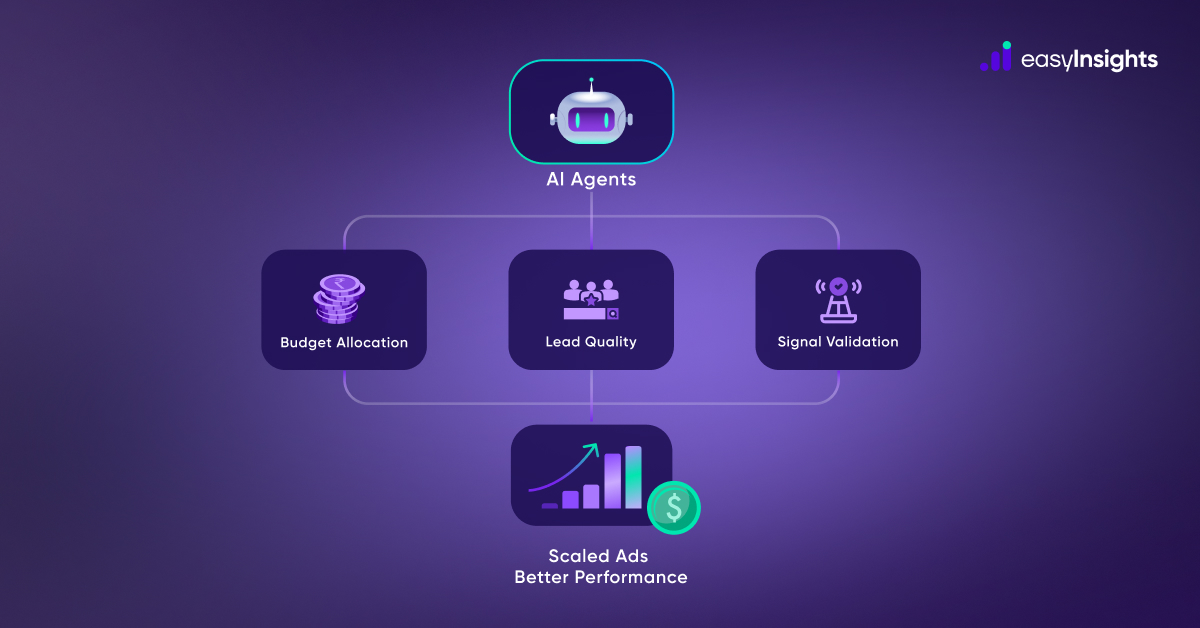
EasyInsights replaces outdated, rule-based lead scoring with intelligent AI that actually understands which leads will buy.
What It Does:
- Analyzes thousands of signals – Not just page views, but behavior patterns, timing, and intent across all channels
- Learns and adapts continuously – Gets smarter over time by learning from your actual conversion patterns (unlike static rules that never change)
- Grades leads in real-time – Instantly assigns A, B, C, D grades based on how well leads fit your ideal customer profile
- Combines fit + engagement – Creates prioritization matrices (like A1 = perfect fit + highly engaged) so sales knows exactly who to call first
- Integrates with your CRM – Seamlessly connects with your existing tools to provide a 360-degree view
Conclusion — The Future of Lead Qualification
Lead grading, when powered by AI, offers a smarter, faster, and more accurate way to identify high-potential prospects. While traditional rule-based scoring has been foundational, it simply can’t keep pace with complex buyer journeys and real-time data.
AI transforms lead qualification from static guesswork into strategic prioritisation — driving higher conversions, better sales efficiency, and more revenue.
If you’re still relying solely on manual rules, now’s the time to explore AI-powered lead grading.
Book a Demo with EasyInsights and improve your lead grading!