Ever launched a campaign that looked perfect on paper, great creatives, solid audience targeting, strong budget-yet the results still felt… off?
You’re not alone. Many marketers notice the same pattern: campaign AI keeps serving ads to people who click but never buy, engage but never convert, or show interest but take no action. It almost feels like you’ve seen this play out before-again and again – like a déjà vu loop of wasted spend and disappointing results.
The truth is, the AI isn’t “wrong.” It’s simply learning from the signals we feed it. And when those signals are broken, missing, or misleading, the algorithm naturally chases the wrong people.
In this blog, we’ll explain why campaign AI sometimes targets the wrong people and how you can teach it using real, accurate conversion data so your ads perform much better.
Jump ahead to:
The Hidden Reason Campaign AI Targets the Wrong People
Ad platforms like Google and Meta use machine learning algorithms to optimize campaign performance. These algorithms look for patterns (in user behavior, contexts, time of day, device, and more) and constantly receive feedback in the form of conversion data. Based on this feedback, the algorithm learns which kinds of users are more likely to convert and starts bidding higher or serving more ads to them.
For example, Google’s Smart Bidding uses auction-time bidding to evaluate each auction individually – it considers device type, location, time of day, and more to predict which user is most likely to convert.
When the algorithm gets good, clean data about who actually converts, it optimizes very effectively.
Why Bad Optimization Signals Lead to Wrong Outcomes
If the algorithm is learning from are wrong, missing, or noisy, the learning becomes skewed:
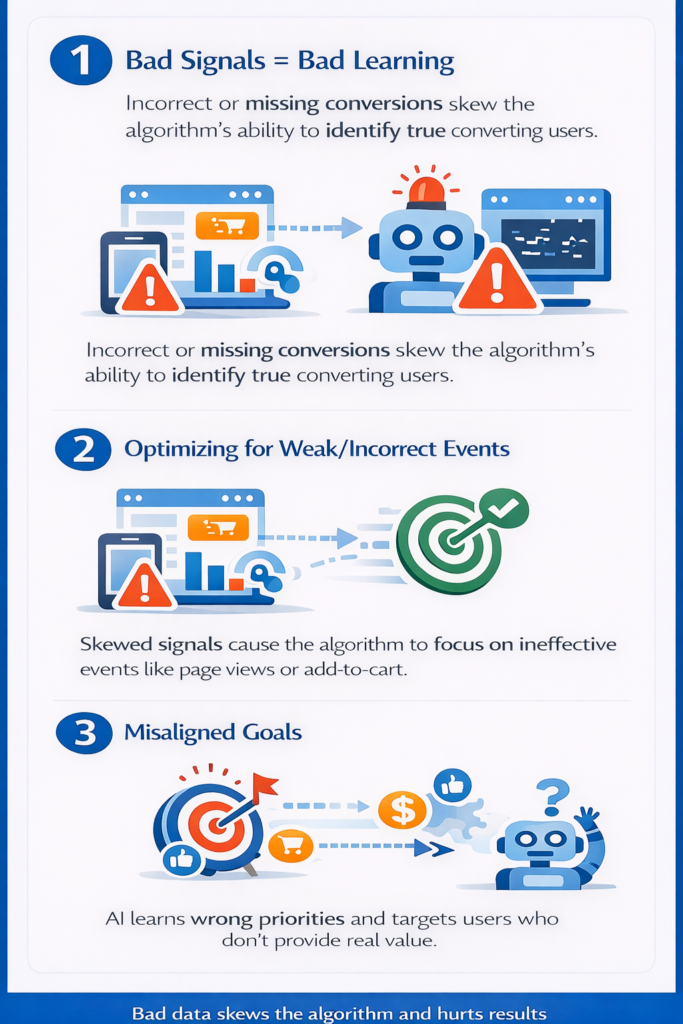
- Bad signals = bad learning: If conversions are wrongly reported (or not reported), the algorithm doesn’t learn who the real converters are.
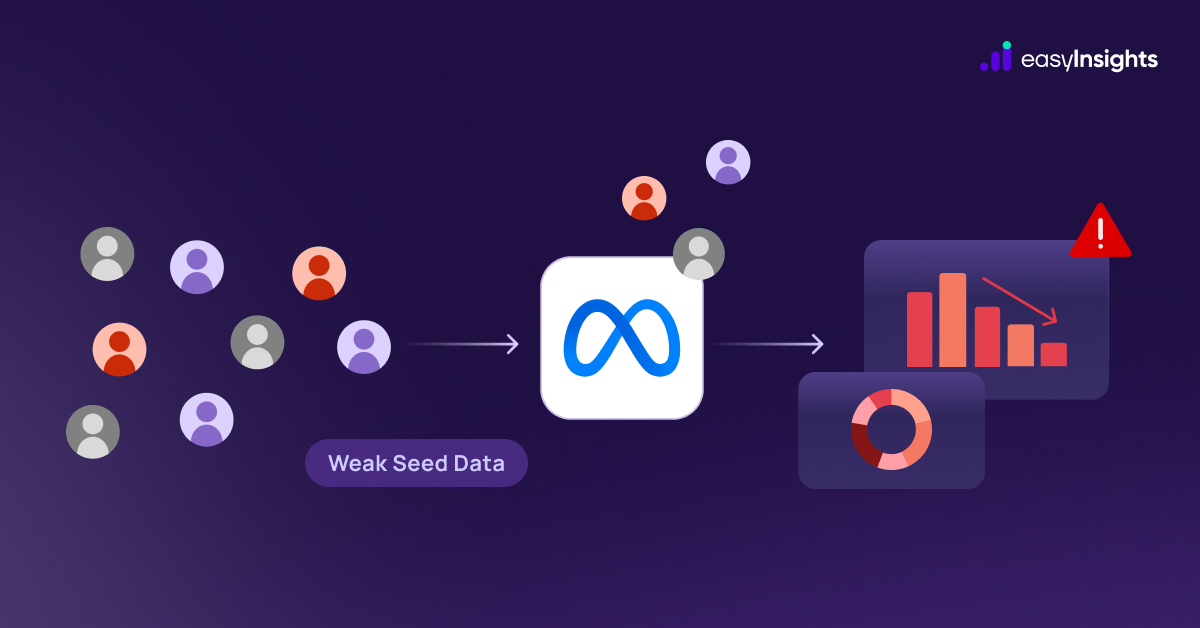
- Optimization on weak/incorrect events: Instead of optimizing for “actual purchase,” it might optimize for weaker events (like page views or add-to-cart) if those are the only ones recorded properly.
- Misaligned goals: The algorithm draws a correlation between the “conversion” events it sees and users, but if those are not the true business goals, it can target users who don’t actually deliver value.
Problems: Incorrect Conversion Data
Here’s a breakdown of common issues and how they distort algorithmic learning:
- Pixel Issues
- If your tracking pixel is broken, firing improperly, or duplicated, conversion events may not be recorded correctly. This disrupts the feedback loop.
- If your tracking pixel is broken, firing improperly, or duplicated, conversion events may not be recorded correctly. This disrupts the feedback loop.
- Offline Sales Not Tracked
- On Meta, this is a well-known blind spot: if offline conversions aren’t synced, the platform will underreport, skew ROAS, and send bad optimization signals.
- Sales may happen after a click or phone call, but if they’re not fed back into the system, the AI doesn’t know those users were valuable.
- On Meta, this is a well-known blind spot: if offline conversions aren’t synced, the platform will underreport, skew ROAS, and send bad optimization signals.
- Partial Funnel Events
- Sometimes, only top-of-funnel events (like “add-to-cart” or “view-content”) are tracked, while bottom-funnel events (like “purchase”) are not.
- This means the algorithm might overly optimize for the “easier” events, not the ones that matter for business.
- Sometimes, only top-of-funnel events (like “add-to-cart” or “view-content”) are tracked, while bottom-funnel events (like “purchase”) are not.
- Under-reporting / Over-reporting
- If tracking is duplicated (e.g., same event fired twice), conversions are over-reported, and the algorithm thinks it’s doing better than it is.
- If events are missed, conversions are under-reported, and the algorithm thinks the campaign is underperforming.
- If tracking is duplicated (e.g., same event fired twice), conversions are over-reported, and the algorithm thinks it’s doing better than it is.
- Poor Match Rates
- When matching offline data back to ad platforms (such as CRM data to Meta or Google), if the identifiers (like user IDs, email hashes, timestamps) don’t align well, many conversions are dropped or mismatched.
- This causes a lower “signal strength” and weaker learning for the algorithm.
- When matching offline data back to ad platforms (such as CRM data to Meta or Google), if the identifiers (like user IDs, email hashes, timestamps) don’t align well, many conversions are dropped or mismatched.
Common Signal Loss & Misattribution Issues
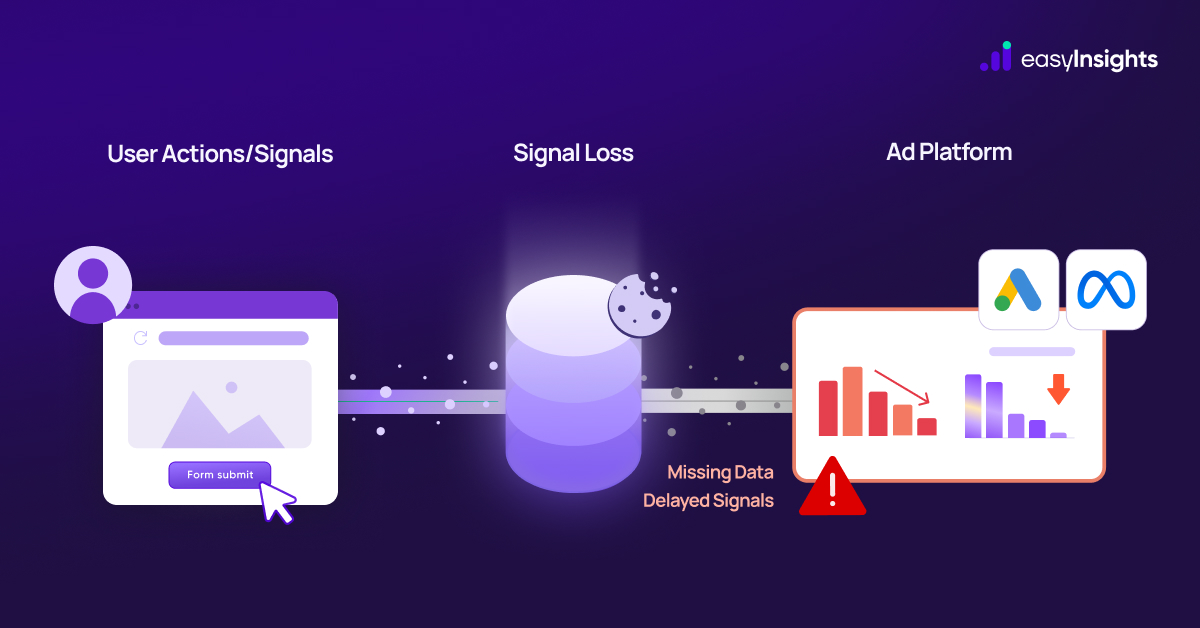
When running ads, the biggest reason campaign AI targets the wrong people is that it never receives the full or correct data about who actually converted. This problem is called signal loss. When the algorithm gets incomplete or misleading signals, it learns the wrong patterns and starts optimizing toward low-quality audiences. Here’s how the major issues usually happen:
1. Missing Click IDs (gclid, fbclid, etc.) – Every platform attaches a unique ID to each click. If these IDs are missing due to redirects, UTMs breaking, or landing page issues:
- Conversions cannot be tied back to the original click
- Platforms assume no conversion happened
- Campaign AI learns nothing about the real buyer
This causes the algorithm to continue targeting broad users who clicked, not those who converted.
2. Dropped Events – Events get dropped when:
- Browser blocks tracking
- Users reload or bounce quickly
- Network issues occur
- Pixel fails to fire
- Page loads too slowly
When purchase or lead events don’t fire, platforms think those users never converted; they never learn who the actual high-value users are.
3. Incomplete Server-Side Events (CAPI Issues) – Even with server-side tracking like – Meta CAPI, Google Enhanced Conversions, TikTok Events API. Events can still become incomplete due to:
- Missing user identifiers
- Poor hashing
- Incorrect timestamp
- Wrong event schema
- Missing deduplication keys
This leads to unmatched conversions, meaning the platform receives the data but cannot connect it to a real ad click.
4. Platform-Specific Limitations (Meta, Google Ads, TikTok, etc.): Each platform has constraints that worsen signal loss:
Meta
- Short attribution window (7-day click / 1-day view)
- Strict match rate requirements
- Heavy privacy restrictions after ATT
- Offline conversions are often under-reported
Google Ads
- Requires gclid or enhanced conversions
- Delayed reporting for some event types
- Strict setup for offline conversion uploads
TikTok Ads
- Limited data for post-click attribution
- Weaker matching capabilities compared to Meta
- Requires precise event mapping through the API
These limitations mean even accurate conversions can be missed or misattributed.
Also read: Server-Side Tracking Explained: GTM vs. True Server-Side Tracking
Real-World Impact: When AI Gets It Wrong
When campaign AI is trained on incomplete or incorrect data, the effects are visible almost immediately in performance. Instead of improving results, the algorithm slowly drifts toward audiences that look active on paper but don’t actually buy. Here’s what happens when AI learns from the wrong signals:
1. Higher CAC (Customer Acquisition Cost)
Because the algorithm is targeting people who are unlikely to convert, you end up paying more to acquire each customer. The system wastes budget on low-intent users, broad lookalikes, or people who only engage but never purchase. Every wrong signal pushes CAC up further.
2. Poor ROAS
When the AI is optimized toward the wrong goals or inaccurate conversion events, you see fewer real purchases and less revenue. Even if clicks and traffic improve, the return stays low because the algorithm isn’t reaching true buyers. ROAS drops, and scaling becomes impossible.
3. Learning Phase Resets
Bad or missing data triggers frequent learning-phase resets. This means the algorithm constantly tries to “relearn” who the ideal customer is – but because it doesn’t get clean signals, it never fully stabilizes. You end up stuck in a loop of unstable campaigns, fluctuating metrics, and unpredictable performance.
4. Audience Quality Drops
AI begins to prioritize users who are cheap to reach, not users who actually convert.
This leads to:
- Broader, less relevant audiences
- Low-value traffic
- Poor purchase intent
- More “engagers” and fewer “buyers”
The audience slowly becomes diluted, and campaign efficiency collapses.
Why Conversion Quality Matters More Than Conversion Quantity
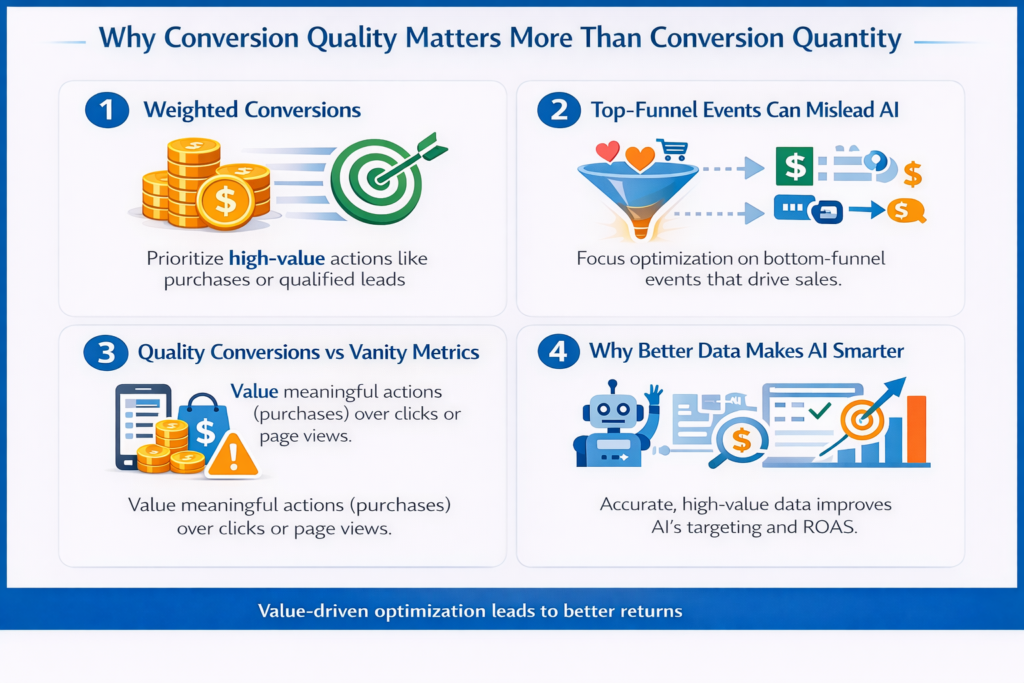
1. Weighted Conversions
Not all conversions have the same value. High-value actions like purchases or qualified leads should be prioritized. Weighted conversions tell the algorithm which events truly matter, helping bidding strategies (like Google’s Target ROAS) focus on revenue, not just volume.
2. Top-Funnel Events Can Mislead AI
Events like “view content” or “add to cart” are easy to generate but don’t always lead to sales. If you optimize only for these, the AI ends up chasing users who engage lightly but never buy. A clear event hierarchy ensures the algorithm focuses on bottom-funnel actions that impact revenue.
3. Quality Conversions vs Vanity Metrics
Vanity metrics = clicks, page views, and add-to-cart.
Quality conversions = purchases, qualified leads, repeat buyers, high-LTV users.
Optimization should be based on quality, not just quantity.
4. Why Better Data Makes AI Smarter
Feeding accurate, high-value conversions into the system makes AI targeting sharper.
Value-based bidding works best when meaningful events are tracked cleanly and consistently.
Better signal → better predictions → better ROAS.
How EasyInsights can help
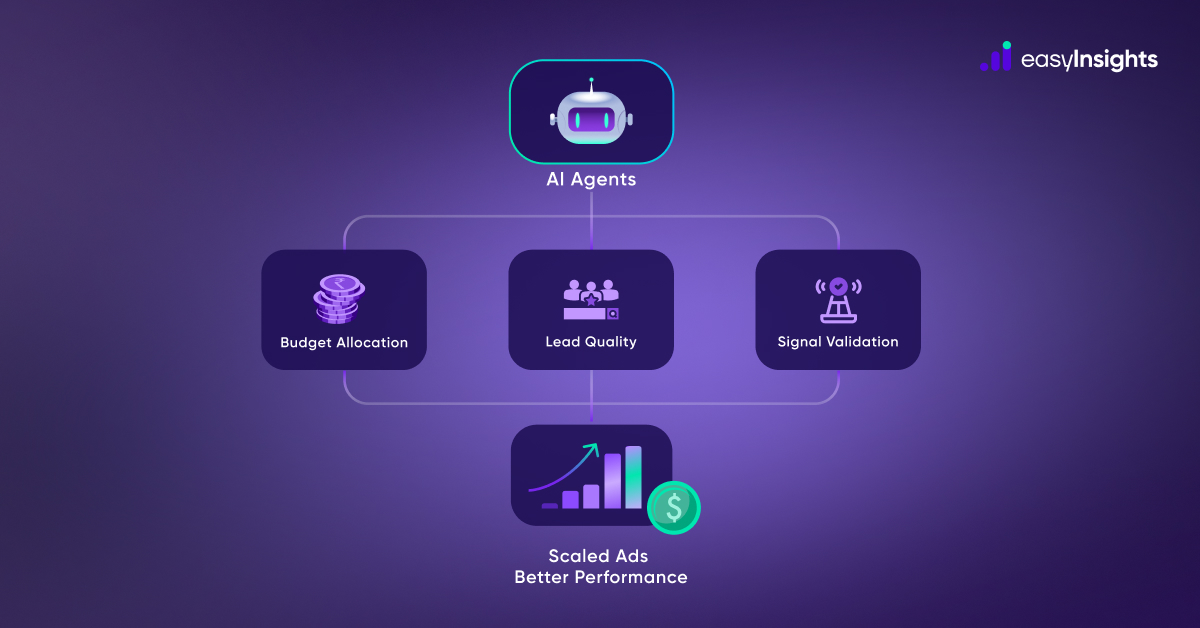
EasyInsights fixes the core reason CAC rises, broken or incomplete signals. It makes your entire data pipeline clean, transparent, and optimisation-ready – so CAC drops and ROAS improves. EasyInsights instantly detects:
1. Automated Signal Health Monitoring
2. Identity Resolution for Higher Match Rates
3. Full-Funnel CAPI Standardization
- Clean browser + server deduplication
- Accurate purchase values
- Standard + custom events
- Unified event schema across platforms
This gives ad platforms high-quality, consistent signals to optimize on.
4. Offline + CRM Event Activation
EasyInsights connects your CRM – HubSpot, Shopify, Offline conversions and pushes these back to Meta/Google, training AI on real revenue – not vanity events.
Conclusion
Campaign AI targets the wrong people when it’s trained on weak or incomplete signals. But once you feed it clean, high-quality conversion events, the algorithm quickly shifts toward real buyers – lowering CAC and improving ROAS. Fix the data, and your targeting automatically improves.
To uncover hidden signal loss and train your campaigns with accurate, revenue-focused data.
Book a demo with EasyInsights today!