Marketing teams used to spend their time iterating creatives and scaling winning funnels. Today, too many are trapped in a loop of debugging pixels, troubleshooting attribution, and patching broken event streams – and that’s eating into growth. The problem isn’t creativity or strategy; it’s data reliability. Without clean, consistent signals, algorithms can’t learn, reports lie, and scaling becomes guesswork.
Below, I explain why tracking problems persist, how they cost you money, and – crucially – how automation and better first-party data pipelines let you stop firefighting and start growing.
Jump ahead to:
The Tracking Problem is Bigger Than You Think
Privacy changes, more complex martech stacks, and fragmented customer journeys have created a perfect storm for tracking failures. Since Apple’s iOS 14.5 App Tracking Transparency rollout, addressable audiences and device-level signals shrank considerably – researchers estimate opt-in rates and audience visibility vary widely, leaving a significant share of users unidentifiable to advertisers. This reduction in observable signals has made conversion measurement and audience building far harder.
Poor data quality compounds the problem. Gartner estimated that poor data quality costs organizations millions annually, underscoring that messy customer records are not just a reporting headache – they’re a business risk. When identifiers are duplicated, misformatted, or missing, platforms like Meta can’t match users reliably, and every campaign optimization gets noisier.
Also read: The Evolution of Apple’s SKAdNetwork (SKAN)
The Problem: Marketers Are Spending More Time Fixing Tracking Than Growing Revenue
Facebook warns iOS ad performance is underreported
- Meta themselves have stated that iOS conversions are being underreported because of Apple’s privacy changes.
Marketing & measuring after iOS privacy (analysis of attribution gaps)
- Discusses how App Tracking Transparency (ATT) breaks deterministic tracking and affects multi-touch attribution.
Meta Ads in the post-iOS14 era
- Explains how attribution windows changed, and how platforms are reconciling data with new measurement methods (like CAPI) to address undercounting.
Digital Marketing in a Post-iOS14.5 world
- Details how conversion windows were shortened, how ad reporting is delayed, and how event limits (8 conversions per domain) make optimisation harder.
iOS 14 Attribution Solutions for E-commerce
- Deep dive into how ecommerce businesses are responding – more reliance on modelled or aggregated data, first-party data, and server-side tracking.
Preparing for iOS 14’s Effects – A Guide for Marketing Leaders
- A more strategic guide: how to estimate unreported conversions, reset conversion goals, and adapt to the new, more limited attribution model.
Revenue Attribution on iOS 14 using Conversion Values
- For a more technical/academic perspective: shows how apps use “conversion values” (SKAdNetwork) to attribute revenue, and the challenges therein.
Reclaiming Conversion Data After iOS 14.5+
- Practical post on how to recover lost conversions via server-side tracking (Conversion API), first-party data, and more.
Also Read: Apple’s iOS 14 Update: Its Impact on Facebook Ad Performance
Why Complex Martech Stacks = More Failure Points
1. Pixels, Tags, APIs, UTMs – Too Many Moving Parts
- Every new tool you add (analytics, ads, CDP, experiment tool) typically comes with its own tracking scripts/tags/pixels. Managing all of them increases risk.
- These multiple tags often lead to configuration errors: wrong triggers, duplicate tags, or old tags still firing.
- As Monita explains, tag or pixel failures often happen because developers make site changes (HTML/CSS/JS) that break tracking, and they aren’t always aligned with the martech team.
- Over-reliance on APIs (for data integration) means that if any API connection fails, data flow breaks – leading to dark spots in your reporting.
- The 2025 State of Your Stack report found that data integration is the top tech challenge for many companies.
2. Multi-Domain Workflows & Cross-Platform Inconsistencies
- When your website has multiple domains (e.g., main site, checkout subdomain, third-party payment page), tracking continuity becomes hard – if cross-domain tracking isn’t configured well, user sessions break and conversions get misattributed.
- In e-commerce setups, especially with third-party gateways like PayPal or Stripe, many businesses lose attribution or session continuity due to poor cross-domain configuration.
- Martech stacks often consist of tools from different vendors, each with slightly different ways of measuring or tagging events. This mismatch can lead to data silos or inconsistent metrics.
3. Manual Fixes Slow Everything Down (and Add Risk)
- Debugging tracking issues (broken tags, duplicate pixels, incorrect event triggers) is often a manual, time-consuming process.
- High developer dependency: marketers rely on dev teams for even small changes; this causes delays, especially if the dev team is busy or not well-aligned on analytics priorities.
- Pixel firing on development/staging environments is a surprisingly common issue. Without proper gating, marketing pixels can fire on dev sites, polluting your data and creating false conversions.
4. Strategic & Operational Risks
- According to Martech Intents, many martech failures come not just from tech issues, but from poor integration strategy and tool overload. Too many tools, poorly aligned, lead to inefficiencies.
- The State of Your Stack survey (2025) also highlights that the lack of skilled resources and tool complexity are major concerns.
5. Real-World Consequences
- Poorly maintained tags have bad data. If key conversion pages don’t have the right tags, you’re blind to real performance.
- In some cases, ad pixels collect data from irrelevant or unexpected domains, skewing your audiences and hurting campaign optimization.
Why This Matters for Marketers & Growth Teams
- Slower Scaling: With frequent manual fixes, decisions get delayed. You can’t scale aggressively if you don’t trust your data.
- Wasted Resources: An Overcomplex stack means you spend more dev hours on tracking than on growth.
- Risk of Inaccurate Attribution: Broken workflows and misfires lead to bad attribution, which impacts budget allocation.
- Operational Fragility: Without resilience (documentation, cross-training), your stack is vulnerable if a key person leaves or a tool fails.
How Tracking Breaks (And Why It Keeps Happening)
Multi-Domain Checkouts
1. Payment Pages Breaking Cookie Tracking
Most e-commerce stores use third-party checkout pages such as Razorpay, PayPal, Stripe, Shopify Checkout, or custom subdomains. When a shopper moves from your main domain → checkout domain → payment gateway → thank-you page, the browser often treats each as a different “site.”
Because cookies are domain-specific, analytics and ad platforms lose their ability to follow the same user across the journey.
2. Lost Attribution Paths
If cross-domain tracking isn’t set up perfectly (GA4, Meta Pixel, UTMs, and click IDs), users come back to the site after payment as “new” visitors.
This leads to:
- Lost conversions
- Drop in attributed ROAS
- Platform conflicts (Meta reports more conversions than GA4, or vice versa)
Misconfigured Pixel & CAPI
1. Duplicated Events
Pixels and Conversion API running together often cause double-firing when event rules overlap.This results in platforms receiving the same event twice – corrupting ROAS, signal quality, and optimization. Symptoms include:
- AddToCart reported twice
- The purchase event is firing twice
- Conversion spikes with no revenue
2. Missing or Incorrect Parameters
Even if the event fires, it may be missing key metadata – such as:
- event_id
- content_ids
- value
- currency
- user identifiers (email, phone, external ID)
When these parameters don’t match between client-side pixel and server-side CAPI, Meta cannot deduplicate events, causing attribution gaps
3. Server–Client Mismatch
When server-side CAPI events are misaligned with client pixel events, Meta often discards or misattributes them. This mismatch happens due to:
- Wrong timestamps
- Wrong event_id
- Events firing at different funnel positions
- Server events not matching the browser path
Also Read: How to Use Client Side and Server Side Tracking together
The Real Cost of Broken Tracking
When tracking breaks, it doesn’t just cause reporting errors – it directly impacts revenue, optimization, and your ability to scale. In the post-iOS14 era, broken tracking is one of the biggest hidden expenses for performance marketers.
1. Wasted Ad Spend
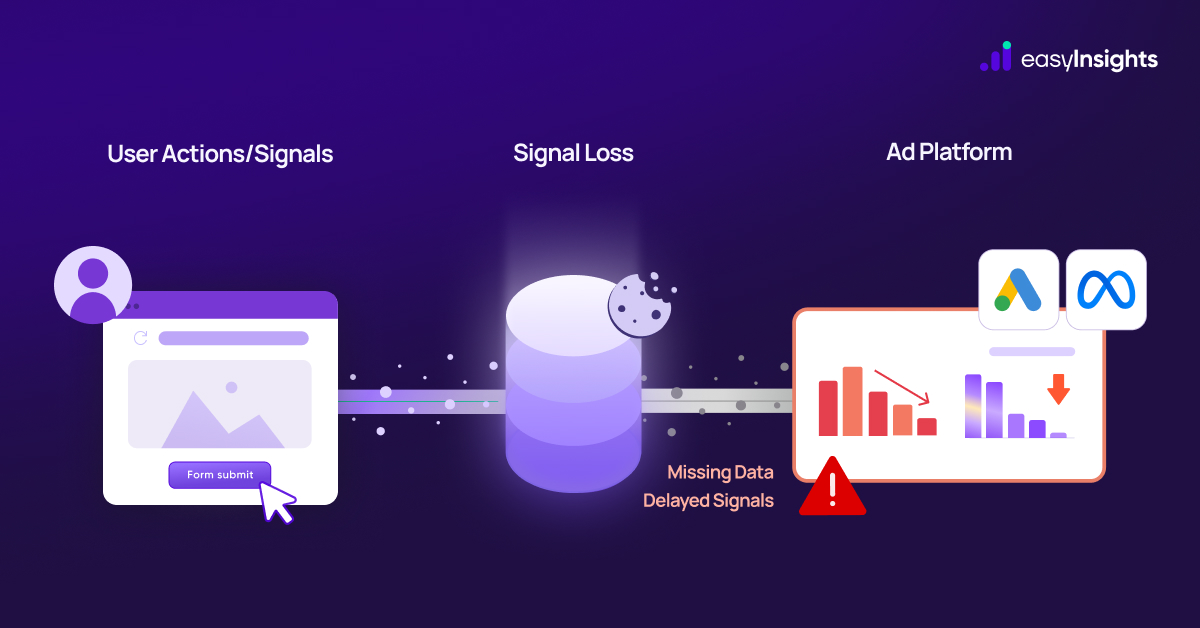
Without accurate tracking, platforms like Meta and Google don’t receive the real conversion signals they need to optimize campaigns. When conversions are underreported, platforms end up targeting the wrong audiences or overspending on low-value segments.
2. Wrong Optimization Decisions
When the data is wrong, the decisions are wrong.
Underreported conversions make certain campaigns or ad sets look “bad,” even when they’re actually profitable.
Examples:
- Marketers pause high-performing campaigns because they “look unprofitable” inside Ads Manager.
- Budgets shift away from profitable audiences to less-effective ones because signals are incomplete.
How EasyInsights Automates Data Reliability
Event Deduplication & Standardization: Fixes duplicate events, normalizes naming, and ensures clean, consistent conversion data across all platforms.
Identity Resolution (CRM + Web + Offline): Stitches customer identifiers from multiple systems into one profile, boosting match rates and optimization accuracy.
Real-Time Error Detection: Instant alerts for drops in conversion tracking, API failures, UTM issues, and multi-domain tracking breaks.
Better Match Rates = Better Optimization: Enriched, clean, standardized signals → higher match rates → lower CPA, stable ROAS, and faster scaling.
Additional read: How to use server side tracking for better conversion tracking
Conclusion
Marketers shouldn’t be spending 50% of their time fixing tracking issues-broken attribution, missing conversions, and constant debugging drain growth time and ad spend.
The only way to scale consistently in today’s privacy-first world is through clean, automated, reliable data – not manual fixes.
Let EasyInsights automate your tracking, fix your data, and power stronger optimization so you can focus on what actually matters: growth.
Book a demo to know more