You spend your day optimizing – cutting costs, boosting conversions, and proving your marketing is working. You A/B test, tweak bids, and celebrate every new purchase your dashboard shows.
But here’s the hard truth: your numbers might be wrong.
Most marketing setups suffer from Duplicate Events.
It sounds technical, but the impact is simple and damaging:
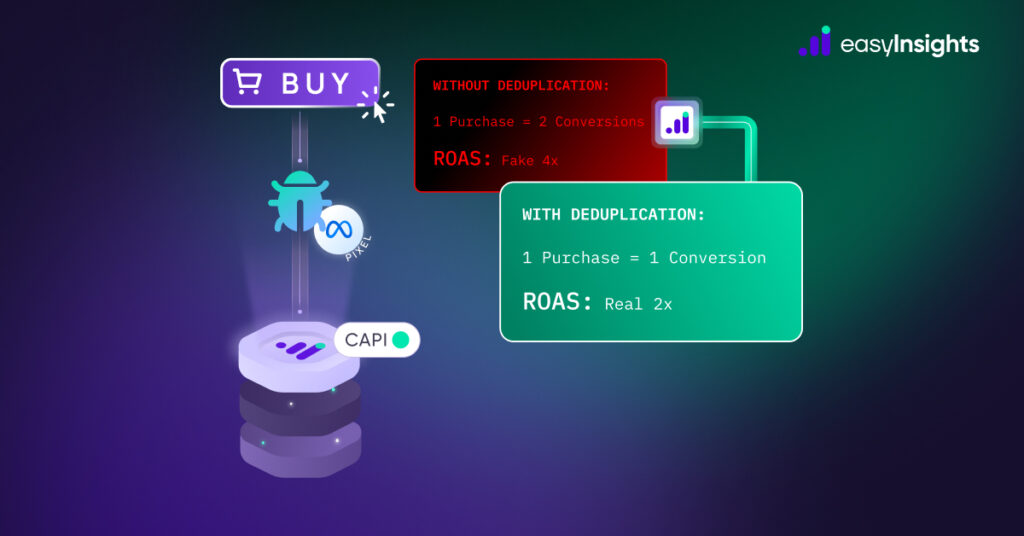
One customer clicks “Buy Now”… and your system logs it twice. Sometimes three times.
It’s like driving with a speedometer that shows double your real speed. You think you’re winning, but you’re actually wasting fuel, making bad decisions, and heading in the wrong direction.
Duplicate events cause:
- ROAS to look amazing – until finance checks the real revenue.
- Wrong campaigns to get scaled, wasting budget.
- Algorithms to learn from fake signals and optimize for phantom conversions.
And the cost is huge. Poor data quality drains businesses an average of $12.9M per year (Gartner),(Forbes).
Over 40% of companies suspect their customer data is inaccurate (Experian).
Jump ahead to:
What Are Duplicate Events in Meta Ads
Duplicate events happen when Meta counts the same user action more than once, because it’s recorded via multiple paths – typically:
- Browser-side (Pixel) and Server-side (Conversions API, or CAPI)
- Or, sometimes, from repeated browser triggers (e.g., two Pixel scripts both fire)
- Without Meta recognizing they’re actually the same event
How Meta Detects Duplicates
Meta uses a deduplication system based on a few core identifiers:
- event_name – The name of the event must match (e.g., “Purchase”)
- event_id – A unique ID that should be shared between the browser and server version of the event.
- Time window – The events should arrive within a short timeframe for Meta to assume they represent the same action.
If Meta can match on those, it will treat them as duplicates (i.e., only count one).
If not – e.g., if the event_id is missing, incorrect, or different – Meta often ends up double-counting.
What Is Event Deduplication – And Why It Matters
Accurate tracking is the backbone of profitable advertising. But after iOS 14, browser tracking weakened, making Conversion API (CAPI) essential for reliable measurement.
If you haven’t enabled CAPI yet, you’re already losing clarity in your data. But with CAPI comes a common issue: event deduplication.
When both the pixel (browser) and CAPI (server) send the same event, it can be counted twice.
One real purchase → reported as two.
A “ROAS 4” suddenly becomes a “ROAS 2.”
Deduplication ensures Meta knows both signals refer to the same event, keeping your reporting clean, accurate, and usable.
The hidden damage of duplicates
Recent reports shows that duplicated in-app reporting can reduce IAP (in-app purchase) accuracy by as much as 10% due to connectivity and reporting retries – that’s not a rounding error; it changes your LTV, ROAS, and cohort analysis.
Duplicate events produce three predictable outcomes:
- Inflated conversions and ROAS miscalculation. If a purchase is recorded twice, attribution systems can over-credit channels and strategies that didn’t actually perform better. Platforms like Meta and GA4 have deduplication tools, but they only work when configured correctly. Facebook
- Bad bidding & wasted ad spend. Automated bidding algorithms optimize for events. If you feed them duplicated conversions, the optimizer chases an illusion – often increasing spend for marginal or negative return.
- Poor business decisions. Duplicate or messy data scales into forecasting errors, poor customer lifecycle decisions, and misallocated resources. The estimated business cost of poor data quality is massive: studies and industry write-ups peg losses in the hundreds of billions to trillions annually (commonly referenced figures include ~$611B and multi-trillion dollar estimates for bad data impact).Impactplus
How Duplicate Events Break Your Campaign Optimization
Duplicate events don’t just inflate numbers – they directly corrupt the signals your ad platforms use to optimize your campaigns, causing your costs to rise while performance drops. Here’s how:

1. Wrong Data = Wrong Optimization Decisions
Platforms like Meta, Google, TikTok, and Snap run on machine-learning optimization models.
These models depend entirely on the accuracy of the events you send – purchase, lead, add to cart, subscription, registration, etc.
When duplicates flow in:
- The algorithm sees more “successes” than actually happened.
- It assumes your campaign, ad set, or targeting is working better than it is.
- It shifts more budget to the wrong audiences, creatives, and placements.
Result: Higher CPMs + lower ROAS because the algorithm is chasing fake signals.
2. Bids Surge Because the System Thinks Conversion Rate is Higher
If an event is duplicated, the platform computes:
- Higher conversion volume
- Higher conversion rate
- Lower cost per conversion
=> Which triggers automatic bid increases, since the algorithm thinks you can afford stronger competition.
This leads to:
- Aggressive bidding
- Wasted budget
- Higher CPA and CAC
Even a 5-10% duplication rate can significantly alter automated bidding models – especially in low-volume accounts or high-value events.
3. Breaks Value-Based Optimization (VBO)
Value signals depend on accuracy.
If your revenue event fires twice (e.g., purchase of ₹5,000 fires twice), the algorithm thinks you made ₹10,000 revenue.
This causes:
- Overestimation of ROAS
- Overvaluing of audiences and segments
- Overspending on “high-value” customers who didn’t actually produce high value
For brands running VBO or tROAS campaigns, duplicate events can collapse the entire optimization logic.
4. Remarketing & Exclusion Lists Break
Duplicated events distort user journey signals:
- A user may appear as both “converted” and “not converted.”
- Or appear as “new purchaser” multiple times.
- Or be excluded from campaigns prematurely.
This means:
- Broken custom audiences
- Too-small or inaccurate remarketing pools
- Wrong exclusion lists
- Expensive retargeting inefficiency
For brands relying heavily on warm audiences, this is extremely costly.
5. Lower Signal Quality = Lower Ad Rank + Higher Costs
Ad platforms reward advertisers who send clean, deduplicated, reliable signals.
Duplicates reduce your signal quality score, leading to:
- Higher CPM
- Worse delivery
- Lower match quality
- Poorer optimization
- Reduced algorithmic trust
In performance marketing, lower signal quality = less efficient spend.
Additional reading: How to improve event match quality with the first party data
How to eliminate duplicate events
Below are prioritized, operational steps you can run through this week. Each is action-oriented and commonly used by analytics teams.
1) Start with detection (audit & baseline)
- Compare event counts across sources (pixel vs CAPI vs GA4 vs your server logs). Look for consistent overcounts on specific event names or time windows.
- Inspect DebugView, server logs, and your ad platforms’ Events Manager to spot identical timestamps or identical event payloads. Tools: GA4 DebugView, Meta Events Manager, server logs. Facebook
2) Implement a deduplication (event_id / transaction_id)
- Assign a single unique identifier per user action (e.g., event_id or transaction_id) and pass it with every event across all channels. Google recommends transaction IDs for purchases to let GA deduplicate duplicates; Meta’s CAPI/Pixel deduplication also relies on shared identifiers. This is the single most effective fix. Google
3) Ensure Your Server Never Processes the Same Event Twice
- Ensure your server won’t process the same event_id twice. Store recent event IDs and reject duplicates (or update rather than insert).It is essential when you retry failed requests.
4) Use platform deduplication features correctly
- Meta: use the event_id and the deduplication docs to map Pixel and CAPI events. GA4: send unique transaction_id for purchase dedupe. Read and follow both vendors’ guides; they handle duplicates only when you give them the keys. Facebook
5) Use de-duplication IDs via third-party tools
- Many platforms / integrations (e.g., tag managers, analytics tools) support generating or mapping event_id to avoid duplication.
- For example, EasyInsights.ai uses a unique de-duplication ID per event to make sure Meta doesn’t double-count.
How EasyInsights Helps Fix Duplicate Events
EasyInsights ensures clean, reliable conversion data by eliminating duplicate events at the source:
- One unified event pipeline → no double firing across Pixel, CAPI, CRM, or backend.
- Automatic event_id / transaction_id generation → EasyInsights generates a unique de-duplication ID for every event, ensuring Meta, Google, TikTok, and other platforms correctly recognize and merge duplicate browser and server signals.
- Eliminate duplicate events → EasyInsights ensures your server never sends the same event twice – even during retries or network failures. Every event_id is checked against a recent-events store, and duplicates are safely ignored.
- Real-time event health monitoring → flags mismatch, overcounts, and duplication issues instantly.
- Platform-native integrations → accurate dedupe across Meta CAPI, Google EC, TikTok API, and more.
Result: clean signals, better optimization, cheaper CPMs, and higher ROAS.
Conclusion
Duplicate events quietly sabotage your campaigns, distort your metrics, and mislead your algorithms. But the fix isn’t complicated – it’s systematic.
With strong deduplication practices and the right infrastructure, you reclaim full control over your optimization engine.
And EasyInsights gives you the easiest, fastest, most reliable way to eliminate duplicates across all channels – so your campaigns run on clean data, your algorithms make the right decisions, and your revenue grows predictably.
Fix your Event Event duplicates with EasyInsights – Book a demo now
Additional reading: How to Use First-Party Events on Meta