B2B brands have invested millions into personalization – intent data tools, ABM platforms, predictive scoring, customer data pipelines, and more. Yet most organizations still see disappointing results: engagement drops, conversion remains flat, outbound response rates decline, and sales teams complain that “marketing leads aren’t relevant.”
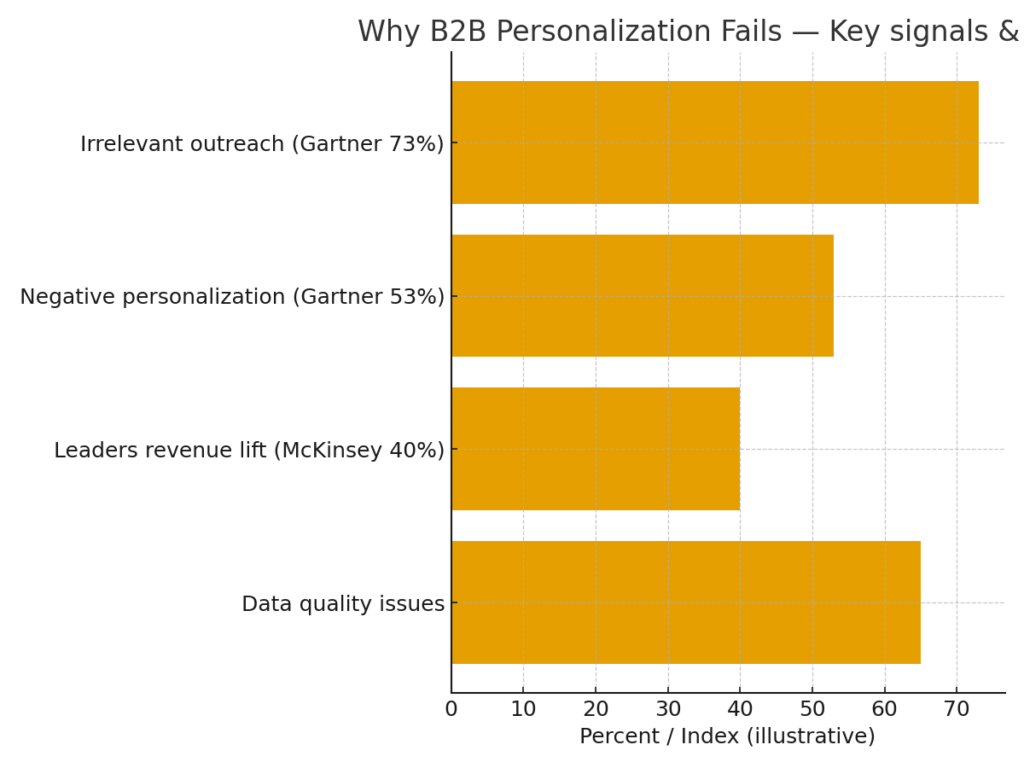
The problem isn’t that personalization doesn’t work. It does – exceptionally well – when done right. McKinsey found that companies that excel at personalization generate 40% more revenue from those efforts compared to average performers.
So why is it failing for so many B2B companies?
This article breaks down the real reasons personalization fails, backed by recent research – and offers a practical, step-by-step roadmap to fix it in 2025.
Jump ahead to:
Why This Matters Now
Recent Gartner research shows a worrying trend: 53% of customers experienced negative outcomes from personalization, which led to regret and loss of trust.
Even worse, 73% of B2B buyers avoid vendors who send irrelevant outreach.
One irrelevant email can get your brand filtered out of a deal cycle before you even realize it.
As buying cycles become longer and more digital-first, the quality of your personalization can determine whether you’re even considered in the shortlisting stage.
The Real Reasons Why B2B Personalization Fails
Your data is fragmented – and often wrong
Poor data quality is the #1 cause of personalization failure.
Most B2B organizations have:
- Duplicate contacts
- Mismatched job titles
- Incomplete data
- Siloed data across CRM, MAP, billing, and product systems
- Missing or unreliable intent signals
Industry evaluations consistently rank bad data and poor governance as the biggest blockers to personalization success.
You personalize to individuals instead of buying committees
B2B buying is multi-threaded. Deals involve:
- Procurement
- Finance
- End users
- Technical gatekeepers
- Executive sponsors
Yet most personalization targets a single lead as if they were the buyer.
This creates messaging that feels misaligned – the CFO receives technical product content, the developer receives pricing content, and the VP receives onboarding material.
Your personalization is too shallow
Most companies personalize by:
- Inserting firstname
- Inserting company name
- Basic industry segmentation
- A “recommended feature” based on a downloaded ebook
This kind of surface-level personalization does not create value.
Personalization only works when it meaningfully changes the relevance of the message – not the cosmetics.
Evidence: The Stats That Prove the Problem
Here are the most important recent findings:
| 40% more revenue for companies that excel at personalization | McKinsey |
| 53% of customers experience negative personalization outcomes | Gartner 2025 |
| 73% of B2B buyers avoid vendors sending irrelevant messages | Gartner 2025 |
| 88% of marketers plan to increase visual content like infographics | HubSpot 2024 |
| Data quality identified as top personalization barrier | Equal Experts 2025 |
A Practical Roadmap to Fix B2B Personalization
Here is a realistic, phased approach that any B2B org can execute:
1. Pause low-performing outreach
Audit your campaigns. Pause segments with:
– <1% engagement
– High opt-out rates
– Irrelevant messaging compared to persona
This immediately protects brand trust.
2. Build a unified identity layer (1–3 months)
This is the foundation of advanced personalization. You need to stitch identity across:
- CRM
- Marketing automation
- Website analytics
- Product usage
- Support & success tools
- Billing systems
This enables “one profile per account” and “one profile per user” — eliminating conflicting signals.
Personalize for the buying committee
For your top ICP segments, build:
Persona matrix (role × buying stage)
| Persona | Awareness | Consideration | Decision |
|---|---|---|---|
| VP/Founder | Market trends | ROI, value proof | Pricing justification |
| Technical user | Pain points | Feature deep dives | Integration docs |
| Procurement | Compliance | Comparative value | Risk mitigation |
Measurement & optimization (ongoing)
Move beyond email engagement.
Measure personalization with revenue metrics:
- Influenced pipeline
- Deal velocity lift
- Higher win rates
- Improved retention/expansion
- Reduced time-to-value
- Lower friction in onboarding
Also measure negative signals:
- Opt-outs
- Spam complaints
- “This is not relevant” feedback
- Sales team pushback
This is the feedback loop that keeps personalization aligned with reality.
How EasyInsights Makes B2B Personalization Smarter
Personalization isn’t just about knowing who clicked an email-it’s about understanding all stakeholders, their behavior, and the signals they give across multiple channels. That’s where EasyInsights comes in.
Why EasyInsights Matters:
- Unify Your Data: Connect CRM, marketing automation, engagement metrics, and support data into one clear view. No more silos.
- Track Every Stakeholder: See which decision-makers are engaging with what content, so you can tailor outreach to each role.
- Real-Time Insights: Get instant alerts on account activity, intent signals, and engagement trends-helping sales and marketing act faster.
- Measure What Matters: Go beyond form fills and clicks. Track engagement by stakeholder, account progression, and deal velocity to know what drives decisions.
Conclusion
B2B personalization isn’t broken because the technology doesn’t exist-it’s broken when companies don’t account for how modern buying really happens. The key to success is simple:
- Understand all stakeholders and their unique needs
- Unify your data across marketing, sales, and support
- Align your teams around shared goals and KPIs
- Act fast using real-time signals and dynamic content
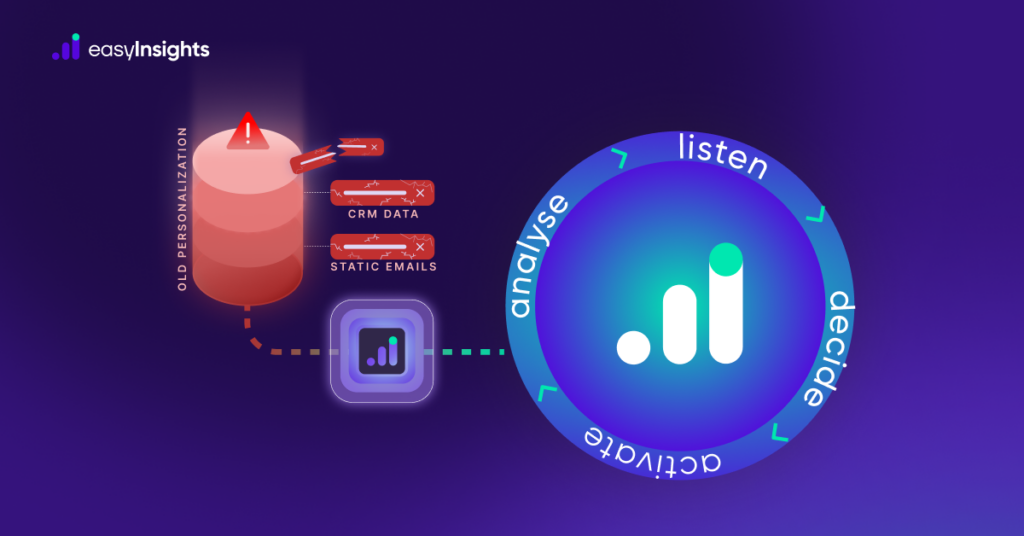
With the right framework-Listen, Decide, Activate, Analyze-and tools like EasyInsights to support your strategy, personalization stops being a one-off tactic and becomes a repeatable, scalable system that drives results.
Fix your data with EasyInsights – Book a demo.