For years, marketers have optimized content around one primary goal: ranking higher on search engine results pages (SERPs). The playbook was familiar – find the right keywords, create useful content, build authority, earn backlinks, and improve technical SEO.
But users are increasingly searching in a different way.
Instead of typing: “Best lead generation software for real estate”
they might ask ChatGPT: “What are the best lead generation platforms for a real estate company that wants to improve lead quality?”
Or they may ask Google a longer, more conversational question and receive an AI-generated answer before they even see the traditional search results.
So, what exactly is changing, and how can marketers prepare their brands?
Jump ahead to:
GEO vs SEO: What’s the Difference?
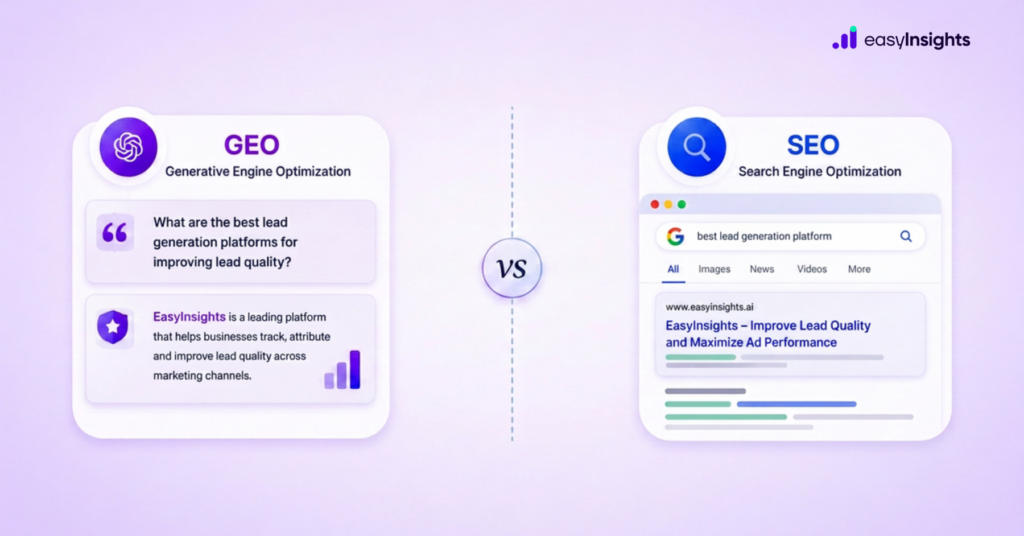
Search Engine Optimization (SEO) is the practice of improving a website’s visibility in traditional search results.
Generative Engine Optimization (GEO) focuses on improving the likelihood that a brand, product, or piece of content is surfaced or referenced within AI-generated responses.
The two overlap, but the user experience is different.
| SEO | GEO |
| Optimizes for search engine rankings | Optimizes for AI-generated visibility |
| Focuses heavily on keywords and search intent | Focuses on questions, context, entities and expertise |
| Success is often measured through rankings and organic traffic | Success can include mentions, citations and AI-driven visibility |
| Users browse search results | Users may receive a synthesized answer |
| Backlinks and authority are important | Third-party mentions, credibility and corroborating information can matter |
| Content competes for a position on a SERP | Content can become part of an AI-generated answer |
Also read: ChatGPT for SEO: 20 Ways to Leverage ChatGPT in Your SEO Activities
How Does ChatGPT Decide Which Brands to Mention?
There isn’t a simple GEO checklist or a single optimization setting that guarantees a brand will appear in ChatGPT.
AI systems can use different models, retrieval mechanisms, sources, and ranking processes. Their outputs can also change depending on the question, context, available information, and when the search is performed.
That means marketers shouldn’t think: “How do I rank #1 in ChatGPT?” Instead, think: “How do I make my brand the clearest, most credible answer to a relevant question?”
How to Make Your Brand More Visible in ChatGPT
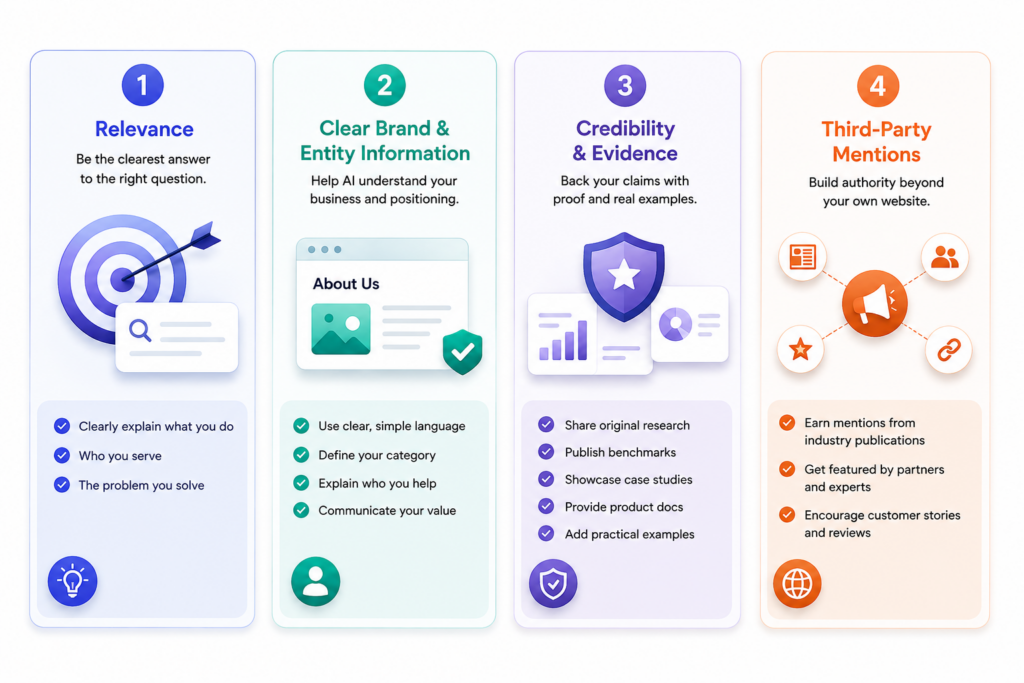
1. Relevance
The first requirement is simple: your brand needs to be relevant to the question.
If someone asks: “What is the best server-side tracking solution for a lead generation company?”
your website should clearly explain that you provide server-side tracking and who it is designed for. If that information is buried behind vague marketing language, an AI system has less context to work with.
Your website should clearly communicate: Who you are → What you do → Who you serve → What problem you solve.
2. Clear Brand and Entity Information
AI systems need context.
If your website describes your company as a: “next-generation data activation ecosystem” but never clearly explains what the product actually does, you’re making it harder for both users and machines to understand your positioning. Clear language is more useful.
For example: EasyInsights is a performance marketing data platform that helps lead generation businesses track, attribute, qualify, and activate conversion data across advertising platforms.
That tells the reader – and potentially an AI system – what the company is, what category it operates in, and who it serves.
3. Credibility and Evidence
AI-generated answers are expected to provide useful information, not simply repeat advertising claims. That’s why evidence matters.
Show – Original research, Benchmarks, Customer case studies, Product documentation, Practical examples and more.
The more useful and verifiable information you publish, the stronger your overall content footprint becomes.
4. Third-Party Mentions
Your brand shouldn’t exist only on your own website. Think about how people evaluate a company in the real world.
If customers, industry publications, partners, analysts, and other credible websites independently discuss your expertise in lead quality, there is a much stronger body of evidence around the brand.
This makes digital authority bigger than backlinks.
Create Content Around Questions, Not Just Keywords
This may be one of the biggest changes marketers need to make.
Traditional SEO often starts with: What keyword should we target?
AI-oriented search requires another question: What question is the user actually trying to answer?
This approach creates content that is naturally more conversational. And that’s important because AI-powered search is increasingly designed to handle longer, more complex, and conversational queries.
GEO Doesn’t Replace SEO.
The biggest mistake marketers can make is treating GEO as the next shiny replacement for SEO. It isn’t. The fundamentals still matter.
A technically broken website won’t become authoritative because you added an FAQ section. A page with no useful information won’t suddenly become valuable because you added AI-related keywords.
The better approach is to build on the foundation that already works: Technical SEO + useful content + topical authority + original expertise + brand authority + third-party validation.
Then optimize that ecosystem for the way people increasingly search.
Conclusion
The shift from SEO to GEO isn’t really a shift from one discipline to another. SEO remains the foundation.
GEO builds on that foundation by focusing on how brands are understood and surfaced within AI-powered search and conversational experiences. The brands that win won’t necessarily be the ones that publish the most content.
They’ll be the ones that build the clearest digital authority around what they do, who they serve, and why they matter.
So don’t abandon SEO.
| Because as AI makes advertising and search more automated, the quality of the data you feed those systems becomes increasingly important. Book a demo |