The line between human-created and AI-generated content is getting harder to see – but Google is making it easier to verify.
In May 2026, Google announced the expansion of its SynthID watermarking technology to Search, with Chrome support coming in the weeks that follow. For marketers who rely on visual content, paid media, and brand trust, this update carries real implications.
Jump ahead to:
What Is SynthID and Why Does It Matter?
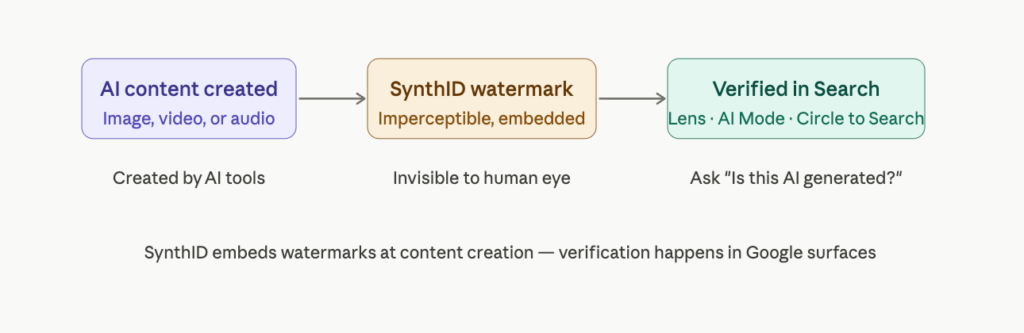
SynthID is Google’s AI watermarking technology, first introduced in 2023 for select Google Cloud customers. It works by embedding an imperceptible digital watermark into AI-generated content at the point of creation – invisible to the human eye, but detectable by Google’s verification tools.
Until now, SynthID verification was limited to the Gemini app for images, video, and audio. The latest update takes it mainstream: verification is now available directly in Google Search, through features like Lens, AI Mode, and Circle to Search. Users can simply ask, “Is this made with AI?” and get a verification result.
| Why this matters to marketers: Any visual asset you publish – product images, ad creatives, social graphics – can now be checked for AI origin by your audience, your clients, or Google itself. |
What’s New: A Three-Part Expansion
1. SynthID in Search and Chrome
Google has rolled out SynthID verification to Search today, with Chrome support planned in the coming weeks. This makes AI content detection a mainstream capability – available wherever people already search and browse, not just inside specialist apps.
2. C2PA Content Credentials
Alongside SynthID, Google is adding support for C2PA Content Credentials – an industry-wide standard that records how media was created and modified. This feature is launching first in the Gemini app, with a rollout to Search and Chrome planned over the coming months.
C2PA is significant because it goes beyond Google’s own ecosystem. It creates a common language for content provenance across publishers, platforms, and tools.
3. AI Content Detection API on Google Cloud
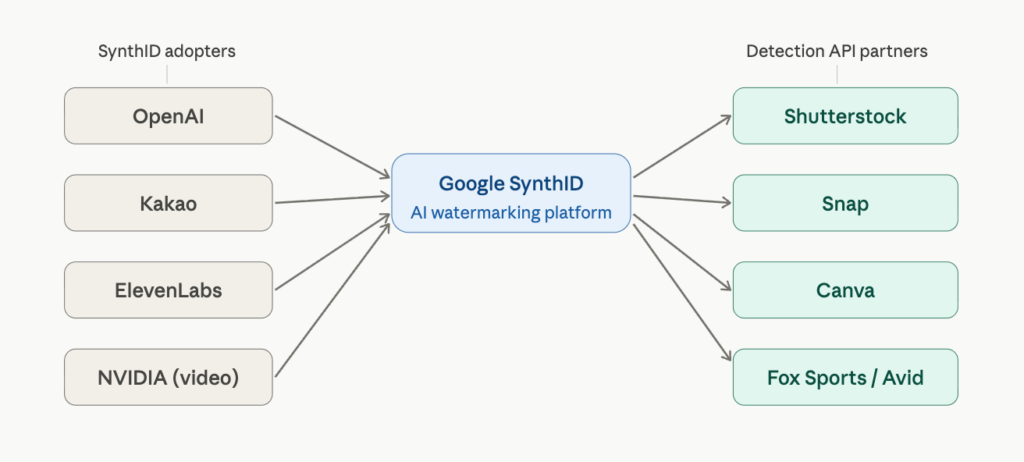
Google is launching a new AI Content Detection API on its Gemini Enterprise Agent Platform, initially available to a select group of partners. The API can detect AI-generated content from Google and other popular AI models – not just Google’s own tools.
Initial partners include Shutterstock, Snap, Canva, Fox Sports, and Avid. Use cases span feed sorting, insurance fraud prevention, fact-checking, and synthetic media labeling.
Industry-Wide Adoption: Who Is Using SynthID?
The update isn’t just about Google’s own products. Several major companies are now embedding SynthID watermarks into their AI-generated content:
- OpenAI is adopting SynthID watermarking for its AI outputs
- Kakao (South Korea’s major tech and social platform) is integrating SynthID
- ElevenLabs (AI voice generation) is bringing SynthID to audio content
- NVIDIA has partnered with Google to watermark AI-generated video from its Cosmos models
Additionally, Meta – a fellow C2PA Steering Committee member – will begin labeling camera-captured media with Content Credentials on Instagram. Photos and videos shot on Pixel phones will be recognized and labeled as camera-captured.
What This Means for Marketers
1. Transparency is becoming a baseline expectation. Audiences and platforms now have tools to verify content origin. Marketers using AI-generated imagery in campaigns should be prepared to disclose this – or risk a credibility gap if users verify independently.
2. Brand safety and media quality checks will evolve. The AI Content Detection API opens new doors for publishers and ad platforms to screen content programmatically. Expect verification checks to become a standard step in media buying and content approval workflows.
3. Your content strategy needs a provenance layer. As C2PA credentials become more widespread, building a habit of recording how your content was created – human, AI-assisted, or fully generated – will matter. Tools that support C2PA tagging will become more valuable.
4. SynthID has limits – for now. It’s worth noting that SynthID can only detect content that was watermarked with SynthID in the first place. Content from AI tools that have not adopted the standard will not be flagged. The system’s usefulness grows with adoption across the industry.
Conclusion
Google has been building toward this moment since 2023. What started as a niche tool for cloud customers is now woven into the surfaces where billions of people encounter content every day – Search, Lens, and Chrome.
For marketers, the message is clear: the era of unverifiable AI content is ending. The brands that get ahead of this shift – by being intentional about content provenance and transparent about AI use – will be better positioned as verification becomes a standard part of the content experience.
| At EasyInsights.ai, we believe great marketing decisions start with great data. As Google continues reshaping Search with AI verification, content provenance tools, and new discovery surfaces, staying on top of performance metrics across every channel has never been more critical. EasyInsights.ai connects your marketing data automatically – so you always know what’s driving results. Book a demo Today |