Two new ad formats debuted at Google Marketing Live 2026 are moving ads out of the sidebar and directly into the AI conversation. If you run paid search, this changes the game.
This is not a hypothetical anymore. At Google Marketing Live 2026, Google confirmed two new ad formats designed specifically for AI Mode – its conversational search experience powered by Gemini. These formats don’t sit alongside search results. They live inside the AI response itself. And for marketers like Priya, that changes almost everything about how paid search works.
Let’s break down what was announced, what it actually means for your campaigns, and what you should be doing about it right now.
Jump ahead to:
What Google Actually Announced
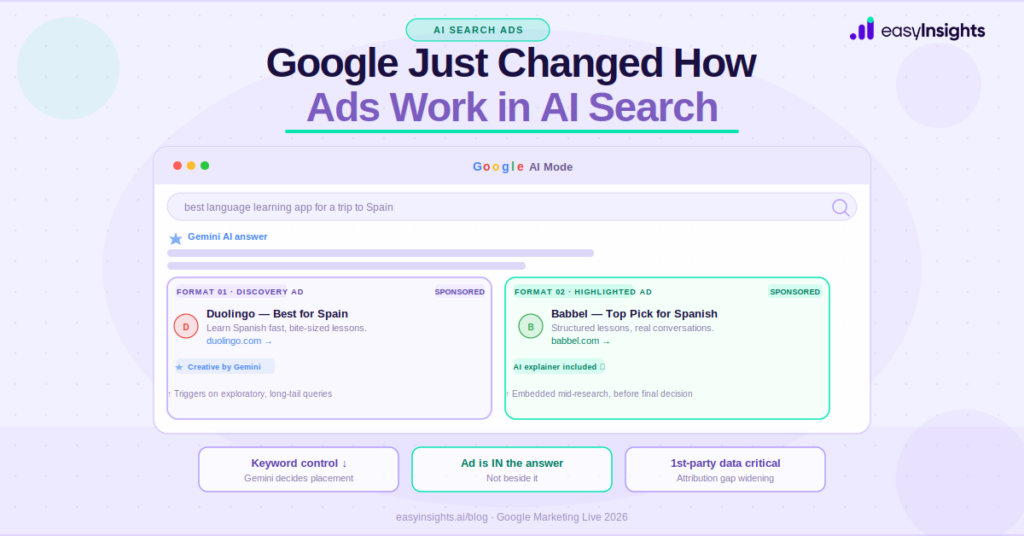
Google unveiled two distinct formats at GML 2026, both powered by Gemini and both designed to embed advertising more naturally into AI-generated responses.
| Format 01 – Conversational Discovery Ads | Format 02 – Highlighted Answers |
| Designed to respond to long, exploratory prompts – think “how do I make my home smell like a luxury spa with low-maintenance solutions.” Gemini generates contextual creative on the fly, drawing from your ad assets. – Triggers on nuanced, multi-intent queries – Creative synthesised by Gemini from your assets – No direct keyword match neededBuilt for upper -funnel discovery moments | Ads appear directly inside AI-generated recommendation lists – for example, when someone asks “best language learning app for a trip to Spain.” Your ad becomes part of the answer, not an afterthought. – Embedded in organic-looking recommendation flows – AI-written explainer included alongside your ad – Reaches users mid-research, before final decision – High relevance threshold required for placement |
Both formats carry sponsored labels – Google has confirmed ads will remain clearly marked. But the placement is fundamentally different from anything that existed before. The ad is no longer beside the answer. It is part of the answer.
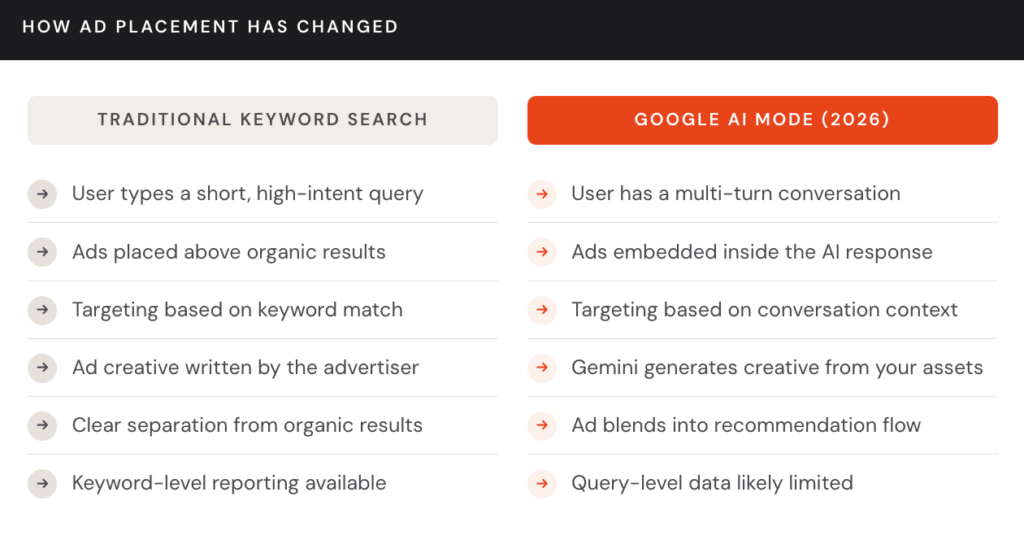
Old Search vs. AI Mode: A Side-by-Side
To appreciate how significant this shift is, compare how ads worked before versus where they’re going now:
Why This Is a Much Bigger Deal Than It Looks
On the surface, this looks like a new placement option. But underneath, it represents a structural shift in the relationship between your campaign inputs and what shows up in front of users.
In traditional search, a keyword is the bridge between your ad and your audience. You control what query triggers your ad. In AI Mode, Gemini is that bridge. It reads the conversation, decides what’s relevant, and then decides whether your ad — and which version of it — belongs in the response. You don’t control that decision. You influence it through the quality of what you give Gemini to work with.
| Gemini isn’t matching your headline to a keyword. It’s reading the entire conversation and deciding if your brand belongs in the answer. |
What This Means for Your Campaigns, Practically
Let’s get specific. Here’s how each major lever in your campaign setup is affected:
Campaign lever impact assessment
| Lever | What changes | Priority |
| Creative assets | Gemini pulls from your existing asset library to generate contextual ad creative. Thin, generic assets will lose out to richer, more specific ones. | Critical |
| Product / service data | Structured, detailed product feeds give Gemini more to work with when matching your ad to a nuanced conversational query. | Critical |
| Landing page quality | AI Mode likely evaluates full page context. A shallow or mismatched landing page won’t just hurt Quality Score – it may exclude you from placements entirely. | Critical |
| First-party data & conversion signals | With less query-level data, your first-party conversion signals become the primary optimization input for Smart Bidding. | Critical |
| Keyword strategy | Direct keyword control matters less in AI Mode. Context signals and audience intent replace exact match as the primary targeting mechanism. | Adapt |
| Reporting & attribution | Conversational queries generate less structured data. Expect gaps in search term reports, similar to what’s already happening in AI Overviews. | Watch closely |
The Attribution Problem Nobody Is Talking About
Here is the part that should concern performance marketers the most – and it barely got a mention at GML.
Traditional keyword search gives you a clean data trail. A user typed X, your ad showed, they clicked, they converted. You can trace that chain and optimise every link in it. Conversational AI search doesn’t work that way. A user who asks a follow-up question two turns into a chat session leaves a fundamentally messier data trail. Google has already started limiting search term visibility in AI Overviews. Expect the same – or worse – as Conversational Discovery and Highlighted Answers scale.
What does that mean for you? It means the advertisers who have robust first-party data infrastructure in place now – tracking that doesn’t rely solely on Google’s own reporting, CRM data that connects ad exposure to downstream revenue, and attribution models that can function without query-level granularity – will have a structural advantage over those who don’t.
6 Things to Do Before These Formats Go Live
Neither format has a confirmed rollout date – Google described them as being in testing within AI Mode. That’s your window. Use it.
Pre-Launch Readiness Checklist:
1. Audit and enrich your creative asset library.
Gemini synthesises your existing assets to generate contextual creative. If your current assets are generic or sparse, you’re handing the algorithm very little to work with. Invest in variety – lifestyle imagery, specific use-case headlines, benefit-led descriptions.
2. Deepen your product and service structured data.
The more descriptive and accurate your feed data, the better Gemini can match your offering to a complex, multi-intent query. Go beyond required fields.
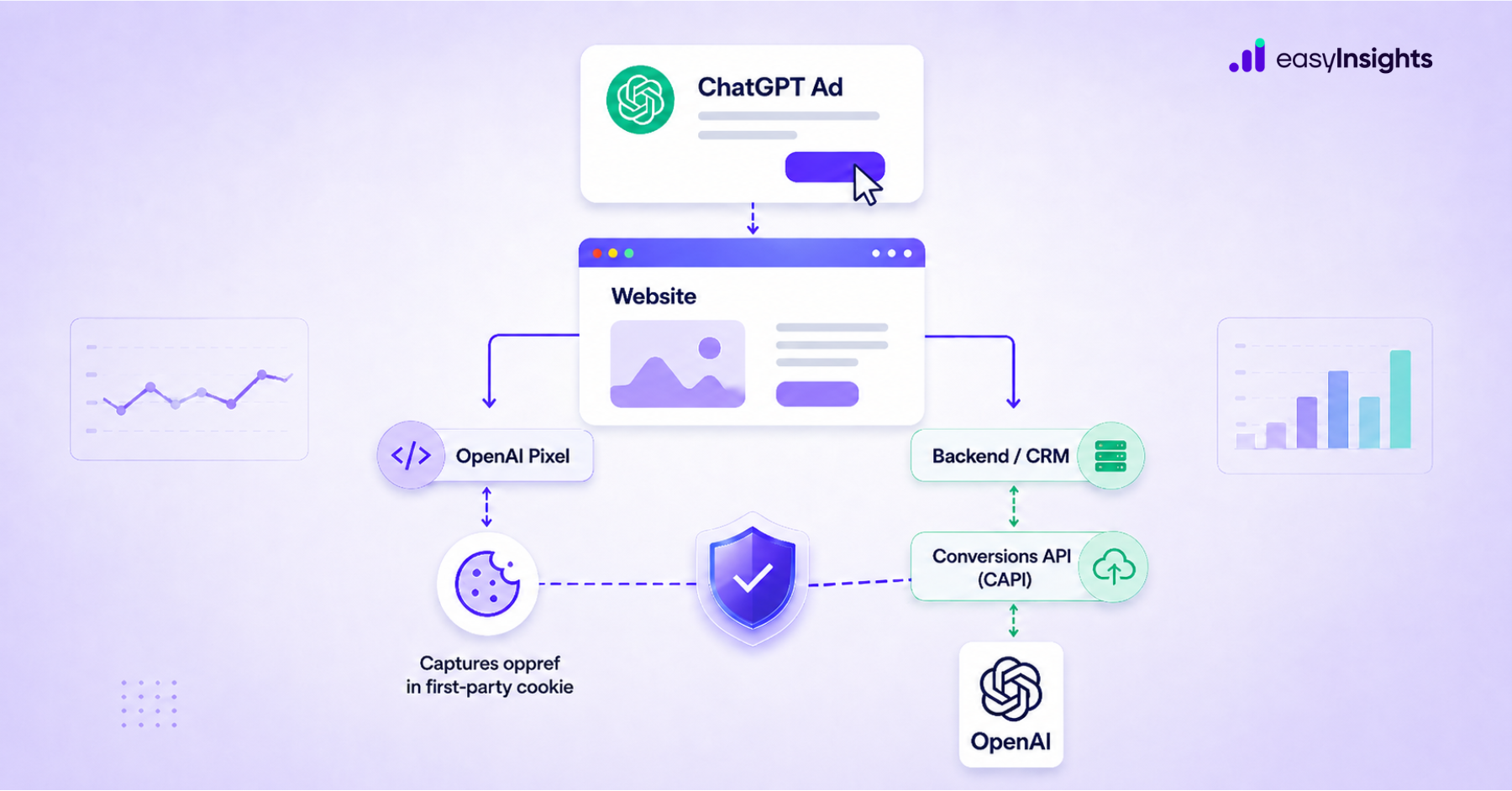
3. Implement and validate Enhanced Conversions now.
First-party conversion data is going to matter more, not less. Make sure Enhanced Conversions are live, correctly set up, and passing clean data to your bidding models.
4. Audit landing page depth and topical relevance.
Your landing pages need to genuinely answer the questions your target audience is asking in AI Mode. Thin pages that exist purely to capture a click won’t cut it.
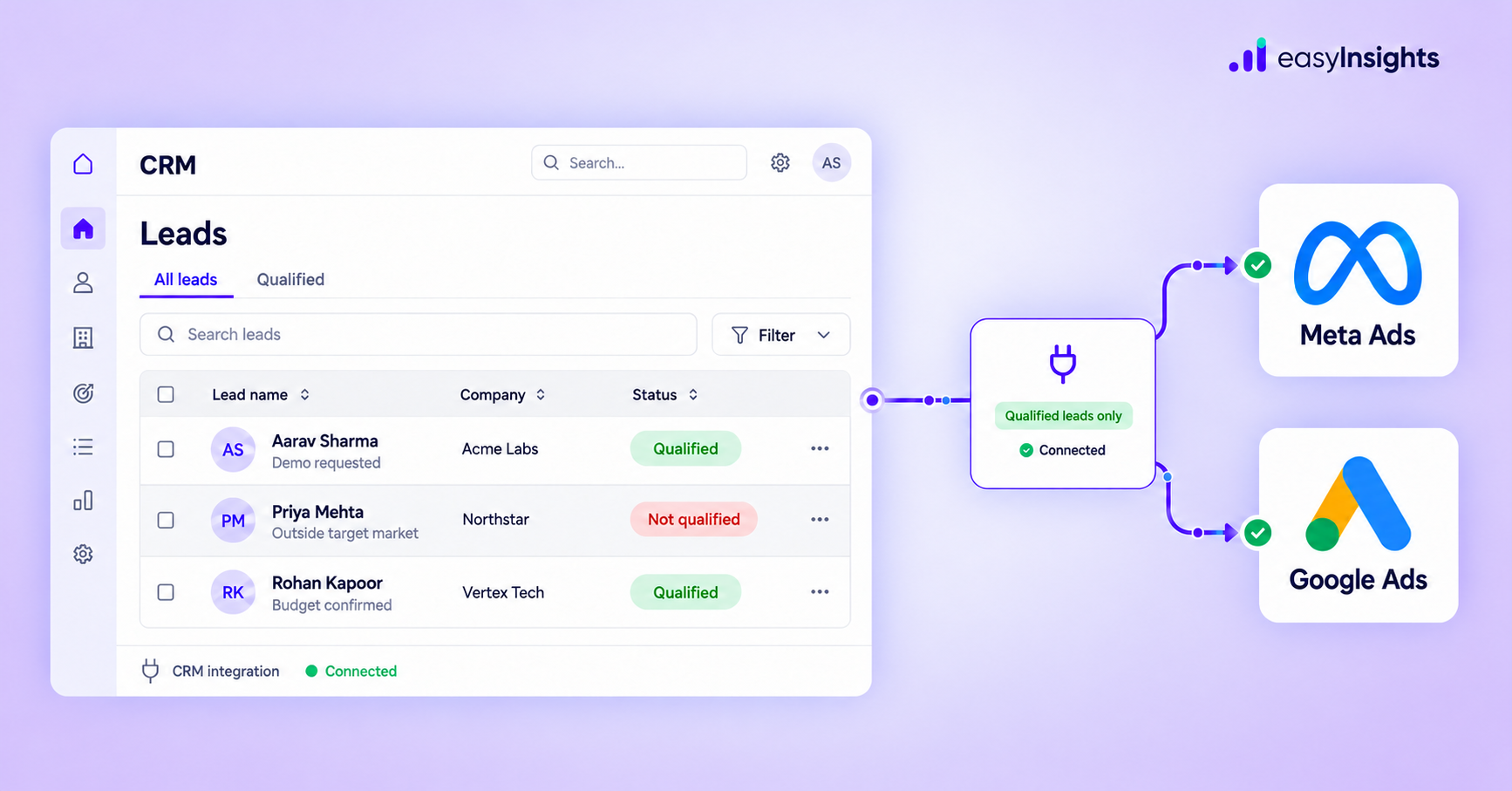
5. Connect your CRM data to your ad platforms.
Offline conversion imports, CRM-to-ad platform integrations – these close the attribution gap that AI Mode reporting is likely to widen. Get them in place before the data gets harder to read.
6.Establish attribution baselines now.
Before these formats start showing up in your reports, document your current attribution model and performance benchmarks. That baseline will be invaluable when you need to measure what’s actually working.
The Bottom Line
Google’s AI Mode ad formats are not a future concern. They are in testing right now, and the infrastructure decisions you make in the coming months will determine how well you perform when they scale. The brands that arrive prepared – with strong creative, rich data, and solid attribution infrastructure – will have a meaningful edge. Those still operating purely in a keyword-first mindset will find themselves optimising for a world that’s quietly shrinking.
The keyword era isn’t over. But it’s no longer the whole game.
| Worried About Attribution in a World With Less Data? EasyInsights Has You Covered.As AI Mode reduces query-level visibility, first-party data becomes your most valuable asset. EasyInsights is a first-party data activation platform built specifically for performance marketers – giving you attribution clarity, precise conversion tracking, and CRM integration so you’re never flying blind, regardless of how Google chooses to report. Book a demo now. |