Privacy is becoming a bigger part of the marketing infrastructure.
Over the last few years, performance marketers have already adapted to major changes such as Apple’s iOS 14 privacy changes, server-side tracking, cookie restrictions, and increasingly automated ad platforms like Meta’s Andromeda.
Now, India’s Digital Personal Data Protection (DPDP) Rules, 2025 add another important layer to that evolution.
The Rules provide the operational framework for India’s Digital Personal Data Protection Act, 2023 (DPDP Act). The Act establishes the core rights and obligations around digital personal data, while the Rules translate those principles into more specific requirements around notices, consent, security, breach reporting, retention, user rights, Significant Data Fiduciaries, and the Data Protection Board.
Jump ahead to:
What is the DPDP Act?
The Digital Personal Data Protection Act, 2023 is India’s legal framework for processing digital personal data.
At a high level, it establishes obligations for organizations that determine the purpose and means of processing personal data and gives individuals greater control over their personal information.
The Act introduces several important concepts.
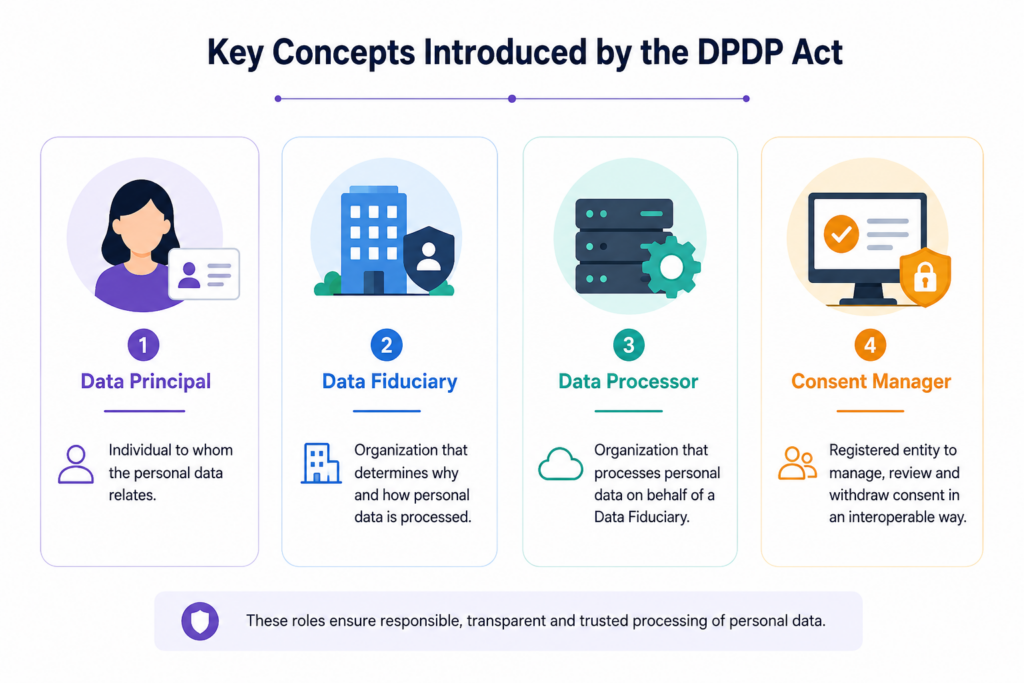
Data Principal
The individual to whom the personal data relates.
For example, if a customer submits their phone number on a company’s website, that customer is the Data Principal.
Data Fiduciary
The organization that determines why and how personal data is processed.
For example, a company collecting leads through its website and deciding how those leads will be used may be the Data Fiduciary.
Data Processor
An organization that processes personal data on behalf of a Data Fiduciary.
For example, a CRM, cloud provider, analytics service, or technology vendor processing customer data on behalf of a business may fall into this category, depending on the arrangement.
Consent Manager
A registered entity designed to act as a single point of contact through which Data Principals can give, manage, review and withdraw consent using an accessible, transparent and interoperable platform.
When do the DPDP Rules come into effect?
This is an important point because the Rules are not a single-date implementation.
The final notification provides a phased commencement structure:
| Rules | When they take effect |
| Rules 1, 2 and 17–21 | On publication in the Gazette |
| Rule 4 | One year after publication |
| Rules 3, 5–16, 22 and 23 | 18 months after publication |
The Rules were published in November 2025, meaning the major operational requirements covered by Rules 3 and 5 – 16 are scheduled to take effect in May 2027.
This phased approach is important for businesses because it provides time to review and redesign their data infrastructure rather than treating compliance as a one-time switch.
The 6 Major Changes Under the DPDP Rules
The DPDP Rules turn the Act’s broad principles into practical requirements for how businesses collect, use, store, secure, and manage personal data.
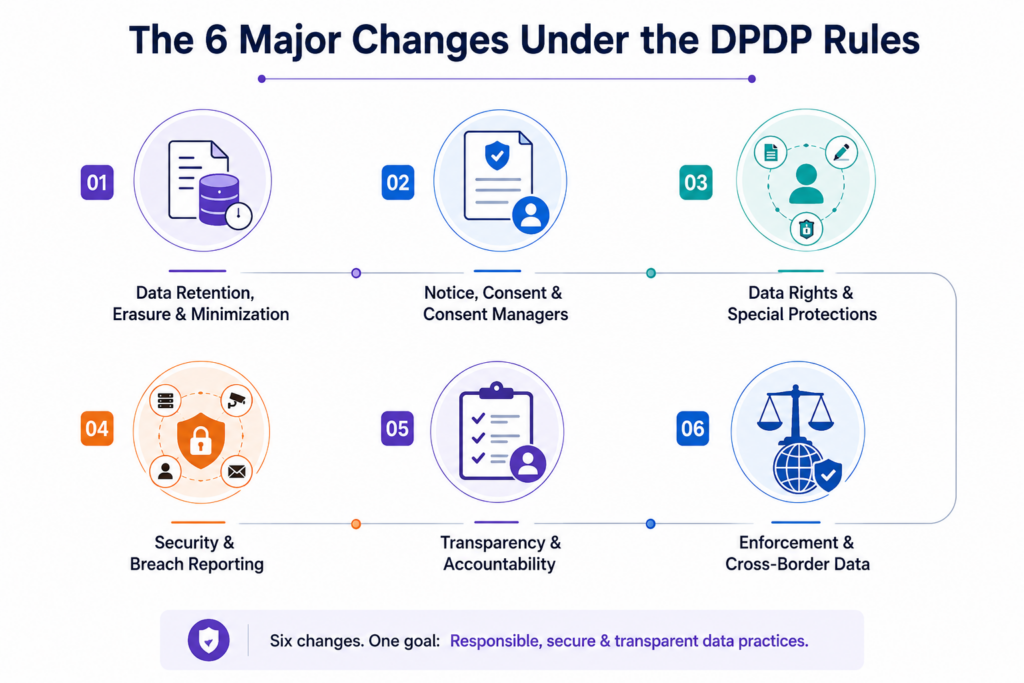
1. Data Retention: Businesses need defined data-retention policies. Specified personal data, traffic data, and processing logs must be retained for the required period, while personal data should be deleted when its purpose is no longer being served.
2. Consent & Consent Managers: Users must receive a clear, standalone notice explaining what data is collected and why. Consent must be manageable and withdrawable, with Consent Managers providing an interoperable way for users to manage consent across organizations.
3. Data Rights & Special Protections: Individuals can request access to their data and ask for inaccurate information to be corrected, updated, or erased. Children receive additional protection, including requirements around verifiable parental consent and restrictions on targeted advertising.
4. Security & Breach Reporting: Businesses must implement reasonable security safeguards such as encryption, masking, access controls, and monitoring. In case of a personal data breach, affected individuals must be informed without delay and the Data Protection Board must receive the required information within the prescribed timeline.
5. Transparency & Accountability: Businesses need clear channels for privacy-related questions and complaints. Significant Data Fiduciaries face additional obligations, including Data Protection Impact Assessments and independent compliance audits every 12 months.
6. Enforcement & Cross-Border Data: The Digital Data Protection Board provides the framework for digital enforcement, with appeals going to TDSAT. Cross-border data transfers are generally permitted, subject to restrictions or requirements notified by the government.
What Does DPDP Mean for Performance Marketers?
DPDP doesn’t mean marketers need to stop using customer data. It means how that data is collected, managed, and activated needs to become more intentional.
For performance marketers, the key areas to focus on are:
- First-party data: Build clean, reliable customer data instead of depending heavily on third-party signals.
- CRM & data pipelines: Know what customer data is flowing between your CRM, analytics tools, and ad platforms.
- Consent: Make data collection and consent clear across forms, websites, and lead-generation journeys.
- Data retention: Define how long customer data is stored and when it should be deleted.
- Data security: Ensure customer data is protected across every system and vendor that processes it.
- Data visibility: Know where your customer data lives, who can access it, and how it is being used.
The takeaway is simple: DPDP is pushing performance marketing toward better-governed, higher-quality first-party data infrastructure.
Final Takeaway
The DPDP Rules 2025 turn India’s data-protection framework into a more operational system.
For organizations, that means stronger requirements around: Data retention → Consent → User rights → Security → Accountability → Enforcement
For performance marketers, the practical impact is even broader. Your website, CRM, tracking infrastructure, analytics stack, data warehouse and advertising platforms are increasingly part of the same data ecosystem.
The winning approach is therefore not to treat privacy as a roadblock. It is to build a marketing infrastructure where data quality, transparency, security and performance work together.
| Collect and track consentful first-party data and send it to your ad platforms to optimize campaigns with EasyInsights. Book a Demo → |