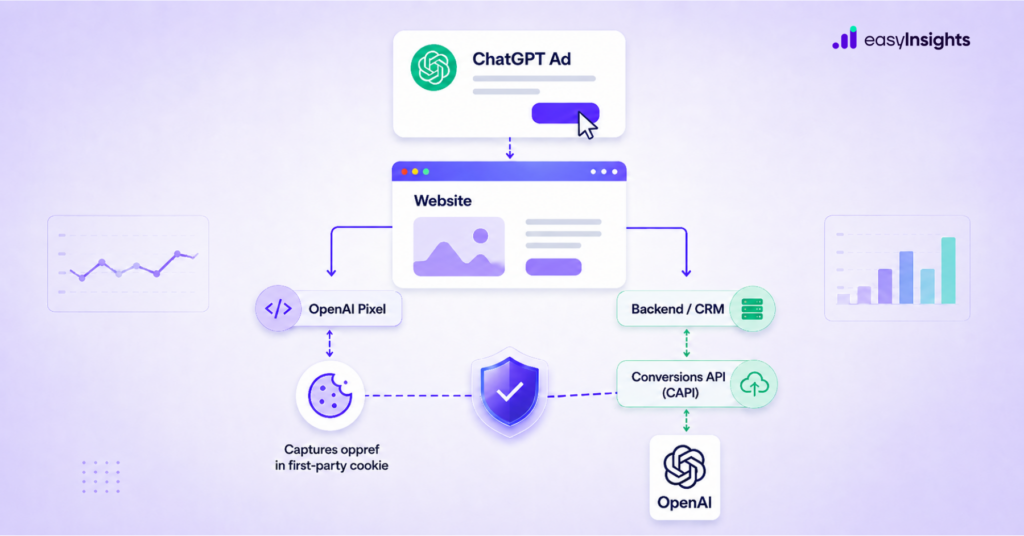
ChatGPT is becoming a new surface for advertising.
But for marketers, buying media is only half the equation. The harder question is what happens after someone clicks the ad.
As ChatGPT Ads evolves, conversion measurement is becoming just as important as ad delivery.
That is where Conversions API (CAPI) comes in.
This guide explains how ChatGPT Ads CAPI works, where it fits into the advertising stack, how Pixel and CAPI work together, what oppref means, and what marketers should consider when implementing it.
Jump ahead to:
What Is Conversions API for ChatGPT Ads?
Conversions API is OpenAI’s server-side mechanism for sending conversion events from your systems to OpenAI.
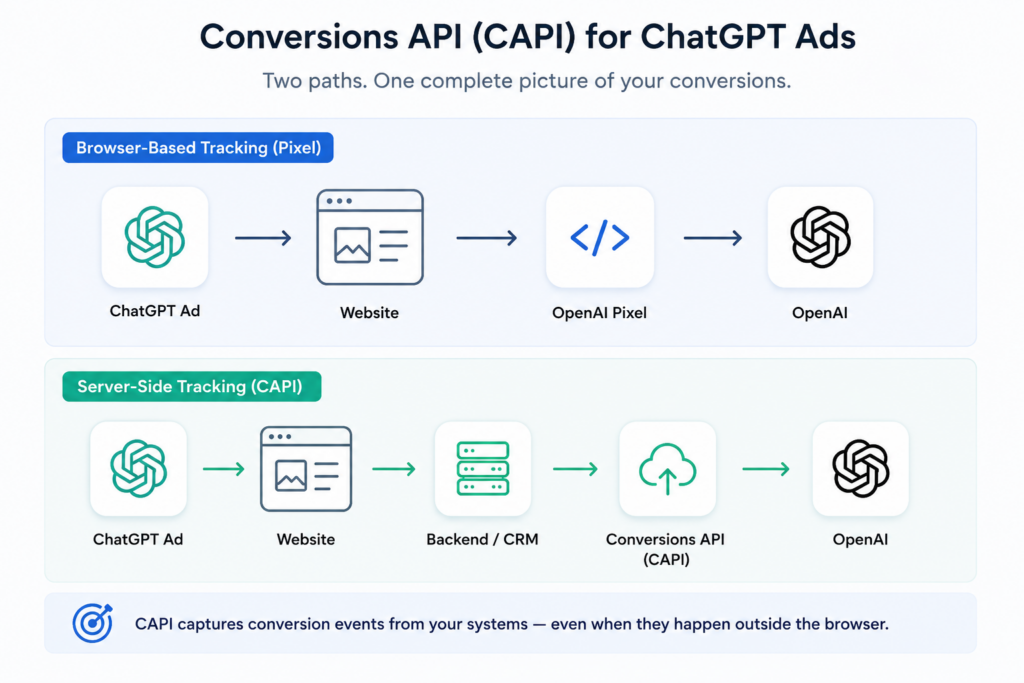
Instead of depending entirely on what happens inside a user’s browser, businesses can send conversion information from their backend, server, CRM, or other systems.
With browser-based tracking, the flow looks like: ChatGPT Ad → Website → Pixel → OpenAI
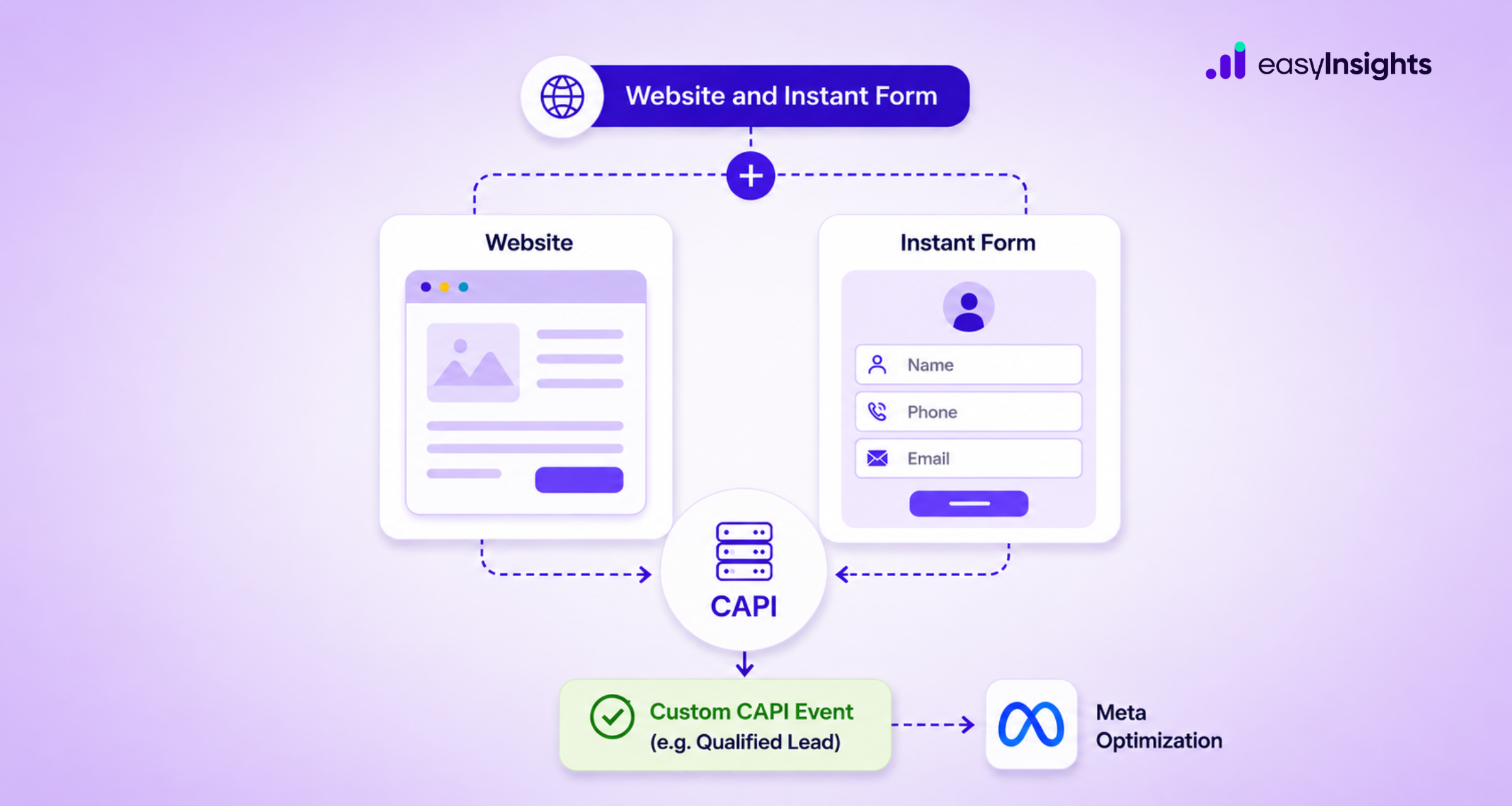
With CAPI, the business can create another path: ChatGPT Ad → Website → Backend / CRM → CAPI → OpenAI
This distinction matters because not every important conversion happens in a browser.
A lead submission might happen on a website. But lead qualification happens in the CRM. A sale may happen days later. CAPI provides a way to send relevant server-side conversion signals back to OpenAI.
OpenAI currently supports conversion measurement for actions such as purchases, leads, and registrations, along with supported custom events.
Pixel vs CAPI
The easiest mistake is to think of CAPI as a replacement for the Pixel. It isn’t. The two solve different parts of the measurement problem.
Pixel captures browser-side activity. CAPI sends server-side events.
For example:
Website
→ OpenAI Pixel
→ Captures a lead submission
CRM
→ Conversions API
→ Sends a qualifying event
Using both gives advertisers more than one source of conversion signals.
OpenAI specifically recommends using Pixel and CAPI together for more resilient measurement. When the same conversion is sent through both, the same event ID should be used so OpenAI can deduplicate the event.
So the ideal setup isn’t:
Pixel + CAPI + correct event architecture
The Role of oppref
One of the most important concepts in ChatGPT Ads measurement is oppref.
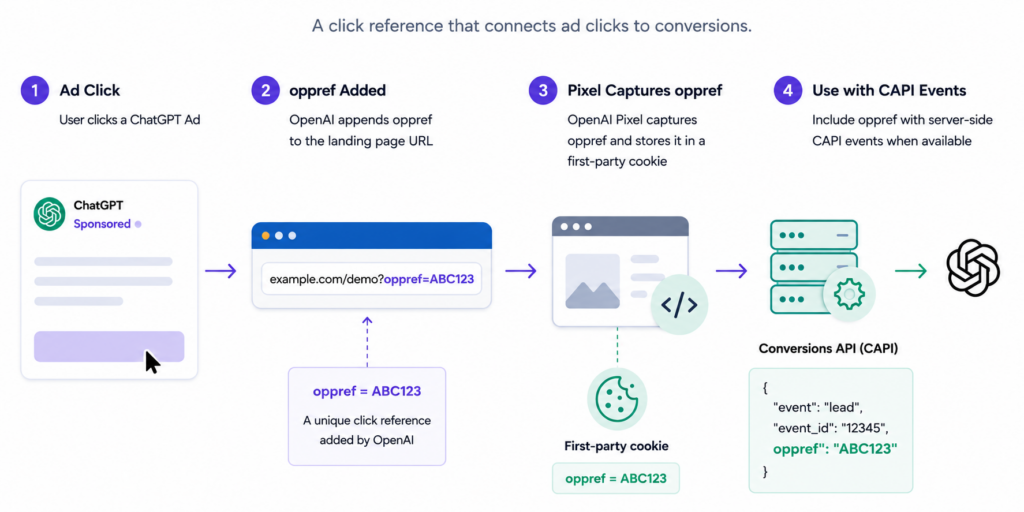
When someone clicks an ad, OpenAI adds a click reference called oppref to the landing-page URL.
For example: example.com/demo?oppref=ABC123
The OpenAI Pixel can capture this value and store it in a first-party cookie. When available, advertisers can also include oppref with server-side CAPI events.
Why does this matter?
Because the click reference helps connect: Ad click → Website activity → Conversion
Imagine a user clicks an ad today, submits a lead, and gets qualified by sales two days later.
The qualification event happens outside the browser.
If the relevant click information is preserved, the server-side event has a stronger connection back to the original ad interaction.
This makes preserving oppref through redirects and landing-page navigation an important part of the implementation.
How OpenAI Measures a Conversion
Sending an event through CAPI does not automatically mean it will appear as an attributed conversion.
OpenAI evaluates conversion events based on several conditions.
A conversion can be reported when:
- OpenAI receives the event from a data source connected to the ad account.
- The event matches the conversion configured for the campaign.
- The event occurs within the applicable attribution window.
- OpenAI can connect the event to an eligible ad click using available measurement signals.
Those signals can include oppref, eligible advanced matching information, and modeled measurement where available.
5 Benefits of ChatGPT Ads Conversions API
A well-implemented CAPI setup can do more than improve tracking. It can create a stronger connection between your advertising activity and the outcomes happening inside your business.
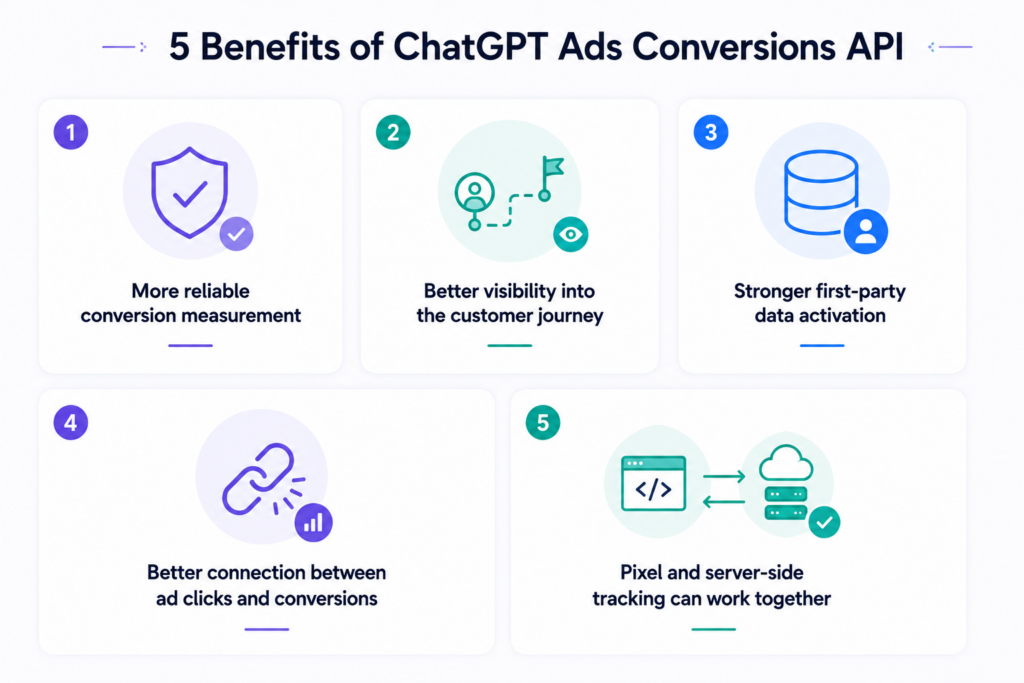
1. More reliable conversion measurement
CAPI gives businesses a server-side path for sending conversion events to OpenAI, reducing reliance on browser-side tracking alone. This is particularly useful when important conversion events happen outside the website.
2. Better visibility into the customer journey
A website may tell you that someone submitted a form. Your CRM can tell you whether that person became a qualified lead or customer.
CAPI helps bring these different stages closer to your advertising measurement.
3. Stronger first-party data activation
Your first-party data is one of the most valuable sources of information about your customers. Instead of leaving that data inside your CRM, CAPI provides a way to activate relevant conversion signals back into your advertising ecosystem.
4. Better connection between ad clicks and conversions
Signals such as oppref, along with other eligible matching information, can help connect conversion events with advertising interactions. That gives marketers a clearer picture of which ad activity is contributing to conversions.
5. Pixel and server-side tracking can work together
Using Pixel and CAPI together creates two complementary measurement paths. The Pixel captures browser activity, while CAPI can capture server-side events.
With proper event IDs and deduplication, businesses can use both without treating the same conversion as two separate events.
Additional reading: Server-Side Tracking Explained: GTM vs. True Server-Side Tracking
Where EasyInsights Fits In
For lead-generation businesses, the challenge isn’t understanding that CAPI exists.
The challenge is operationalizing it.
EasyInsights helps businesses connect these first-party signals with their advertising platforms. Instead of stopping the
measurement journey at: ChatGPT Ad → Lead
businesses can build toward: ChatGPT Ad → Lead → Qualified Lead → Customer
That is the direction modern performance marketing is moving toward.
From tracking conversions to activating business outcomes.
If your CRM already knows which leads matter, it’s time to make those signals work harder for your advertising.
Conclusion
ChatGPT Ads are creating a new opportunity for marketers, but the fundamentals of performance marketing haven’t changed.
Getting the click is only the beginning. The real challenge is understanding what happens after that click – and making those outcomes measurable.
That’s where Conversions API becomes important.
With Pixel capturing browser-side activity and CAPI bringing server-side conversion signals into the picture, businesses can build a more complete measurement path:
ChatGPT Ad → Click → Website → Lead → CRM → Business Outcome
For lead-generation businesses, that means moving beyond lead volume and giving advertising platforms a clearer view of the outcomes that actually matter.
| Need Help Setting Up ChatGPT Ads Tracking? EasyInsights can help businesses build and manage their ChatGPT Ads tracking infrastructure, including OpenAI Pixel, Conversions API, first-party data activation, and CRM-to-ad-platform conversion tracking. Our platform helps connect the journey from ad click to lead to qualified business outcome, so marketers can measure campaigns against the signals that matter – not just the conversions that are easiest to count. If you’re planning to run ChatGPT Ads or want to build a more reliable conversion tracking setup, Talk to the EasyInsights team. |