Jump ahead to:
TL;DR
- 13 November 2026 is Phase II of India’s DPDP rollout. Rule 4 and the First Schedule of the DPDP Rules, 2025 are now in force, which means anyone acting as a Consent Manager must be registered with the Data Protection Board of India (DPBI).
- Only a company incorporated in India with a net worth of at least ₹2 crore (certified by a practising CA) can apply.
- The Board’s checklist reportedly asks for 17 mandatory documents across five areas: corporate, financial, technical, operational and declarations.
- For most businesses, nothing new becomes mandatory on 13 November. Using a Consent Manager is optional. The big Data Fiduciary obligations start on 13 May 2027.
- Marketers should treat the next six months as the build window for consent records, notices and withdrawal flows.
Quick recap: India’s DPDP Act
- Purpose: The Digital Personal Data Protection Act, 2023 is India’s first dedicated data protection law. It protects individuals’ digital personal data while allowing lawful processing for legitimate purposes.
- Scope: It covers personal data collected in digital form, or collected offline and later digitised.
- Key terms: A Data Principal is the individual the data belongs to. A Data Fiduciary is the organisation that decides why and how the data is processed. A Consent Manager is a registered intermediary that helps individuals manage consent. The Data Protection Board of India oversees compliance.
- Consent: Consent must be free, specific, informed, unconditional and unambiguous, given by a clear affirmative action. Withdrawing it should be as easy as giving it.
- Rights of Data Principals: access to information about how their data is processed, correction and erasure of their data, grievance redressal, and the right to nominate someone to exercise their rights on their behalf.
The Act was passed in 2023, and the DPDP Rules, 2025 (notified on 13 November 2025) bring it into force in phases.
DPDP Phase II: What Changed on 13 November 2026
The Digital Personal Data Protection Rules, 2025 were notified on 13 November 2025 and are being switched on in three phases:
| Phase | Date | What comes into force |
|---|---|---|
| Phase I | 13 November 2025 | Definitions and the framework for the Data Protection Board |
| Phase II | 13 November 2026 | Rule 4 and the First Schedule: registration and obligations of Consent Managers |
| Phase III | 13 May 2027 | Remaining rules, including core Data Fiduciary obligations, Data Principal rights and the Board’s inquiry and penalty mechanisms |
After the date passed, MeitY launched an online portal (dpbi.gov.in) through which eligible Indian companies can submit Consent Manager applications to the Board.
What is a Consent Manager under the DPDP Act?
A Consent Manager is a Board-registered intermediary that gives a person (a “Data Principal”) one interface to give, review, manage and withdraw consent across multiple companies (“Data Fiduciaries”). The role comes from Section 6(7) to 6(9) of the DPDP Act and is detailed in Rule 4.
Two features make it different from a normal cookie banner tool:
- It is a regulated role. Operating as a Consent Manager without registration is a violation of Section 6(9).
- It acts for the individual. The First Schedule requires a Consent Manager to act in a fiduciary capacity towards the Data Principal, and the personal data passing through its platform must not be readable by the Consent Manager itself (a “data-blind” design).
Consent Manager vs Consent Management Platform (CMP): a CMP is a software category that collects consent for one organisation. It needs no registration and has no net worth requirement. A Consent Manager is a statutory role that carries consent across many organisations.
Who can register? The eligibility conditions
Part A of the First Schedule sets the conditions. In plain language, the applicant must:
- Be a company incorporated in India (not an LLP, partnership or foreign entity).
- Have the technical, operational and financial capacity to meet its obligations.
- Be sound in financial condition and in the general character of its management.
- Have a net worth of not less than ₹2 crore (total assets minus liabilities as per its books), supported by a CA certificate.
- Show adequate business volume, capital structure and earning prospects.
- Have directors, key managerial personnel (KMPs) and senior management with a reputation for fairness and integrity.
- Have MoA and AoA that lock in the prescribed conflict-of-interest obligations, with changes allowed only after Board approval.
- Operate in the interests of Data Principals.
- Hold independent certification that its interoperable consent platform meets the standards the Board publishes.
The ₹2 crore requirement is a hard gate. Registration can also be affected if conditions stop being met after approval, so net worth has to be maintained, not just shown once.
Consent Manager registration documents checklist
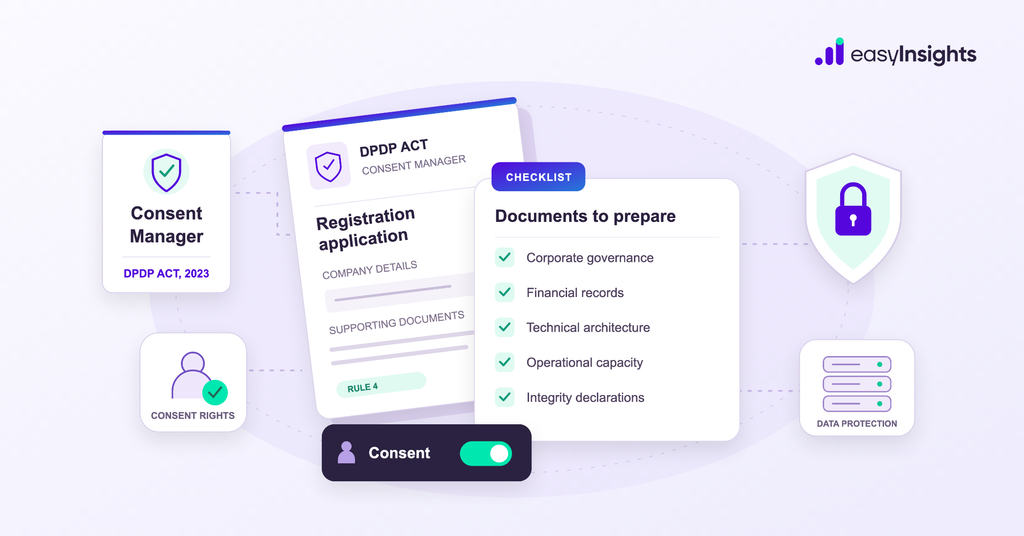
According to the Board’s registration checklist reported at launch, applicants must prepare 17 mandatory documents. Files should be PDF (preferably machine-readable), maximum 8 MB each.
1. Corporate governance documents
- Certificate of Incorporation from the Registrar of Companies
- Memorandum of Association (MoA)
- Articles of Association (AoA)
Check: the MoA and AoA must contain provisions requiring compliance with the conflict-of-interest obligations in Items 9 and 10 of Part B, and amendments must need prior Board approval. Most companies will need to amend these documents with counsel before applying.
2. Financial documents
- Audited financial statements for the preceding three financial years (or latest balance sheet where applicable)
- Annual turnover certificates for the preceding three years, issued by a practising CA
- Net worth certificate showing at least ₹2 crore, issued by a practising CA
Newer companies: if you are under three years old, submit what is available for your operating years. If you have not completed your first financial year, a provisional profit and loss statement certified by a practising CA is expected.
3. Technical documentation
- System Architecture Overview covering platform architecture and interoperability, security safeguards and hosting, consent lifecycle management, data-blind design, consent record-keeping, and scalability and availability
Check: it must show conformity with the Part B obligations.
4. Operational capacity and governance documents
- Statement of operational capacity (on letterhead, signed by an authorised signatory: manpower, functions, engagement arrangements)
- KMP and senior management details (qualifications, experience, roles)
- Board governance structure (composition, committees, directors’ other directorships)
- Conflict-of-interest policy (disclosure, prevention and management of conflicts with Data Fiduciaries)
- Internal audit and compliance monitoring plan
- Business continuity plan (availability, backup and disaster recovery, protection of consent records, communication with users and fiduciaries)
- Business and capability plan (platform, operating model, fees, grievance redressal)
- Capital structure statement (authorised, issued and paid-up capital; promoters and holders of more than 2% of shares; relevant shareholdings in other companies)
5. Fairness and integrity declarations
- Fit-and-proper declaration (directors, KMPs and senior management have a record of fairness and integrity and no regulatory debarment)
- Declaration that operations will be conducted in the interests of Data Principals
Applicants also undertake to comply with Part A conditions and, after registration, the Part B obligations.
Important: requirements and form details can be updated by the Board. Confirm the final checklist on the official portal before filing.
Step-by-step: how to apply
- Check eligibility against all nine Part A conditions, starting with Indian incorporation and the ₹2 crore net worth.
- Fix your constitutional documents. Amend MoA and AoA for the conflict-of-interest provisions.
- Build and certify the platform. Design for interoperability and data-blind operation, then arrange independent certification.
- Compile all 17 documents in the required PDF format and size.
- Apply on the DPBI portal (dpbi.gov.in), complete the online form and upload the documents.
- Wait for the Board’s decision. The Board can register the applicant or reject it with reasons, and registered Consent Managers’ particulars will be made public on the Board’s website.
What Consent Managers must do after registration (Part B highlights)
- Provide a website or app as the main way Data Principals access its services
- Act in a fiduciary capacity towards the Data Principal
- Keep personal data unreadable to itself (data-blind)
- Not sub-contract or assign its obligations under the Act and Rules
- Maintain reasonable security safeguards against personal data breaches
- Follow conflict-of-interest and governance requirements locked into its constitutional documents
Marketer takeaway: what Phase II means for you
If you run lead generation, ads or CRM, here is the practical reading.
1. Nothing new becomes mandatory for you today. Rule 4 governs who may be a Consent Manager. Neither the Act nor the Rules require a Data Fiduciary to use one. Your main deadline is 13 May 2027.
2. Consent Managers will change where consent lives. Over time, a customer may withdraw consent from a single dashboard rather than your form or banner. Your systems need to receive and act on those signals quickly.
3. Use the six-month window to get your own house in order.
- Audit every data entry point: lead forms, WhatsApp click-to-chat flows, landing pages, offline imports and CRM uploads.
- Version your privacy notices and store proof of what the person saw and agreed to, with timestamp and source.
- Make withdrawal as easy as giving consent, and make sure it reaches your CRM, ad platforms and any enrichment tools.
- Review conversion tracking. If you send hashed customer data to Meta or Google via server-side APIs, your pipeline should respect each person’s consent status before the event is sent.
- Map your vendors. Know which processors touch personal data and what your contracts say.
- Define retention and deletion rules for leads that never convert.
This is where first-party data infrastructure matters: consent status has to travel with the lead from the first click to the CRM and into ad platform signals, not sit in a banner database.
FAQs
1. When did Consent Manager registration begin under the DPDP Act?
Rule 4 and the First Schedule came into force on 13 November 2026, with the application portal launched shortly after.
2. Who can register as a Consent Manager?
A company incorporated in India that meets the nine Part A conditions, including a net worth of at least ₹2 crore.
3. Can a foreign company or LLP apply?
No. The applicant must be a company incorporated in India.
4. How many documents are needed?
The Board’s checklist lists 17 mandatory documents across five categories.
5. Is it mandatory for my business to use a Consent Manager?
No. Using one is optional, though you must still meet Data Fiduciary obligations from 13 May 2027.
6. What is the difference between a Consent Manager and a consent management platform?
A Consent Manager is a registered statutory intermediary that works across many fiduciaries. A CMP is software that manages consent for one organisation and needs no registration.
7. What is the next DPDP deadline?
13 May 2027, when the remaining rules, including Data Fiduciary obligations and the Board’s penalty mechanisms, come into force.
Conclusion
Phase II opens the door for a new class of regulated consent infrastructure in India. If you plan to become a Consent Manager, start with the ₹2 crore net worth, your MoA and AoA, and platform certification, because those take the longest. If you are a marketer, use the months before 13 May 2027 to make consent traceable, reversible and connected to your tracking stack.
Disclaimer: this article is for general information and is not legal advice. Consult a qualified professional and verify requirements on the official DPBI portal before applying.