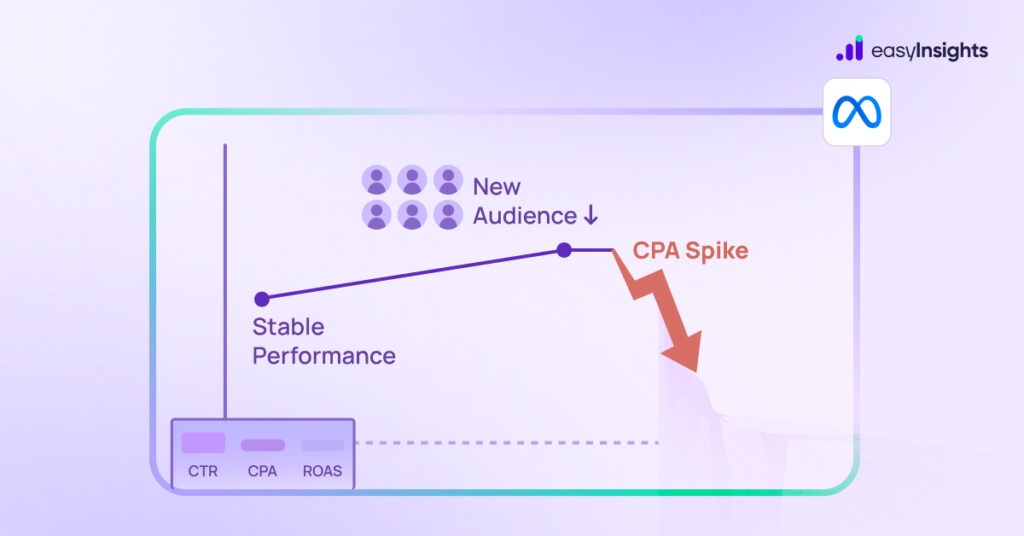
You’re watching CTR, CPA, Frequency, ROAS. Your dashboard is full of data. And yet, one day, performance falls off a cliff – and nobody saw it coming.
Here’s the problem: the metrics you’re tracking are lagging indicators. By the time they signal trouble, the damage is already done. What you need is a leading indicator – one that tells you audience saturation is setting in weeks before CPA starts climbing.
That metric is Net New Reach. And it’s not in your default Meta Ads Manager columns.
Jump ahead to:
Why Your Current Metrics Don’t Predict Saturation
CTR measures engagement with people who already saw your ad. CPA measures conversion efficiency on existing demand. Frequency tells you how often the same person sees your ad – but only within a single reporting window. None of them tell you whether Meta is finding new people or endlessly recycling the same audience.
That’s how saturation hides. ROAS can look stable for weeks while your pool of responsive, unconverted users quietly shrinks. The algorithm optimizes within what’s available – it shifts budget toward warm audiences, retargeting pools, and returning visitors. New customer acquisition stalls. And then, all at once, CPA spikes.
Net New Reach is the early warning system that catches this before it shows up in your cost metrics.
What Is Net New Reach?
Net New Reach measures the percentage of your Period B spend that reached people who had never been exposed to your brand in Period A. In simple terms: how much of your budget is actually expanding your audience – and how much is just hitting the same people again?
Meta doesn’t surface this number directly, but it’s straightforward to calculate using Meta’s built-in de-duplication across reporting windows.
How to Calculate Net New Reach (Step-by-Step)
Step 1 – Pull Period A Reach
In Meta Ads Manager, set your date range to Period A (e.g. July 1–31). Pull account-level Reach – not campaign or ad set level, which can double-count shared audiences. Record this as Reach A.
Step 2 – Pull Period B Reach
Change the date range to Period B (e.g. August 1–31). Pull account-level Reach again. Record this as Reach B.
Step 3 – Pull Combined Reach
Set your date range to cover both periods (July 1–August 31). Pull account-level Reach. Meta automatically de-duplicates users across the full window, so this figure represents your true unduplicated audience. Record this as Combined Reach.
Step 4 – Run the Formula
| FormulaNet New Reach = Combined Reach − Reach ANet New Reach % = (Net New Reach ÷ Reach B) × 100 |
Example
- Reach A (July): 500,000
- Reach B (August): 480,000
- Combined Reach (July–August): 720,000
- Net New Reach: 720,000 − 500,000 = 220,000
- Net New Reach %: (220,000 ÷ 480,000) × 100 = 45.8%
A 45.8% result sits in warning territory. Not yet critical – but a clear signal that audience refresh should be a priority before the week-over-week trend worsens.
Benchmarks to Watch
| Status | Net New Reach % | Action |
| ✓ Healthy | 60%+ | Keep going |
| ⚠ Warning | 40–60%, declining | Review creative |
| ✗ Critical | Under 40% + Frequency > 3 | Act immediately |
Always compare against your own account’s historical baseline. A mature brand in a narrow vertical may run structurally lower than a broad DTC account — what matters most is the direction of the trend, not the absolute number.
Why Net New Reach Predicts CPA Spikes
When Net New Reach falls, it signals that Meta has exhausted its supply of new, responsive users within your targeting parameters. The algorithm doesn’t stop spending – it reallocates.
Budget shifts toward:
- Warm audiences (website visitors, video viewers, engagers)
- Retargeting pools (existing demand, not new acquisition)
- Lookalikes that increasingly overlap with your existing customer base
In the short term, ROAS can appear stable because warm audiences convert at higher rates. But you’re no longer growing. New customer volume declines. CAC starts rising quietly in the background.
By the time your CPA metrics visibly spike, the root cause – audience exhaustion – started compounding weeks earlier. Net New Reach lets you intervene at the source, not after the fact.
The Fix Is Not Bid Adjustments
When media buyers see CPA creep, the instinct is to adjust bids, tighten targeting, or reallocate budget across campaigns. These are the wrong levers. They redistribute spend within an already-saturated pool; they don’t replenish it.
Declining Net New Reach is almost always a creative and audience problem. The algorithm has already found everyone responsive to your current message. To reset growth, pull these levers:
- Launch new creative angles and personas – the algorithm needs fresh signals to identify new user segments
- Test partnership ads and new creator content – different creative contexts unlock different audience pockets
- Tighten TOF exclusions – exclude engagers, visitors, and existing customers from prospecting campaigns to force true net-new reach
- Run true TOF objectives – Reach and Traffic campaigns can reseed the algorithm with fresh audience data
- Introduce differentiated new-customer offers – price anchoring or entry offers that specifically target first-time buyers
Done correctly, Net New Reach typically recovers within 10 days. New visitor rate follows. CPA stabilises before the spike arrives.
How to Track It Weekly
Build a simple tracker: every Monday, pull the prior week vs. the week before using the method above. Log Net New Reach %, Frequency, and combined Reach. You’re looking for trend, not just a snapshot.
| Week | Reach A | Reach B | Combined | NNR % | Frequency |
| — | — | — | — | — | — |
| — | — | — | — | — | — |
| — | — | — | — | — | — |
Flag any week-over-week decline while spend holds flat. That is your earliest actionable signal.
The Bottom Line
Most Meta Ads dashboards are optimised to tell you what happened. Net New Reach tells you what’s about to happen. It’s not a vanity metric – it’s a structural health indicator for your acquisition engine.
Track it before you feel it. Act on it before it costs you.
Book a demo to know more.