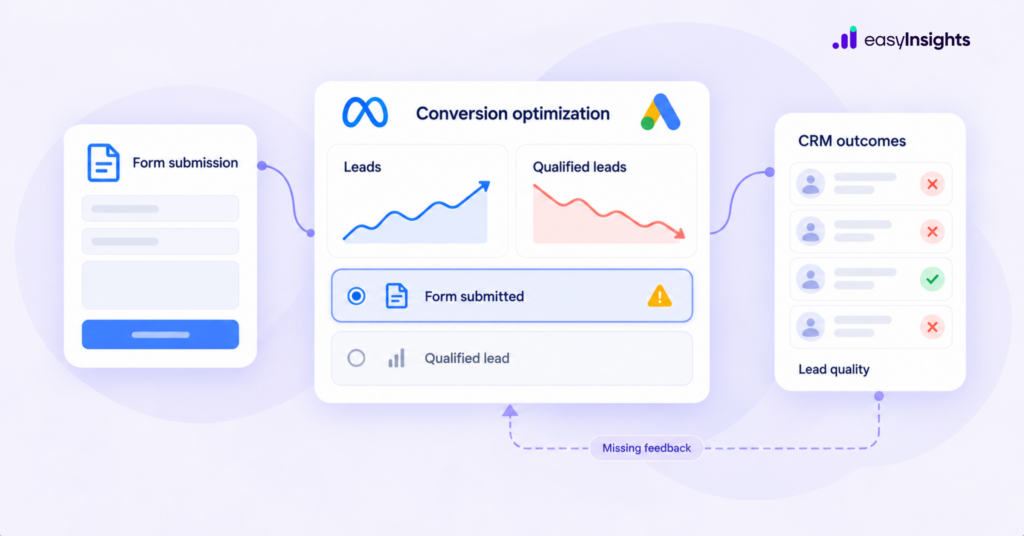
Your ad campaigns are generating leads. Your cost per lead is improving. Conversion numbers look healthy. But when your sales team follows up, a large percentage of those leads turn out to be irrelevant, unresponsive, or unlikely to buy.
This creates a difficult question for performance marketers: if campaign performance is improving, why aren’t business results improving with it?
One possible reason is that your advertising platforms are optimizing for the wrong conversion event.
When Meta Ads or Google Ads receive conversion signals that don’t reflect actual lead quality, their automated bidding systems may prioritize people who are likely to complete the tracked action rather than those who are likely to become qualified prospects or customers.
For lead generation businesses, this distinction matters. A form submission is an initial response. A qualified lead, sales opportunity, or closed deal represents a different level of business value.
The solution is not necessarily to generate more conversions. It is to ensure your campaigns are measuring and optimizing for the outcomes that matter to your business.
Jump ahead to:
What Is a Conversion Event in Digital Advertising?
A conversion event is a specific action that an advertiser tracks to measure whether someone has completed a desired step after interacting with an ad or website.
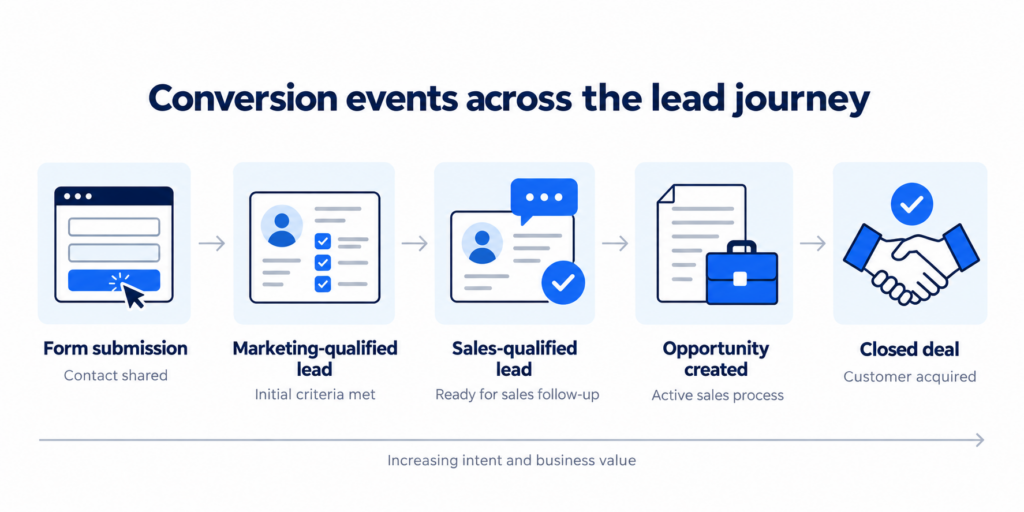
Depending on the business and campaign objective, this could include:
- Submitting a lead form
- Booking a demo or consultation
- Completing a purchase
- Becoming a marketing-qualified lead (MQL)
- Becoming a sales-qualified lead (SQL)
- Completing a sale after an offline sales process
Advertising platforms use configured conversion actions and goals to measure results and, when selected for optimization, inform automated bidding and campaign delivery.
For example, a B2B company might track a website form submission as a conversion. However, only some of those submissions may meet its qualification criteria, and an even smaller percentage may eventually become customers. If the campaign optimizes exclusively for form submissions, the platform is receiving a signal about who completes the form – not necessarily who becomes a valuable customer.
| The key distinction is between tracking an action and measuring business value. A conversion event can be tracked correctly while still being the wrong primary goal for campaign optimization. |
What Happens When Ad Platforms Optimize for the Wrong Conversion Event?
When the conversion event used for optimization doesn’t align with business outcomes, several problems can emerge.
1. Your campaigns may generate more leads without improving lead quality
Suppose a company generates 1,000 leads in a month. The advertising platform records each successful form submission as a conversion.
However, the sales team finds that only 150 leads meet its qualification criteria.
The platform can identify patterns associated with the tracked conversion, but if it doesn’t receive reliable qualification feedback, it has limited information about which leads are valuable to the business.
This can create a gap between campaign performance and sales performance. The number of conversions may increase while the proportion of qualified leads remains unchanged or declines.
2. Your cost per lead may improve while your cost per qualified lead increases
Consider this illustrative example:
| Metric | Campaign A | Campaign B |
| Ad spend | ₹1,00,000 | ₹1,00,000 |
| Leads generated | 200 | 100 |
| Cost per lead | ₹500 | ₹1,000 |
| Qualified leads | 20 | 30 |
| Cost per qualified lead | ₹5,000 | ₹3,333 |
Campaign A appears more efficient when judged by cost per lead. However, Campaign B generates more qualified leads for the same spend.
If the business evaluates campaigns only on CPL, it might allocate more budget to Campaign A, even though Campaign B delivers a better qualification rate and lower cost per qualified lead.
This is why lead generation teams should evaluate both the cost of acquiring a lead and the cost of acquiring a lead that meets their business criteria.
3. Automated bidding may learn patterns that don’t match your sales objectives
Automated bidding systems use conversion data and other available signals to make predictions and adjust bids according to the campaign’s selected goals.
When the optimization event is a form submission, the system is primarily being guided toward that action. It doesn’t automatically know which leads your sales team considers valuable unless relevant outcome data is made available through supported measurement and optimization features.
The result can be a mismatch between what the campaign is designed to achieve and what the business actually needs.
4. Budget allocation decisions can become misleading
When all leads are treated as equally valuable conversions, campaign reports may hide meaningful differences in lead quality.
One campaign may generate many inexpensive leads that rarely progress beyond the initial enquiry. Another may generate fewer leads but contribute a greater share of qualified opportunities.
Without CRM-backed funnel data, marketers may struggle to distinguish between the two.
Over time, this can affect budget allocation, campaign scaling, creative evaluation, and decisions about which audiences or channels deserve more investment.
How to Identify Whether Your Campaigns Are Optimizing for the Wrong Event
Look beyond the conversion numbers shown in your ad account. Compare platform performance with the outcomes recorded by your CRM.
Here are four useful checks:
- Compare leads with qualified leads: Are campaigns generating more enquiries without increasing MQLs or SQLs?
- Review CPQL alongside CPL: Are apparently efficient campaigns becoming more expensive once lead quality is considered?
- Compare campaign and CRM outcomes: Do the leads attributed to a campaign progress through the funnel, or do most stop after submission?
- Check conversion tracking: Are the events being recorded accurately, and are the intended conversion goals selected for campaign optimization?
Also examine the time lag between lead creation and qualification. Some businesses have long sales cycles, so recent campaigns may not yet have enough downstream data for a fair comparison.
Additional read: Why Conversions Don’t Match Across Meta, Google, and GA4 – and How to Fix Cross – Platform Attribution
How to Connect Your CRM to Meta Ads and Google Ads
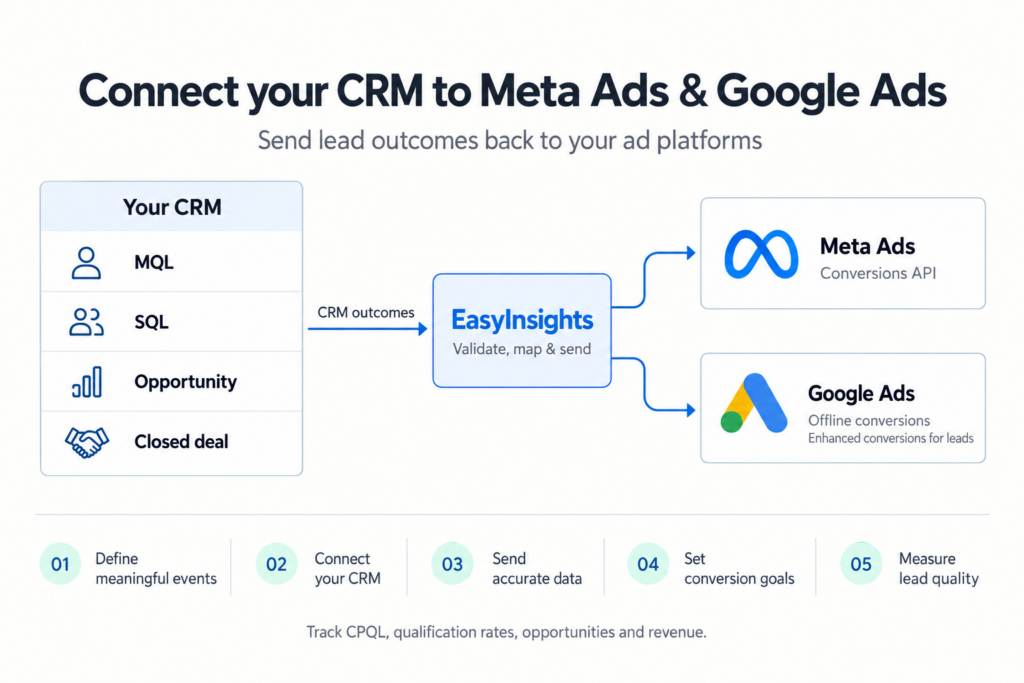
Your CRM contains information that ad platforms may not see by default: whether a lead was qualified, accepted by sales, converted into an opportunity, or marked as a sale.
Connecting your CRM to Meta Ads and Google Ads allows you to send these downstream conversion signals back to the platforms. This gives their optimization systems additional information about what happens after a form submission.
EasyInsights helps lead generation brands connect their CRM with advertising platforms and send relevant lead-stage and conversion data back to Meta Ads and Google Ads. This helps businesses move beyond optimizing only for form submissions and incorporate lead quality into their campaign optimization strategy.
Step 1: Define meaningful conversion events
Work with marketing and sales to identify the stages that represent genuine progress. These could include marketing-qualified leads (MQLs), sales-qualified leads (SQLs), sales-accepted leads, opportunities, and closed deals.
Choose events that are consistently recorded and relevant to your business goals.
Step 2: Connect your CRM to your ad platforms
Use a suitable integration to connect your CRM with Meta Ads and Google Ads. EasyInsights helps facilitate this connection so that relevant CRM events can be sent to the appropriate advertising platforms.
Depending on your setup, this may involve Meta’s Conversions API or Google Ads offline conversion imports and enhanced conversions for leads.
Step 3: Send accurate, timely conversion data
When a lead progresses through your CRM, the corresponding event can be sent to the relevant advertising platform, subject to the integration and platform requirements.
Accurate event mapping, identifiers, timestamps, and deduplication are important. Missing or incorrectly mapped events can affect data quality, so event delivery and matching should be validated.
Step 4: Configure campaign conversion goals
Sending CRM data to an advertising platform does not automatically mean every event will guide bidding. Review your conversion actions, campaign-level goals, and primary or secondary conversion settings where applicable.
Select the events that should inform optimization based on your business objective and the volume and reliability of the available data.
Step 5: Measure the impact on lead quality
Compare CPL with CPQL, qualification rates, opportunities, and revenue. Allow enough time for leads to progress through your sales funnel before drawing conclusions.
With EasyInsights helping connect CRM outcomes to Meta Ads and Google Ads, marketers can give their campaigns additional feedback about lead quality rather than relying exclusively on initial form submissions.
The objective is to align advertising optimization more closely with the outcomes that matter to the business.
Frequently Asked Questions
What is a conversion event in Google Ads?
A conversion event in Google Ads is a defined action, such as a form submission, phone call, qualified lead, or purchase, that helps advertisers measure results and can inform automated bidding when configured as a campaign goal.
Why does Meta Ads generate leads that don’t convert?
Meta Ads optimizes according to the campaign objective, selected performance goal, and available signals. If the system receives little or no feedback about lead qualification and sales outcomes, it may have limited information to distinguish high-quality leads from low-quality ones.
Should lead generation campaigns optimize for form submissions or qualified leads?
It depends on conversion volume, tracking reliability, and business goals. Form submissions may be a practical starting point. Qualified-lead events can provide a more relevant signal when qualification data is accurate, sufficient, and configured appropriately.
How can CRM data improve ad campaign performance?
CRM data can tell advertising platforms what happened after an initial lead submission. Returning eligible downstream conversion events can help connect campaign activity with qualification and sales outcomes, giving platforms additional signals for optimization.
What is the difference between CPL and CPQL?
Cost per lead (CPL) is total advertising spend divided by the number of leads generated. Cost per qualified lead (CPQL) is total advertising spend divided by the number of qualified leads. CPQL helps assess the cost of acquiring leads that meet defined qualification criteria.
Addtional read: How to do google ads conversion tracking
Conclusion
A campaign can generate more leads, report a lower CPL, and still fail to deliver the outcomes your sales team needs. The problem may not be the number of conversions, but what those conversions represent.
For lead generation brands, the next step is to connect advertising data with what happens after a lead enters the CRM. Accurate qualification events, reliable tracking, and appropriate campaign goals can help align optimization with business priorities.
| When your ad platforms receive better information about lead quality, you give them a stronger basis for optimizing beyond the initial form submission. Book a demo |