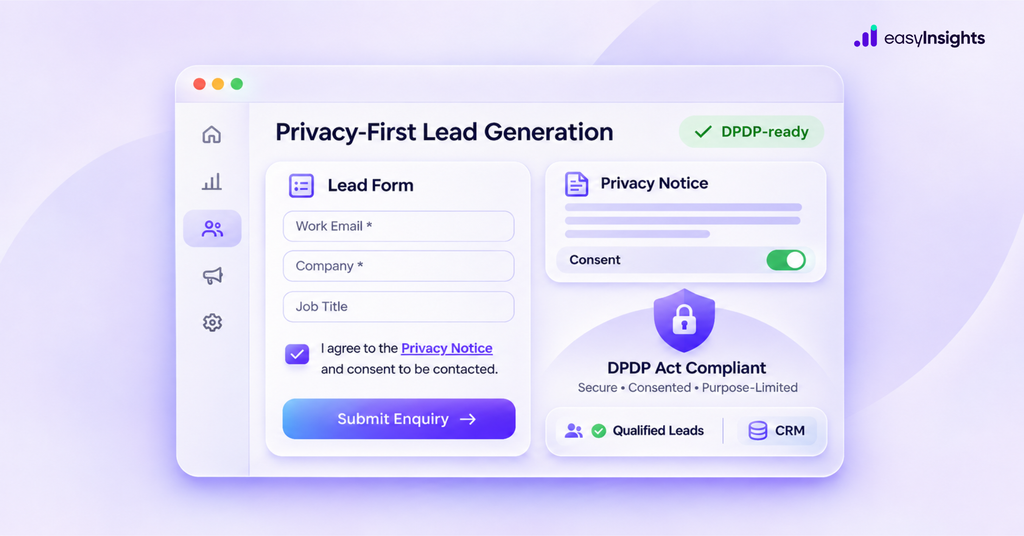
The Digital Personal Data Protection (DPDP) Act, 2023 will change how B2B businesses collect, store, process and use personal data for lead generation. It introduces requirements around lawful data processing, consent, transparency, data security and individual rights. These changes will affect website forms, CRM databases, email marketing, lead enrichment, advertising tracking and marketing attribution.
For B2B marketers, the biggest change is the need to connect lead generation activities with responsible personal data management.
The Government notified the Digital Personal Data Protection Rules, 2025 in November 2025. The main operational provisions are scheduled to take effect on 13 May 2027.
This guide explains the DPDP Act’s impact on B2B lead generation, the marketing activities that need attention and the steps businesses should take to prepare.
Jump ahead to:
How B2B websites worked before the DPDP Act
Before the DPDP Act, most B2B websites focused on collecting visitor information and converting it into sales leads. Consent mechanisms, tracking scripts and follow-up communication were often managed through broad privacy policies and general checkboxes, with limited distinction between different purposes of data collection.
How Will the DPDP Act Change Website Lead Forms?
The DPDP Act will require B2B businesses to clearly explain why they collect personal information through website forms and obtain valid consent for processing activities that rely on consent. A visitor requesting a product demo should not automatically be treated as someone who has agreed to receive ongoing marketing communication.
Under Sections 5 and 6 of the DPDP Act, businesses must provide a clear notice explaining what personal data they collect and why. Where consent is the legal basis for processing, it must be free, specific, informed, unconditional and unambiguous, and given through a clear affirmative action.
What Are the Key DPDP Act Requirements for B2B Marketers?
The DPDP Act establishes seven important data protection principles that influence how organisations manage personal data.
| Principle | Meaning for B2B marketing |
|---|---|
| Consent and transparency | Explain why personal data is collected and obtain consent where required |
| Purpose limitation | Use data for the specified or otherwise legally permitted purpose |
| Data minimisation | Collect only the personal data necessary for the purpose |
| Accuracy | Take reasonable steps to maintain accurate personal data |
| Storage limitation | Do not retain personal data longer than permitted or necessary |
| Security safeguards | Protect personal data against unauthorised processing and breaches |
| Accountability | Take responsibility for processing activities and compliance |
These principles affect the entire lead generation lifecycle, from the first website interaction to CRM storage and marketing communication.
Additional read: DPDP Phase II Is Live: How to Register as a Consent Manager
How Will the DPDP Act Affect Third-Party and Purchased Lead Databases?
Purchasing a B2B contact database does not automatically give a company permission to use the personal data for marketing. Businesses must assess how the data was collected, whether an applicable lawful basis exists and whether the intended use complies with the Act.
For example, finding someone’s work email on a public website does not automatically establish permission for every promotional use.
Section 3 provides a specific exclusion for personal data made publicly available by the individual or someone legally required to publish it. This exclusion should not be extended to every scraped, purchased or commercially distributed database.
How Will the DPDP Act Affect CRM Data Management?
CRM systems will need stronger controls over personal data sources, processing purposes, retention and individual requests.
A typical B2B company receives leads from multiple sources:
- Website forms
- Meta Lead Ads
- Google Ads
- LinkedIn Lead Gen Forms
- Webinars and events
- Sales prospecting
- Third-party data providers
Without proper data governance, the same contact may enter multiple systems, receive unrelated communications or remain in the database indefinitely.
The DPDP Act gives individuals rights relating to access to information, correction, erasure and grievance redressal. Businesses must establish appropriate processes to respond to applicable requests.
What information should a B2B CRM maintain?
| CRM information | Business purpose |
|---|---|
| Lead source | Identify where personal data originated |
| Collection date | Track when information entered the system |
| Processing purpose | Understand why the information is being used |
| Consent status | Record whether consent was obtained, where applicable |
| Consent timestamp | Maintain evidence of the consent event |
| Notice version | Identify the notice presented to the individual |
| Withdrawal status | Manage consent withdrawal requests |
| Retention status | Support data retention and deletion workflows |
A CRM should not be treated as just a database of contacts. It should support the organisation’s wider data governance processes.
How Will the DPDP Act Affect Email Marketing and Marketing Automation?
Marketing automation workflows must respect the purpose and lawful basis associated with personal data processing. A demo request, ebook download or webinar registration should not automatically be treated as unrestricted permission for every future promotional campaign.
For example, a B2B company may use the following automation journey:
- A visitor downloads an industry report.
- The CRM creates a new contact.
- An automated email delivers the requested report.
- The marketing platform sends promotional emails.
- The contact enters a remarketing audience.
Each activity should be evaluated according to its purpose and applicable lawful basis.
What should marketing teams change?
- Review the purpose of every automated communication workflow.
- Separate transactional or requested communication from promotional campaigns where appropriate.
- Maintain relevant consent and communication preference records.
- Process withdrawal requests across connected systems.
- Review integrations with email and WhatsApp marketing platforms.
- Establish processes for removing or restricting personal data when required.
Business impact: Marketing automation should be driven by the purpose and permissions associated with each contact, not simply by whether the contact exists in the CRM.
How Will the DPDP Act Affect Meta Pixel, Google Analytics and Advertising Attribution?
The DPDP Act does not prohibit advertising tracking or marketing attribution. However, businesses must assess how these technologies collect, process and share personal data and implement the applicable privacy controls.
B2B marketers commonly use:
| Technology | Marketing purpose |
|---|---|
| Meta Pixel | Track website activity and advertising conversions |
| Meta Conversions API (CAPI) | Send conversion events from servers to Meta |
| Google Analytics 4 | Understand website traffic and user journeys |
| Google Enhanced Conversions | Improve conversion measurement using appropriately processed first-party data |
| Google Offline Conversion Imports (OCI) | Import offline conversion outcomes into Google Ads |
| Marketing attribution platforms | Connect marketing touchpoints with leads and revenue |
Does server-side tracking eliminate DPDP compliance requirements?
No. Moving data collection from the browser to a server does not automatically remove data protection obligations. The processing of personal data remains subject to the applicable legal requirements.
What Should B2B Businesses Do Before the DPDP Compliance Deadline?
The main operational provisions of the DPDP Act and Rules are scheduled to take effect on 13 May 2027. Businesses should use the preparation period to assess their data collection, marketing and technology processes.
| Priority | Recommended action |
|---|---|
| Lead collection | Audit website forms and lead sources |
| Privacy notices | Review data collection notices and consent language |
| CRM | Document data sources, purposes and retention |
| Third-party data | Review vendors and data provenance |
| Marketing automation | Audit email, WhatsApp and remarketing workflows |
| Advertising tracking | Review pixels, cookies, CAPI and conversion integrations |
| Data rights | Establish processes for access, correction and erasure requests |
| Data security | Review access controls and security safeguards |
| Data retention | Define retention and deletion procedures |
| Vendor management | Review data processor agreements and responsibilities |
Conclusion
The DPDP Act changes how B2B organisations need to approach personal data throughout the lead generation lifecycle.
Businesses should review their website forms, CRM databases, marketing automation, third-party data sources and advertising integrations before the main compliance provisions take effect. For marketing leaders, the opportunity is to combine responsible data practices with better lead qualification and measurement.
The goal is not simply to collect more leads. It is to understand where leads come from, how their data can be used, which prospects qualify and how marketing contributes to revenue.
Frequently Asked Questions
1. Does the DPDP Act apply to B2B companies in India?
Yes. The DPDP Act can apply to B2B companies processing digital personal data, including professional contact information such as names, work email addresses and phone numbers. B2B use does not automatically exempt personal data from the Act.
2. Can B2B companies use purchased lead databases under the DPDP Act?
Purchasing lead databases is not automatically prohibited. However, businesses must assess the source of personal data, the applicable lawful basis and whether the intended processing is permitted.
3. Does the DPDP Act prohibit third-party cookies and server-side tracking?
The Act does not impose a blanket prohibition on third-party cookies or server-side tracking. However, the personal data processing involved must comply with applicable requirements. Server-side tracking does not automatically exempt businesses from data protection obligations.
4. What happens when a lead withdraws consent?
When consent is the basis for processing, the Data Principal can withdraw it at any time, with the ease of withdrawal comparable to the ease of giving consent. The organisation must stop processing on that basis within the applicable requirements, unless another legal requirement permits continued processing.
5. When will the main DPDP Act compliance requirements take effect?
The main operational provisions under Sections 3-17 and the corresponding phased Rules are scheduled to take effect on 13 May 2027, following the November 2025 commencement notification. Some provisions have earlier commencement dates.
6. What is the role of first-party data under the DPDP Act?
First-party data is information collected directly by an organisation through its own interactions with individuals. It can provide better visibility into customer journeys and marketing performance. However, first-party collection does not automatically make processing compliant. Organisations must still establish an applicable lawful basis and meet relevant obligations.
7. What is the difference between a Data Fiduciary and a Data Processor?
A Data Fiduciary determines the purpose and means of processing personal data. A Data Processor processes personal data on behalf of a Data Fiduciary. A business using an external service provider to process lead information may engage that provider as a Data Processor, depending on the actual arrangement.