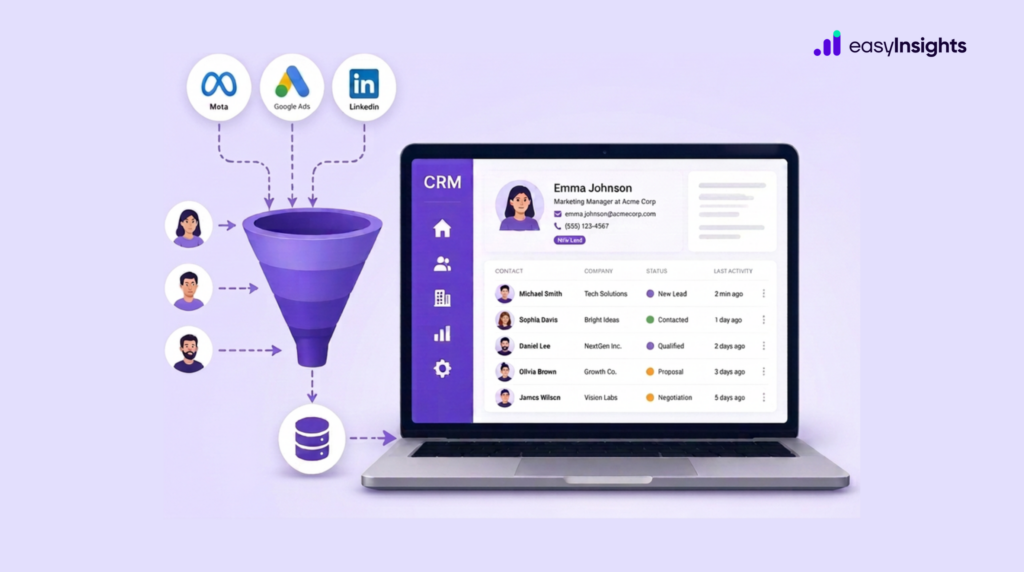
Scaling your ad budget is easy. Scaling profitable growth is not.
Most performance marketers know how to launch campaigns, optimize creatives, and test audiences. But when it comes to scaling spend, many overlook the one system that has the biggest impact on campaign performance: the CRM.
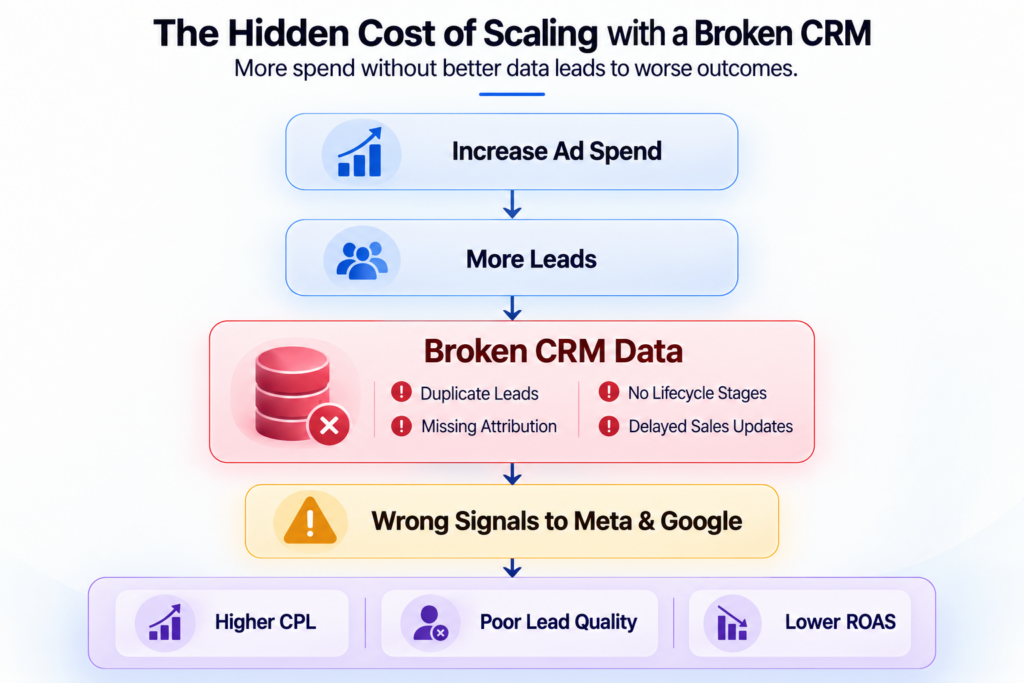
Today, platforms like Meta and Google don’t just optimize based on clicks or leads—they learn from the conversion signals you send back. If your CRM data is incomplete, delayed, duplicated, or disconnected from your ad platforms, your campaigns are learning from the wrong information.
The result? Higher CPLs, lower lead quality, and diminishing returns as budgets increase.
The data backs this up. According to HubSpot’s 2026 State of Marketing Report, lead quality is now the #1 performance metric for marketers, ranking above lead volume. Additionally, 66 – 69% of marketers say high-quality audience data is critical to success, yet only 65% believe they actually have high-quality audience data.
Jump ahead to:
7 CRM fixes that every performance marketing team should prioritize.
1. Standardize Your Lead Lifecycle Stages
One of the most common issues inside CRMs is inconsistent lead statuses.
Marketing says a lead is “Qualified.”
Sales marks it as “Interested.”
Another team calls the same lead “Hot.”
When lifecycle stages aren’t standardized, reporting becomes unreliable and ad platforms receive inconsistent conversion signals.
Define a clear journey:
| Lead → MQL → SQL → Opportunity → Customer |
Every team should use the same definitions.
This not only improves reporting but also enables platforms like Meta and Google Ads to optimize toward actual business outcomes instead of just form submissions.
2. Eliminate Duplicate Leads
Duplicates quietly reduce CRM accuracy.
A single prospect may submit multiple forms, respond to WhatsApp campaigns, or call directly. Without proper deduplication, that customer appears multiple times in reports.
This creates several problems:
- Inflated lead volume
- Incorrect attribution
- Poor conversion reporting
- Sales teams contacting the same prospect repeatedly
Clean data leads to cleaner optimization.
Remember: every duplicate is another misleading signal being sent back into your marketing ecosystem.
3. Capture Complete Attribution Data
Ask yourself: Can you identify exactly which campaign generated your highest-value customer?
Not just the lead. The customer.
Many CRMs still lose essential attribution fields during handoffs between forms, marketing automation, and sales.
Capture and preserve:
- UTM parameters
- Campaign ID
- Ad ID
- Keyword
- Landing page
- First-touch source
- Latest-touch source
Without these fields, your reporting tells you where leads came from—not where revenue came from.
The CRM Fields Every Performance Marketer Should Never Miss
| Acquisition | Qualification | Revenue |
| UTM Source | Lead Score | Deal Value |
| UTM Campaign | Lifecycle Stage | Revenue |
| Ad ID | Owner | Closed Won Date |
| Landing Page | Qualification Reason | Product Purchased |
4. Sync CRM Events Back to Your Ad Platforms
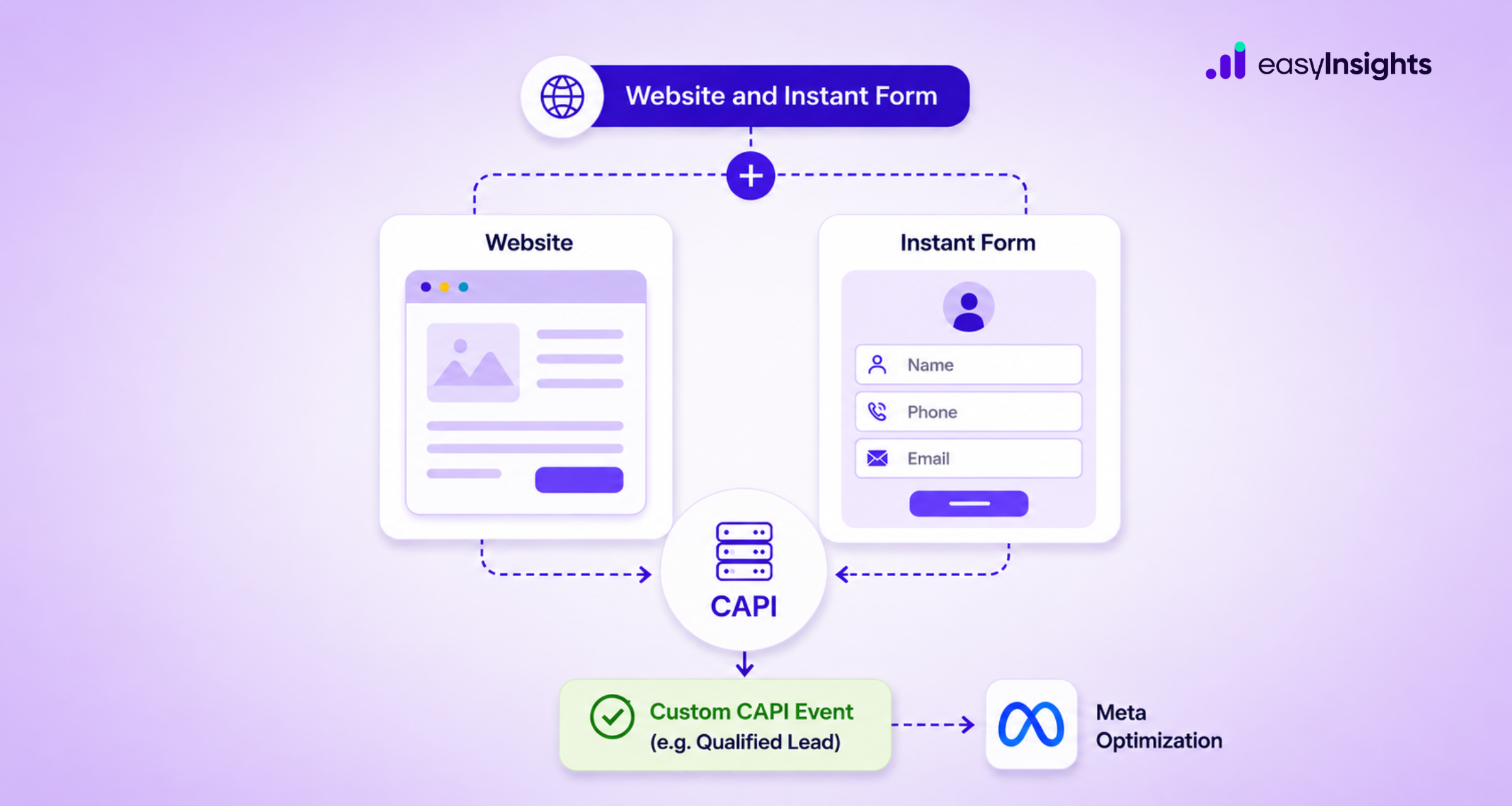
Generating leads is only the beginning. Your advertising platforms need to know which leads eventually become opportunities, qualified prospects, or paying customers.
Otherwise, Meta and Google continue optimizing toward people who simply fill out forms.
Instead, send events like:
- Marketing Qualified Lead (MQL)
- Sales Qualified Lead (SQL)
- Opportunity Created
- Purchase
- Revenue Generated
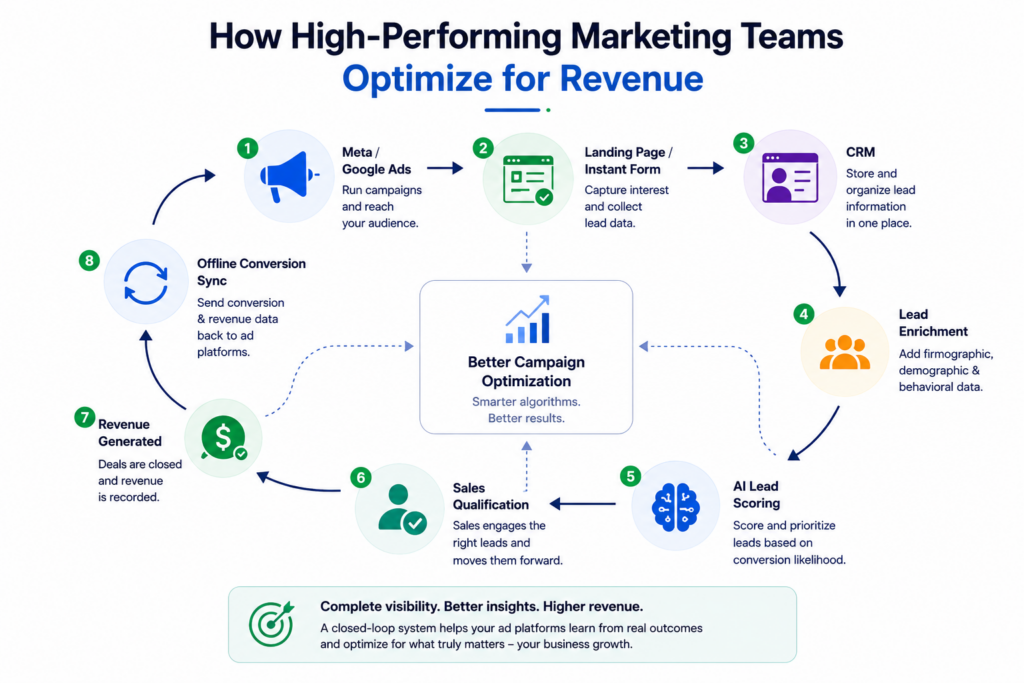
This creates a closed-loop feedback system where campaigns learn from real business outcomes rather than surface-level conversions.
5. Keep Your CRM Data Fresh
CRM quality naturally declines over time.
According to HubSpot, contact databases typically decay by 22 – 30% every year due to changing jobs, email addresses, company information, and other factors.
That’s why CRM hygiene isn’t a one-time project.
Review regularly:
- Invalid phone numbers
- Missing emails
- Company information
- Job titles
- Lead ownership
- Inactive contacts
Fresh data improves segmentation, personalization, and campaign optimization.
6. Enrich Leads Before Sales Engages
Not every lead deserves immediate attention. Modern performance teams enrich leads with firmographic and behavioral data before routing them to sales.
Useful enrichment includes:
- Company size
- Industry
- Revenue
- Location
- Technology stack
- Buying intent
- Lead score
HubSpot notes that enriched CRM records help teams qualify and prioritize leads faster while reducing manual research. The richer the CRM data, the smarter both your sales team and advertising algorithms become.
7. Build a Closed-Loop Marketing System
This is where leading performance teams separate themselves from everyone else.
They don’t stop at generating leads.
They continuously feed sales outcomes back into their marketing ecosystem.
Instead of asking:
“How many leads did we generate?”
They ask:
- Which campaigns produced qualified leads?
- Which channels generated the pipeline?
- Which audience segments closed fastest?
- Which ads generated the highest revenue?
This creates an optimization cycle where every campaign becomes smarter over time.
As AI-driven advertising becomes more sophisticated, your competitive advantage won’t come from creating more ads – it will come from sending better data.
Turn Your CRM Into a Growth Engine
Your CRM shouldn’t just store leads – it should help your ad platforms find more customers.
EasyInsights helps lead generation businesses connect CRM data with Meta, Google, LinkedIn, and other marketing platforms through server-side tracking, Conversions API, Offline Conversion Tracking, and AI-powered lead intelligence.
With EasyInsights, you can:
- Improve lead quality instead of just increasing lead volume
- Send qualified lead and revenue events back to ad platforms
- Build a complete closed-loop attribution system
- Activate first-party data for better campaign optimization
- Give your sales and marketing teams a single source of truth
Whether you’re scaling campaigns for EdTech, FinTech, Healthcare, Real Estate, or B2B, EasyInsights helps you make every marketing dollar work harder.
Final Thoughts
Scaling ad spend without fixing your CRM is like upgrading a race car while ignoring its engine.
Your CRM is no longer just a sales database. It has become the intelligence layer that powers campaign optimization, attribution, lead qualification, and AI-driven decision-making.
Before increasing your next marketing budget, ask yourself:
- Are your lifecycle stages standardized?
- Are duplicates under control?
- Are attribution fields complete?
- Are offline conversions flowing back into ad platforms?
- Is your CRM data continuously maintained?
- Are leads enriched before reaching sales?
- Are you optimizing for revenue instead of just leads?
The marketers who answer “yes” to these questions won’t just generate more leads – they’ll build a marketing engine that scales profitably.
| Ready to optimize for revenue – not just leads? Book a demo with EasyInsights and see how better CRM data leads to better campaign performance. |