A leadership perspective on the most underrated shift in enterprise AI right now.
We didn’t get here overnight.
The story of AI going from a text box on a website to a voice that calls your leads, qualifies them, and feeds that signal back to your ad campaigns – that’s a 60-year arc compressed into about 5 years of real-world business adoption.
And most leaders are still catching up to what actually happened.
Jump ahead to:
The First Wave: AI Learned to Understand Text
In 1966, a computer scientist named Joseph Weizenbaum built ELIZA – a program that could simulate conversation by pattern-matching text. It wasn’t intelligent. It was clever. But it planted the idea that machines could talk back.
For the next five decades, the field crawled.
Then in 2017, a Google research paper changed everything. “Attention Is All You Need” introduced the Transformer architecture – the backbone of every large language model we use today. It unlocked parallel processing of language at a scale no one had seen before.
By 2020, GPT-3 arrived and made the language model real for businesses. By late 2022, ChatGPT put it in front of 100 million users in two months.
Suddenly, AI could write. It could reason. It could hold a conversation in text with near-human fluency.
But it was still just typing.
The Second Wave: AI Got a Voice – But It Was Shallow
The first “voice AI” wave was actually the 2010s: Siri (2011), Alexa (2014), Google Assistant (2016). These felt like the future, but they were essentially sophisticated command-and-response machines. You said a trigger word. They executed a task. There was no real conversation – no memory, no context, no intelligence applied to the interaction.
Businesses noticed, but deployment was narrow. Customer service IVRs got slightly smarter. FAQ bots moved to voice. The experience was still robotic, frustrating, and limited to scripted flows.
Then something changed around 2023 – 2024.
LLMs got fast enough and cheap enough to power real-time voice. Latency dropped below 500ms – the threshold where conversation starts to feel natural. Text-to-speech became indistinguishable from human tone. And suddenly, you could have an AI agent that calls a prospect, navigates their objections, captures intent signals, and updates your CRM – all without a human in the loop.
That’s a fundamentally different product than Alexa.
What Industry Leaders Are Actually Seeing
The numbers from 2025 tell a clear story.
The global Voice AI Agents market, valued at $2.4 billion in 2024, is projected to reach $47.5 billion by 2034 – a CAGR of 34.8%. But market projections don’t capture what’s happening on the ground inside industries.
Here’s what actually shifted:
Healthcare
moved from appointment reminders to autonomous clinical documentation. By December 2025, AI voice systems had returned 30 million minutes to the healthcare workforce. Physicians stopped losing hours to notes and started spending that time on patients. The metric wasn’t “calls handled.” It was minutes of human capacity reclaimed.
Banking and Financial Services
leads all sectors in voice AI adoption with a 32.9% market share. One institution cited a 40% decrease in costs to verify commercial banking clients through AI-driven onboarding and verification tools. Voice AI isn’t answering balance queries anymore – it’s running KYC workflows.
Real Estate and EdTech
discovered that speed-to-contact is their most important metric. Calling a lead within 5 minutes delivers a 21x higher conversion rate than waiting 30 minutes or longer. No human team can hold that window at scale. Voice AI can.
Retail is using voice agents not just for customer service, but for post-purchase engagement, cart recovery calls, and loyalty interactions – creating touchpoints that email and SMS simply can’t replicate in warmth or response rate.
What’s common across all of these? The shift from reactive to proactive. Older chat systems waited for a customer to start a conversation. Voice agents initiate. They reach out. They act on signals from your CRM, your ad campaigns, your website behavior – and they do it at a moment that matters.
The Gap Most Businesses Are Still Living In
Here’s where I think the honest leadership conversation gets uncomfortable.
Most businesses adopting AI voice agents today are solving the top of the funnel problem: speed-to-contact, call volume, first-pass qualification. And that’s genuinely valuable.
But they’re leaving the downstream loop completely broken.
Your voice agent qualifies a lead. The lead is marked “qualified” in your CRM. And then – nothing. Your Meta campaign keeps bidding on the same lookalike audience it was optimizing for before. Your Google Smart Bidding is still treating a form fill as your conversion signal. The conversation that happened on that call – the intent, the objection, the buying timeline – never makes it back to the platform that spent money to generate that lead.
McKinsey’s 2025 State of AI research shows that 23% of organizations are scaling agentic AI systems, and an additional 39% are experimenting – but most are deploying in only one or two functions. The integration across functions – from customer conversation back to marketing spend – is where the real value lies and where most companies haven’t gone yet.
The leaders who will win this decade aren’t the ones who automate the call. They’re the ones who close the loop – using what happens in that conversation to make every upstream marketing decision smarter.
What the Next Chapter Looks Like
Gartner predicts that by 2028, 60% of brands will use agentic AI for one-to-one customer interactions – effectively ending channel-based marketing as we know it.
That’s not a technology prediction. It’s a business model prediction.
The brands that thrive won’t be the ones that spent the most on ads or had the largest sales teams. They’ll be the ones whose AI infrastructure makes every customer signal – a voice conversation, a CRM update, a qualified lead – flow back into the engine that allocates budget, decides creative, and chooses the audience.
Voice is the richest signal we’ve ever had from a customer interaction. It carries intent, emotion, urgency, and context that no form fill or click event ever could.
The question for every marketing and revenue leader right now is simple: are you capturing that signal, or are you letting it disappear after the call ends?
This Is What EasyInsights Does Right Now
Here’s what actually happens when a lead enters your system through EasyInsights:
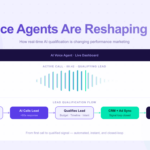
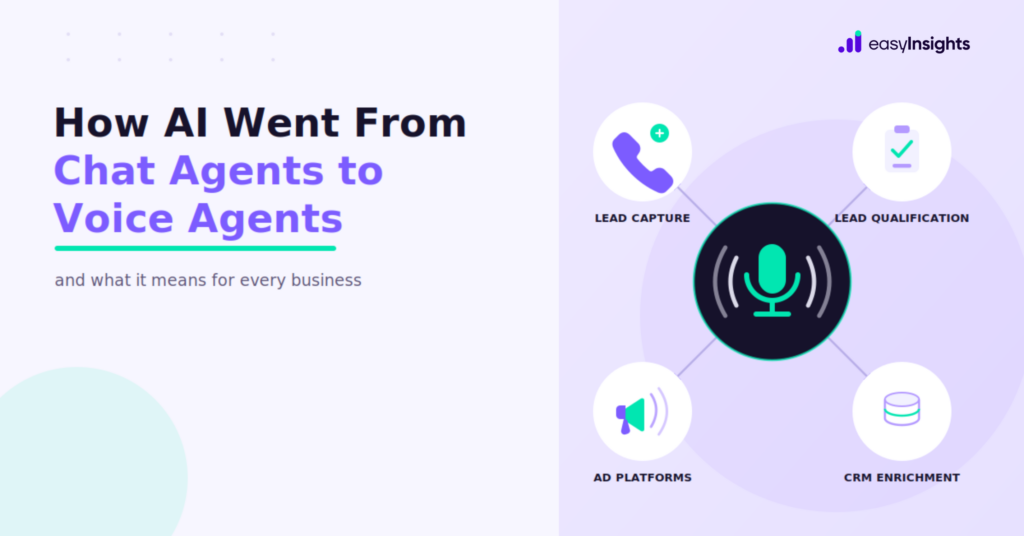
1. It calls your lead and holds a real conversation. Not a robotic IVR. Not a scripted flow. A natural, one-to-one voice conversation – with emotion detection, context awareness, and the ability to respond to what the lead actually says, not just what you anticipated they’d say.
2. It qualifies based on your parameters. You define what a qualified lead looks like for your business. EasyInsights asks the right questions, listens to the answers, and scores the lead against your criteria – budget, intent, timeline, whatever matters to your funnel.
3. It enriches your CRM automatically. The conversation doesn’t end with a call log. Every intent signal, qualification status, and key detail from the call is structured and pushed directly into your CRM – no manual entry, no data loss, no relying on a sales rep’s notes.
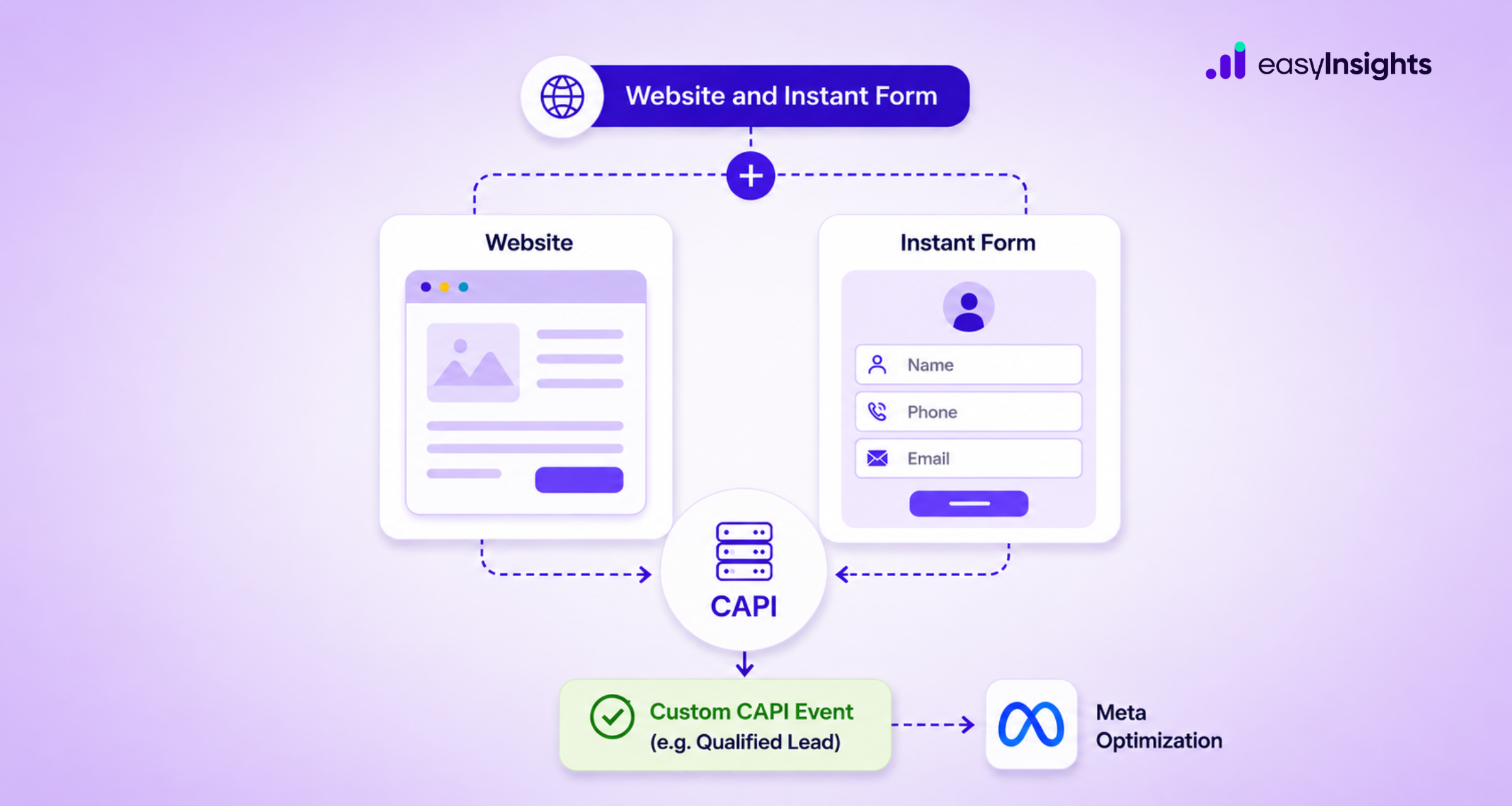
4. It sends the signal back to your ad platforms. This is the step every other AI voice agent skips. EasyInsights takes the qualified lead data and feeds it back to Meta – so your campaigns stop optimizing on form fills and start optimizing on actual buyer intent coming from real conversations.
The result: your ad platform learns what a real customer sounds like. Your bidding improves. Your CPL drops. Your next campaign is smarter than the last one – not because you changed your creative, but because your data loop finally closed.
That’s not a feature. That’s a fundamentally different way to run performance marketing.
| EasyInsights’ AI voice agent is built to solve – not just calling leads, but listening to calls (including your existing recordings), qualifying from conversation, enriching your CRM, and sending those signals back to ad platforms to close the attribution loop. The flywheel your marketing should have had from day one. Book a demo |