There’s a lot of noise right now around AI voice agents. Every SaaS vendor is calling their product “conversational AI.” Every conference deck has a slide on autonomous agents. But underneath the hype, something real is happening — and if you’re running a sales or marketing function, you need to understand it clearly.
Let me break it down.
Jump ahead to:
The Problem with Traditional Sales Outreach (And Why It’s Getting Worse)
Sales teams have always struggled with speed-to-lead. A prospect fills out a form at 11 PM. Your rep picks it up at 9 AM the next morning. By then, that lead has already spoken to two competitors.
This isn’t a people problem. It’s a structural one.
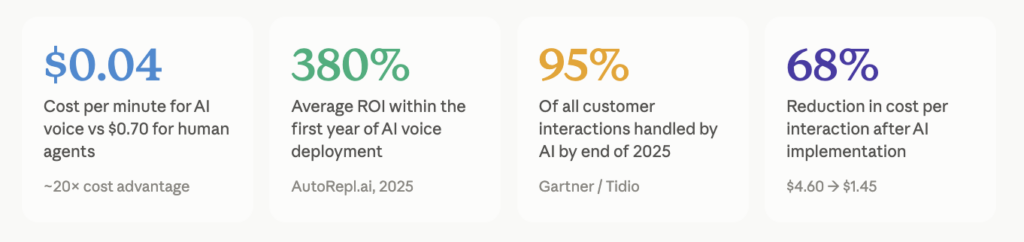
Human agents cost, on average, $0.70 per minute to operate. They burn out – contact centers see roughly 38% annual turnover. They can’t scale during peak hours without hiring. And they’re inconsistent: the quality of a call on Monday morning is very different from Friday afternoon.
AI voice agents address all of this, not by replacing human judgment, but by removing human bottlenecks from the parts of the process that don’t actually need human judgment.
What AI Voice Agents Actually Do (Without the Buzzwords)
A modern AI voice agent isn’t a smarter IVR. It’s a system that can:
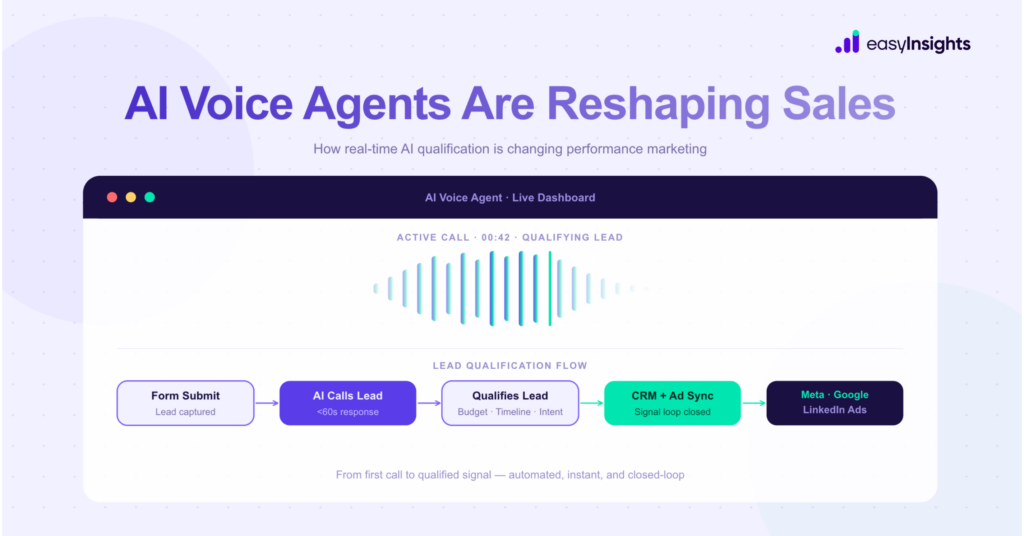
- Call a lead within seconds of form submission, any time of day
- Qualify them against your specific criteria (budget, timeline, intent)
- Adapt the conversation based on responses in real time
- Log everything to your CRM – automatically
- Hand off to a human rep only when it matters
The numbers back this up. AI voice agents cost between $0.03-$0.04 per minute versus $0.70 for human agents — roughly a 20x cost advantage. Companies that have deployed them report an average ROI of 240–380% within the first year. And lead response times improve by 30-50%, which directly correlates with conversion rates.
But here’s what the vendor decks don’t tell you: the technology is only as good as the workflow it sits inside.
The Challenges Nobody Talks About
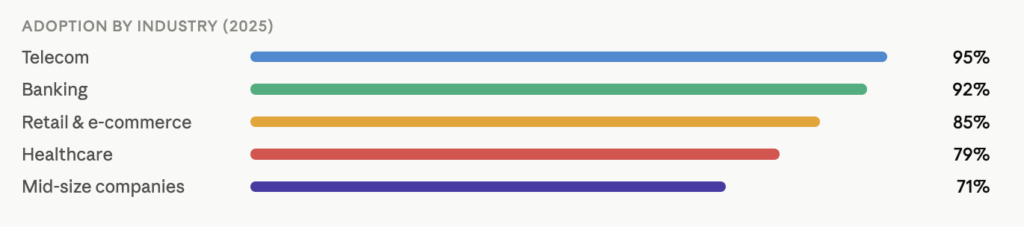
Adoption is accelerating fast – 78% of businesses have already deployed or are piloting voice AI solutions, up from 45% just two years ago. But only 25% have fully integrated AI into their daily operations.
That gap exists for real reasons:
Integration complexity. 42% of businesses cite connecting AI voice agents to their existing CRMs and systems as their biggest hurdle. An AI that can qualify a lead but can’t write to your CRM or push data to your ad platforms is just a fancy call recorder.
Data quality. AI voice agents learn from what they’re fed. If your lead data is dirty, your qualification logic will be too.
The trust gap. 75% of customers still prefer human agents for complex or sensitive issues. This means voice AI needs to know when to escalate – and do it gracefully, not after frustrating a prospect with a loop they can’t break out of.
Training and calibration. This is not a “set it and forget it” solution. The businesses seeing the best results are the ones treating AI voice agents as a product they actively manage – refining scripts, reviewing transcripts, iterating on handoff triggers.
Best Practices for Sales Teams Rolling This Out
If you’re implementing AI voice agents for lead qualification or outbound sales, here’s what actually moves the needle:
1. Define the qualification criteria before you touch the technology. What makes a lead “sales-ready” for your team? Budget range, company size, timeline, use case? AI can only qualify against criteria you’ve actually specified.
2. Optimize for speed first. The biggest win AI voice agents deliver is response time. Prioritize getting that sub-60-second callback live before you optimize for anything else.
3. Build the handoff carefully. The moment a human rep takes over from an AI agent is where deals are won or lost. The rep needs context — what was said, what was qualified, what the prospect’s tone was. Your AI should be logging all of this in real time.
4. Close the loop to your ad platforms. Every qualified lead your AI agent generates is a conversion signal. That data should flow back to Meta, Google, and LinkedIn to train your campaigns on what a real customer looks like — not just a form fill.
5. Start with inbound, then expand. Use cases like inbound lead qualification and appointment setting are lower risk and faster to show ROI. Outbound cold calling with AI is harder to get right and has more compliance complexity.
The Future: Where This Is Heading
By 2026, 80% of businesses plan to integrate AI-driven voice technology into their customer service and sales operations. Gartner projects that agentic AI will resolve 80% of common customer issues without human intervention by 2029.
But the more interesting shift is happening at the data layer.
The companies that will win with AI voice agents aren’t just the ones with the best conversational AI. They’re the ones that treat every conversation as a first-party data asset – feeding qualified lead signals back into their marketing, their ad targeting, and their CRM to create a flywheel that compounds over time.
Voice AI isn’t just a productivity play. It’s a data collection infrastructure for the next generation of performance marketing.
How EasyInsights Fits Into This Picture
EasyInsights’ AI Voice Agent calls leads immediately after form submission, qualifies them against your business criteria, enriches your CRM with what it learns, and — critically — sends that qualified lead data back to your ad platforms as a conversion signal.
That last piece is what most voice AI tools miss entirely.
When your Meta or Google campaigns optimize on “form fills,” they’re optimizing on noise. When they optimize on “qualified prospects who met your sales criteria during a real conversation,” they start finding more of the right people. That’s the compound effect that changes your CAC over time.
If you’re running lead gen at any meaningful scale and you’re not closing this loop, you’re leaving a significant part of your ad spend on the table.
Conclusion
AI voice agents are not a future technology – they’re a present-day competitive advantage for businesses that deploy them thoughtfully.
The companies seeing the best results share three traits: they treat AI as infrastructure, not a shortcut; they keep humans in the loop for high-stakes conversations; and they use every AI-generated interaction as a data signal that feeds back into their marketing and sales systems.
The businesses that will fall behind are those waiting for the “perfect” implementation before starting, or those deploying voice AI in isolation – without connecting it to their CRM, their ad platforms, or their broader revenue operations.
Voice AI is not a replacement for human relationships. It’s a force multiplier for the systems and people you already have. The question isn’t whether to adopt it. It’s how fast you can build the right foundation around it.
We built our AI Voice Agent at EasyInsights because we kept seeing the same gap: businesses were generating leads, qualifying them over calls, and then losing that intelligence somewhere between the conversation and the campaign.
| See how EasyInsights AI Voice Agent works → EasyInsights is a B2B MarTech platform helping performance marketers activate first-party data, track conversions accurately, and send qualified signals back to ad platforms – at every stage of the funnel. |