Every marketing team has workflows they repeat over and over again.
Every Monday, someone logs into Meta Ads, checks Google Ads, reviews CRM data, compares lead quality, updates dashboards, and prepares performance reports. Before launching a campaign, someone validates tracking, checks attribution, verifies UTM parameters, and ensures conversion events are firing correctly. These aren’t one-off tasks – they’re the operational backbone of modern marketing.
Now imagine if you could teach AI to perform these workflows the same way you would train a new team member.
Not by writing long prompts every time. Not by building dozens of automation rules. Simply by showing it how the work gets done once.
That’s the direction AI is heading.
Anthropic recently introduced a new capability that allows Claude to learn workflows by observing users perform them. Instead of relying entirely on prompts, AI can now understand a sequence of actions, remember the process, and execute similar tasks in the future.
While this may seem like another AI product update, it represents a much bigger shift for marketers.
We’re moving from using AI to answer questions to teaching AI how we work. And that could fundamentally change how marketing teams operate over the next few years.
Jump ahead to:
From Prompt Engineering to Workflow Engineering
Over the last two years, marketers have invested countless hours learning how to write better prompts.
How do you generate better ad copy?
How do you summarize campaign performance?
How do you analyze CRM data?
The answer was always the same: write a better prompt.
But AI is evolving beyond that.
Instead of relying on detailed instructions every time, the next generation of AI will learn your processes. You demonstrate a workflow once, explain the decisions you make, and AI can repeat that process whenever it’s needed. This changes the role of AI from a chatbot that answers questions to a teammate that understands how your business operates.
Marketing Runs on Workflows, Not Just Creativity
Marketing is often associated with creativity, but behind every successful campaign is a series of repeatable operational workflows.
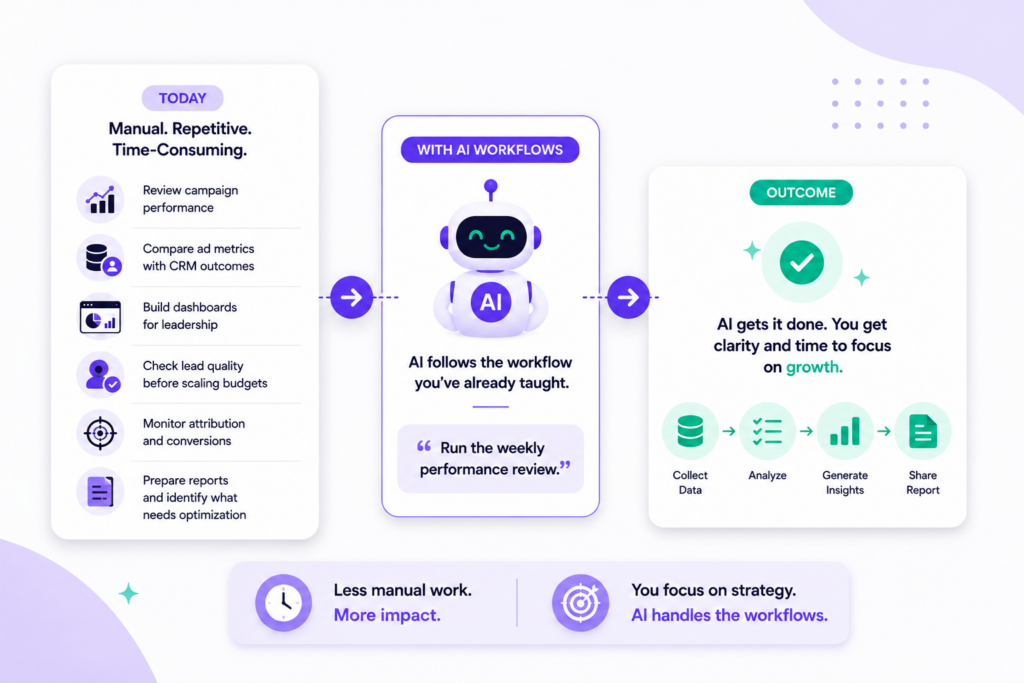
Think about how much time your team spends every week on activities like:
- Reviewing campaign performance across platforms.
- Comparing ad platform metrics with CRM outcomes.
- Building dashboards for leadership.
- Checking lead quality before increasing budgets.
- Monitoring attribution and conversion tracking.
- Preparing weekly or monthly performance reports.
- Identifying campaigns that need optimization.
None of these tasks are particularly creative, yet they’re essential. Now imagine an AI that already knows how your team performs these tasks.
Instead of asking it to generate another report, you simply ask:
“Run the weekly performance review.”
The AI follows the workflow you’ve already taught it. That’s where marketing operations are heading.
The Real Competitive Advantage Won’t Be Better Prompts
When ChatGPT first became popular, prompt engineering was seen as a competitive skill. Today, almost every AI platform can generate content, summarize data, write emails, or create campaign ideas.
The advantage is no longer in asking better questions. It’s in teaching AI how your organization works. Companies that have well-documented processes will be able to train AI much faster than companies where every employee follows a different approach.
In other words, your workflows become intellectual property. The organizations that standardize and document how they work today will be the ones that scale AI successfully tomorrow.
AI Is Only as Good as the Data It Can Access
Teaching AI your workflow is only one part of the equation. The other – and arguably more important – part is data.
Imagine asking AI:“Which campaigns should I increase my budget on?”
If the AI only has access to Meta Ads data, it might recommend campaigns generating the lowest cost per lead. But what if those leads rarely convert into customers? Without CRM data, offline conversion tracking, or revenue attribution, AI is making decisions with only half the picture.
Now imagine the same AI has access to:
- CRM lifecycle stages.
- Qualified lead data.
- Sales outcomes.
- Revenue attribution.
- First-party customer interactions.
- Offline conversions.
Its recommendations become far more valuable because they’re based on business outcomes rather than surface-level marketing metrics.
This is why the conversation around AI shouldn’t begin with models. It should begin with data.
Why First-Party Data Is Becoming Even More Important
As privacy regulations evolve and third-party cookies continue to disappear, marketers are already investing more in first-party data.
This new generation of AI makes that investment even more valuable. AI can’t learn from data it doesn’t have. If customer journeys are fragmented across advertising platforms, CRM systems, analytics tools, spreadsheets, and offline sales systems, AI has no complete picture of the customer.
That’s why modern marketing teams need connected data. When campaign data, CRM events, lead quality, and revenue signals are unified, AI can understand not just what happened – but why it happened.
And that’s where better decisions come from.
Also read : How to Use First-Party Events on Meta
What This Means for Performance Marketers
Performance marketers should view this shift as an opportunity rather than a threat. Instead of spending hours gathering reports, checking dashboards, and validating data, AI can handle much of the operational work.
Imagine starting your day with an AI-generated summary that tells you:
- Which campaigns are driving qualified leads.
- Which ad sets have declining lead quality.
- Whether conversion tracking is working correctly.
- Which audiences are becoming saturated.
- Where attribution discrepancies exist.
- Which campaigns deserve additional budget.
Instead of spending the morning collecting information, marketers can spend it making strategic decisions. That’s where human expertise becomes even more valuable.
Final Thoughts
Anthropic’s latest announcement isn’t just about AI learning from videos. It’s about AI learning how businesses operate.
For marketers, that’s a fundamental shift. Over the next few years, success won’t depend on who writes the most sophisticated prompts. It will depend on who has the cleanest data, the best-defined workflows, and the strongest operational foundation.
Because the future of AI isn’t just about answering your questions. It’s about understanding how your marketing team works – and helping you do it better.
The marketers who prepare today by building connected data systems, documenting repeatable processes, and investing in first-party data won’t just use AI more effectively.
They’ll build marketing organizations that are faster, smarter, and ready for the next evolution of AI.
| AI can only be as effective as the data behind it. EasyInsights connects your CRM, ad platforms, and first-party data to build an AI-ready marketing foundation. Book a demo |